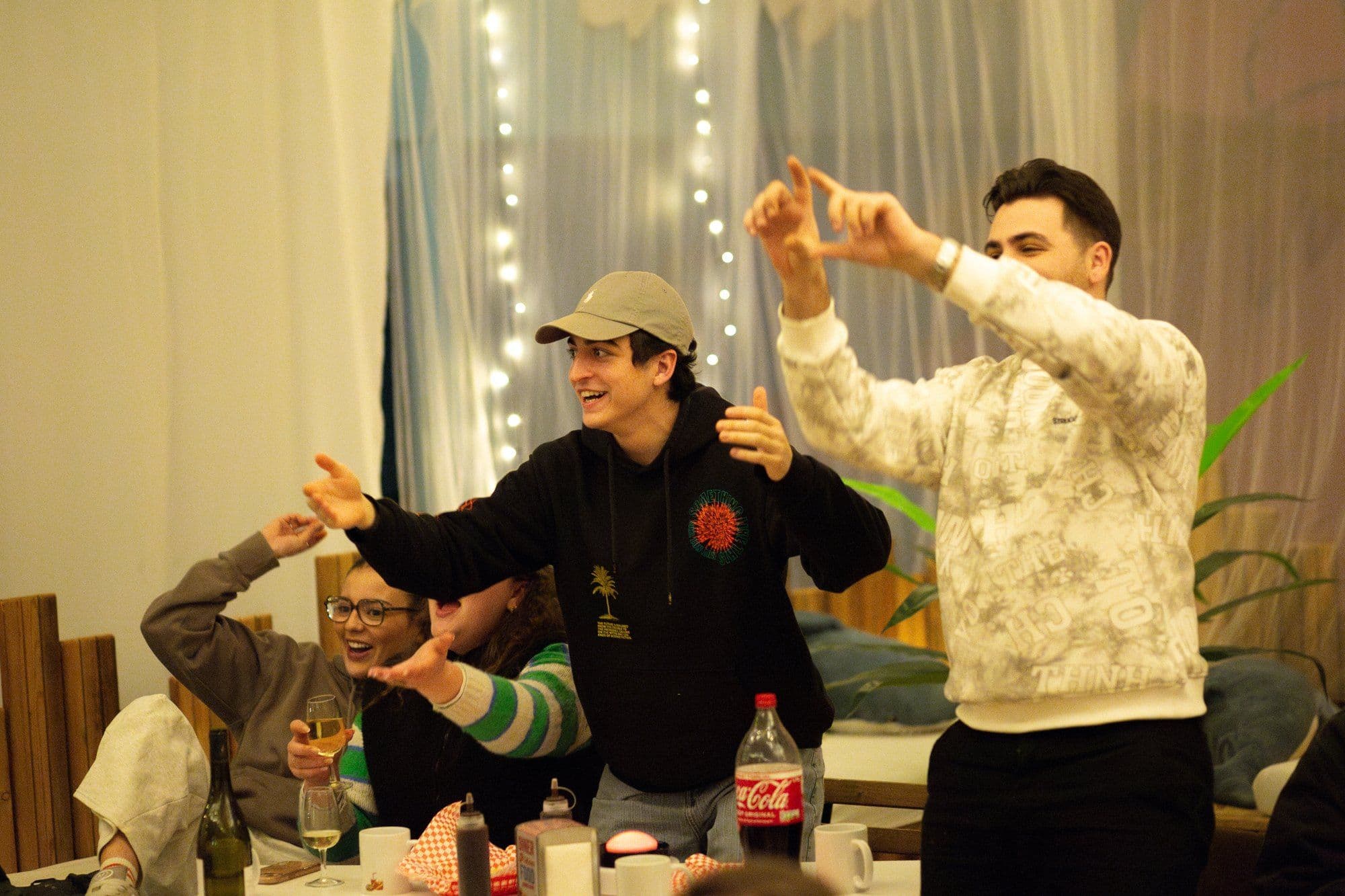
These team bonding games give planners quick ways to build trust, lift energy, and help people talk without forcing it. Use them to match the moment, from a short break to a longer workshop, and choose the format that fits your group in person or online. You will find simple options for new teams, mixed groups, remote sessions, and quieter moments as well as more active play.
Key takeaways
- The mix runs from physical circle games such as human knot and count to 20 to quieter non-verbal options like charades and line up.
- There are low-pressure ways to help new teams connect, including two truths and a lie, rapid icebreakers, and show and tell.
- Remote and hybrid groups are covered too, with virtual group map, virtual trivia, remote coffee breaks, guess whose workspace, emoji story, and virtual bingo.
- Some games need no materials at all, while others depend on a shared screen, a chat window, or a digital bingo card.
- The selection also includes a calmer reset and a practical discussion format, with online mindfulness session and what would you do?
1. Human knot
Human knot is a physical cooperation game where the group stands in a circle, links hands with two different people, and works together to untangle the knot without letting go.
It is direct, slightly chaotic, and very good at showing how a team communicates under pressure. Because nobody needs equipment, it fits easily into a short break or a longer workshop.
Group setup: the group stands in a circle
Best for: showing how a team communicates under pressure
How to apply: Have everyone stand in a circle and link hands with two different people. Work together to untangle the knot without letting go. The value comes from the shared problem-solving, not the tangle itself.
2. Two truths and a lie
Two truths and a lie is a personal connection game where each person shares three statements about themselves, two true and one false, and the group guesses which is the lie.
It works well for new teams because it reveals small, memorable details without putting anyone on the spot. The activity is quick, low-risk, and easy to run in person or online.
Group setup: the whole group
Best for: new teams and quick personal connection
How to apply: Each person shares three statements about themselves, two true and one false. The group guesses which statement is the lie. Keep it moving so people learn something real about one another fast.
3. Charades
Charades is a non-verbal communication game in which participants act out words, phrases, or concepts without speaking.
The group has to interpret gestures, timing, and context, which often leads to laughter and surprisingly sharp observation. It suits mixed groups because the rules are familiar and the pace is lively.
Group setup: small teams or larger groups split into rounds
Best for: mixed groups and lively play
How to apply: Have participants act out words, phrases, or concepts without speaking. Let the group interpret the gestures, timing, and context. No materials are needed, and the game can be played in small teams or larger groups split into rounds.
4. Count to 20
Count to 20 is a focus and coordination exercise where the group stands in a circle and tries to count in order, one number at a time, with only one person speaking at once.
If two people speak together, the count restarts. That simple rule makes the game harder than it sounds.
Group setup: the group stands in a circle
Best for: focus, coordination, and staying present together
How to apply: Stand in a circle and count in order, one number at a time. Only one person should speak at once. If two people speak together, restart the count.
5. Line up
Line up is a non-verbal problem-solving game where the group arranges itself in a specific order, such as by height, birthday month, or alphabetical order, without speaking.
It is useful when you want people to coordinate quickly and notice how they signal ideas without words. The activity is easy to adapt and needs no materials.
Group setup: small teams or larger groups split into circles
Best for: quick coordination and noticing non-verbal signals
How to apply: Ask the group to arrange itself in a specific order without speaking. Use an order such as by height, birthday month, or alphabetical order. It works well with both small teams and larger groups split into circles.
6. Trust fall
Trust fall is a vulnerability and support exercise where one person falls backwards from a standing position and relies on teammates to catch them.
It is a strong trust-building activity, but it should only be used when the group feels comfortable and the environment is safe. The point is not drama. It is reliability.
Group setup: one person at a time with teammates ready to catch
Best for: trust-building when the group feels comfortable and the environment is safe
How to apply: Have one person fall backwards from a standing position. Teammates catch them. Use it carefully and only when the group feels comfortable and the environment is safe.
7. Wink murder
Wink murder is an observation and deduction game in which one person is secretly chosen as the murderer and eliminates others by winking at them.
The person winked at must react dramatically after a short delay, and the rest of the group tries to identify the murderer before everyone is out. It sharpens attention, reading of body language, and quiet group awareness.
Group setup: the whole group
Best for: attention, deduction, and body language reading
How to apply: Choose one person secretly as the murderer. That person eliminates others by winking at them, and the winked-at person reacts dramatically after a short delay. The rest of the group tries to identify the murderer before everyone is out.
8. Rapid icebreakers
Rapid icebreakers are quick-fire questions that ask for instant answers, such as favourite superpower or coffee versus tea.
They are useful when a meeting needs energy without losing time. Because the pace is brisk, people do not overthink their responses, which keeps the tone light and inclusive.
Group setup: the whole group
Best for: warming up a group before a longer discussion or workshop
How to apply: Ask quick-fire questions and invite instant answers. Keep the pace brisk so people do not overthink their responses. Use prompts such as favourite superpower or coffee versus tea.
9. Virtual group map
Virtual group map is a remote or hybrid activity where participants mark their location on a shared screen and briefly share a local tradition or value from that place.
It helps people see the spread of the team and understand the different backgrounds in the room. It works especially well for distributed groups because it creates a sense of place without needing any physical materials.
Group setup: remote or hybrid group
Best for: distributed teams
How to apply: Ask participants to mark their location on a shared screen. Then have each person briefly share a local tradition or value from that place. Keep it simple and visual so it is easy to run.
10. Show and tell
Show and tell is a personal connection activity where each person chooses an item from their immediate environment and explains why it matters to them.
The item can be physical or visible in a virtual background, which makes the game flexible for office and remote settings. It is low-pressure, but it still gives colleagues a glimpse into each other's lives, interests, and habits.
Group setup: the whole team at once
Best for: office and remote settings
How to apply: Ask each person to choose an item from their immediate environment. Have them explain why it matters to them. Let the item be physical or visible in a virtual background. Keep the tone low-pressure so the conversation can flow naturally.
11. Virtual trivia
Virtual trivia is a collaboration and fun game where teams answer questions across different categories using a shared digital document or chat.
The questions are prepared in advance, but the activity itself needs no physical materials. It works well because it mixes teamwork with friendly competition.
Group setup: teams using a shared digital document or chat
Best for: energy and engagement
How to apply: Prepare the questions in advance. Put teams into a shared digital document or chat. Ask them to answer across different categories and agree quickly under light pressure. Let people contribute different strengths as they work together.
12. What would you do?
What would you do? is a decision-making exercise where the facilitator presents a hypothetical scenario and the team works out a response together.
A project snag, a sudden change, or a difficult client situation can all become prompts. The game reveals how people think, who takes the lead, and how the group handles disagreement.
Group setup: the whole team at once
Best for: practical discussion rather than pure entertainment
How to apply: Present a hypothetical scenario to the team. Use a project snag, a sudden change, or a difficult client situation as the prompt. Ask the group to work out a response together. Watch how people think, who takes the lead, and how disagreement is handled.
13. Remote coffee breaks
Remote coffee breaks are scheduled, non-mandatory virtual sessions with a clear no-work-talk rule.
They are not structured around a task, which is exactly why they work. The aim is to recreate the casual conversations that happen around a kettle or in a corridor.
Group setup: scheduled virtual sessions
Best for: teams that need a lighter, more natural way to connect
How to apply: Schedule a virtual session and make it non-mandatory. Set a clear no-work-talk rule. Keep the session unstructured and task-free so people can have casual conversations. Repeat it when you want an easy way for people to join in.
14. Guess whose workspace
Guess whose workspace is an environment-sharing game where team members anonymously submit a photo of their workspace and the group guesses who it belongs to.
It is lighthearted, but it also gives people a better sense of how colleagues work day to day. The activity can reveal habits, personalities, and practical setups without feeling intrusive.
Group setup: remote teams and hybrid groups
Best for: a more personal conversation starter
How to apply: Ask team members to anonymously submit a photo of their workspace. Show the photos to the group and have everyone guess who each workspace belongs to. Keep the tone lighthearted so the activity stays personal without feeling intrusive.
15. Emoji story
Emoji story is a creativity and interpretation game where participants build a short narrative using only emojis in a chat window.
Others then try to decode the meaning. It is playful, fast, and surprisingly revealing, because people have to think about how symbols are read by others.
Group setup: online chat space
Best for: mixing humour with communication
How to apply: Give participants a chat window and ask them to build a short narrative using only emojis. Have the others try to decode the meaning. Keep it fast and playful. Use the guesses to spark conversation about how symbols are read by others.
16. Virtual bingo
Virtual bingo is an engagement and speed game where the host prepares a digital bingo card or reads prompts based on common work experiences.
Participants mark off squares as they recognise the situations, and the first to complete a line wins. It is easy to run, easy to understand, and good for groups that need a quick lift.
Group setup: digital bingo card or host-led prompts
Best for: groups that need a quick lift
How to apply: Prepare a digital bingo card or read prompts based on common work experiences. Ask participants to mark off squares as they recognise the situations. The first to complete a line wins. Use shared references so people can join in quickly.
17. Online mindfulness session
Online mindfulness session is a guided 15-minute pause for collective calm. It is a wellness and focus activity, not a performance.
Because it needs no materials, it can be added before a busy meeting or after a demanding stretch of work. For teams under pressure, that short reset can help people return with more attention and steadier energy.
Group setup: the whole team at once, 15 minutes
Best for: a busy meeting or a demanding stretch of work
How to apply: Run a guided 15-minute pause for the group. Keep the tone calm and focused on collective quiet. Use it before a busy meeting or after a demanding stretch of work. Let people return to the next task with steadier energy.
18. Speed networking
Speed networking is an accelerated introduction format with short, structured conversations in breakout rooms before participants switch partners. The prompts keep the discussion moving, and the short time limit stops any one conversation from taking over.
It is especially useful for larger groups or teams that do not know each other well. The format creates several quick one-to-one connections in a short period, which helps people feel less distant.
Group setup: larger groups, breakout rooms
Best for: teams that do not know each other well
How to apply: Set up short, structured conversations in breakout rooms. Use prompts to keep each exchange moving. Switch partners after each round. Keep the time limit short so no one conversation takes over.
19. Animal sounds
Animal sounds is a coordination and auditory focus game where participants are assigned an animal sound and must find the others making the same sound. Eyes are closed or participants are blindfolded, so the group has to rely on listening rather than sight.
It is energetic, a little silly, and very effective at breaking tension. The game works because it strips the task down to one sense and one goal.
Group setup: the whole team at once, eyes closed or blindfolded
Best for: breaking tension
How to apply: Assign each participant an animal sound. Have everyone close their eyes or use blindfolds. Ask people to listen and find the others making the same sound. Keep the focus on one sense and one goal.
20. Virtual talent show
Virtual talent show is a vulnerability exercise where team members share a brief non-professional talent, such as a poem, a song, or a juggling attempt. It gives people a chance to be seen outside their usual work role, which can deepen respect and camaraderie.
The tone should stay supportive, not competitive. Because it costs nothing and can be run online, it is a strong closing activity for teams that want something memorable and human.
Group setup: the whole team online
Best for: a memorable closing activity
How to apply: Invite team members to share a brief non-professional talent. Keep the tone supportive, not competitive. Let people choose something simple, like a poem, a song, or a juggling attempt. Run it online as a closing activity.
Where to host team bonding games
The venue decides which team bonding games work, from quick indoor rounds to open-air challenges. Each type below includes a real Naboo venue you can book for the right setting.
A venue with outdoor space
A venue with outdoor space suits human knot and count to 20 because the group can spread out, reset quickly, and keep the energy moving between rounds. Open ground also helps with games that need quick formation changes or a bit of movement, so the pace stays light and the whole team can join in without feeling boxed in.

Dunlara Scotland Dunlara Castle is a historic Scottish Baronial castle in Culross, Scotland. It sits on a 1,500-acre estate in Fife, with views over the Firth of Tay and surroundings that include ancient wild forest, walled gardens, and a private beach.
A venue for active team games
A venue for active team games works well for ideas that need movement, quick reactions, and a bit of friendly pressure. Games like human knot and charades land better when people can spread out, regroup, and keep the pace up without feeling boxed in. The right space keeps energy high and makes simple activities feel more engaging.

Sixes Social Cricket Sussex is an activity venue within The 1st Central County Ground in Sussex, housed in a characterful warehouse space. It brings cricket-themed entertainment together with an urban social setting, and it is set up for corporate events, team building, private celebrations, and group gatherings in Brighton and Hove, England.
Frequently asked questions
What makes zero-cost team bonding games worth using?
They work because they strip away the noise: no props, no budget, no long setup. That leaves people with attention, a reason to talk, listen, and solve something together, which is why they suit moments when morale dips, a project wraps, or new starters need a quick way in.
How do I choose the right team bonding game?
Choose by the depth of connection you want, the time you have, and how much facilitation is needed. If you want quick personal connection, Two Truths and a Lie or Rapid Icebreakers fit well; if you want communication under pressure, Human Knot or Count to 20 are stronger choices.
How do I run a team bonding game well?
Keep the activity simple and leave time to discuss the process, not just the result. The learning comes after the game, so ask what communication hurdles came up, who stepped forward naturally, and what the group learned about working together.
What group size works best for these activities?
It depends on the game, but many work for the whole group, while others are better in small teams or larger groups split into rounds or circles. Charades, Line Up, and Virtual Trivia can scale well when participation needs to stay manageable.
Can remote or hybrid teams use these games?
Yes. The strongest options need no materials and can be used in person or online, which makes them easy to run with hybrid or fully remote teams. Virtual Group Map, Show and Tell, Virtual Trivia, Emoji Story, and Remote Coffee Breaks all fit digital settings.
Which games are best for team bonding in practice?
Human Knot is good for showing how a team communicates under pressure, Two Truths and a Lie works well for new teams, and What Would You Do? is useful when you want practical discussion rather than pure entertainment. Trust Fall can build trust, but only when the group feels comfortable and the environment is safe.