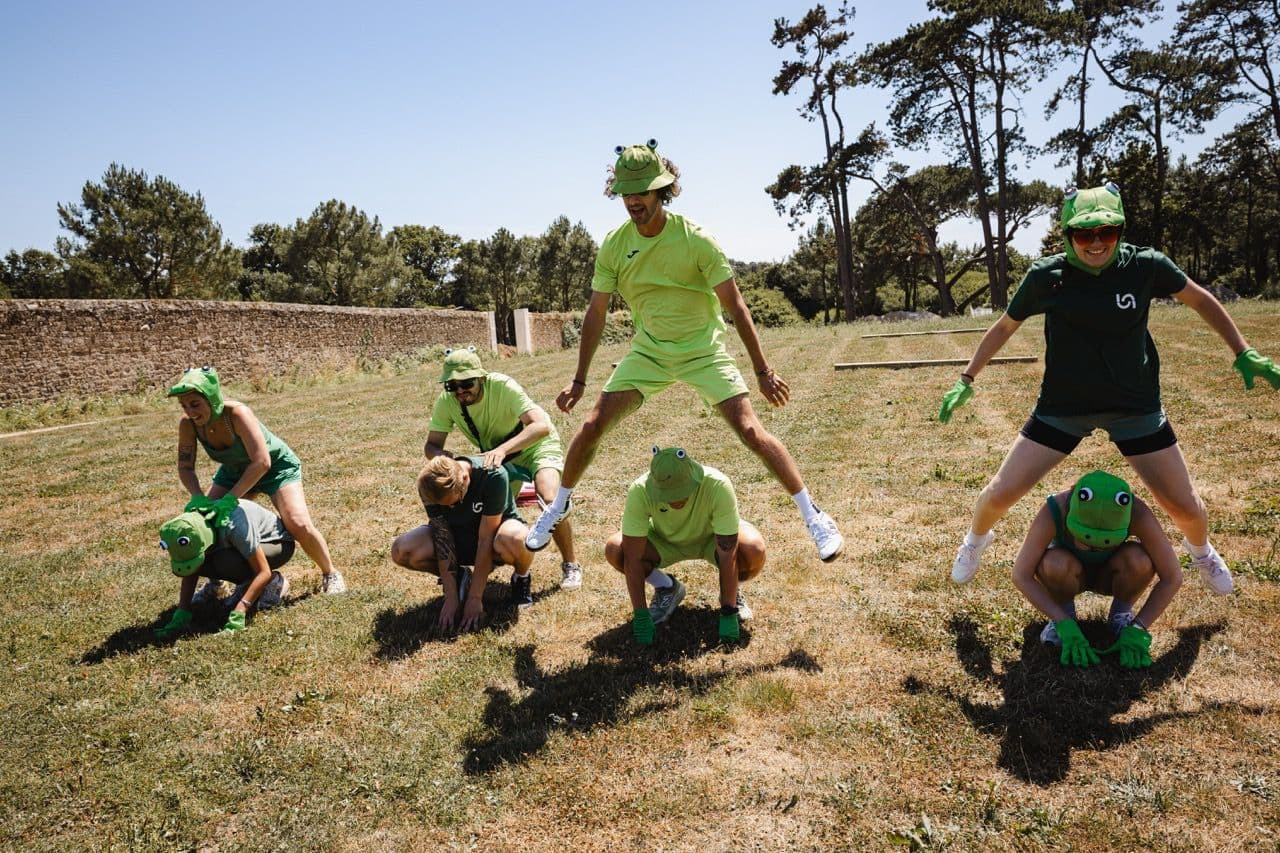
Many company offsites in cities like London, Manchester or Edinburgh follow the same tired formula: a morning of presentations, a catered lunch, perhaps an awkward trust fall exercise no one requested, and a room full of polite but bored colleagues. This means teams spend a day together without truly connecting. If you want your next company offsite to be memorable and impactful, the games and activities you choose matter far more than the venue or the catering.
The good news is that the most effective company offsite team building activities usually need very little budget and no prep. What they do rely on is a readiness to laugh, a bit of organised fun, and formats that get people talking beyond the usual meetings or video calls.
This guide shares five team game ideas for a company offsite that have been tested in real workplaces across the UK, explains why each builds genuine connection, and offers a simple framework to sequence them through your day. Whether you’re running a half-day workshop or a full retreat in the Cotswolds or the Lake District, these games boost teamwork long after the day ends.
Why Most Team Building Activities Fail From the Start
Before we dive into the games, it’s useful to understand why many engaging team games fall short. Usually, the problem comes down to design, not execution. People often pick activities that are too competitive (which causes stress rather than bonding), too passive (which leads to boredom), or too complicated to organise (meaning more time on instructions than connection).
Another barrier is the psychological one. Most adults at work guard their professional image carefully. Activities that ask people to be vulnerable or silly only work if the entry point feels low risk. The best fun office team games get around this by being familiar and approachable before they fire up the energy.
A Common Mistake: Starting Too Wild
One frequent error is kicking off with a highly competitive or high-energy game before the group has warmed up socially. Imagine launching a company offsite in Birmingham or Glasgow with a fierce contest before everyone’s had their tea or coffee. It tends to make everyone feel tense rather than relaxed.
A better plan is to build the day from gentler, more social activities up to livelier, competitive ones. Think of it like warming up – slowly raising energy and willingness to join in. Teams often say this improves enjoyment and engagement greatly.
The Pitfall of Over-Preparation
Many companies find that complicated team activities with lots of printed sheets, props or tricky rules actually reduce engagement. If people spend ten minutes reading instructions, the momentum and fun disappear. This article focuses on no prep team building games which need only people and a bit of space. Their simplicity is an advantage.
The PACE Framework: A Simple Model for Your Offsite
Before listing the games, it helps to have a clear way to organise them. The PACE Framework stands for: Personal, Active, Competitive, Expansive. Each phase helps teams engage in a different way as the day goes on.
- Personal: Gentle activities where people share something small about themselves to start feeling familiar.
- Active: Fun games that get everyone moving or laughing together, lifting the room’s energy.
- Competitive: Light contests that bring excitement without excluding anyone.
- Expansive: Group tasks encouraging creative or collaborative thinking, cementing connections.
The five games below fit neatly into this framework for an all-round engaging day.
Using PACE in Practice
Picture a 25-strong marketing team from a London firm heading out for a strategy day. The morning starts gently with a Personal phase activity. After the first break, an Active game boosts laughter and movement. Just before lunch, a Competitive game creates shared stories. The afternoon Expansive activity finishes with collaborative thinking. People who usually only chat on Teams or Zoom leave with real rapport. Tools like Naboo help teams plan such days smoothly and effectively.
1. The Preference Chain: A Personal Icebreaker
This low-pressure game is perfect for opening any offsite. It’s easy, inclusive and reveals surprisingly interesting things about colleagues you wouldn’t hear in regular meetings. Participants sit or stand in a circle and each shares a simple, specific personal preference like how they take their tea or train commute quirks. Before sharing their own, each person repeats all the previous preferences exactly.
For example, the first person might say how they take their tea – milk first or after. The second then repeats that before adding their own detail. By the time you reach the tenth person, everyone laughs at trying to remember, and everyone’s picked up something real about their colleagues. This game scores highly for team icebreaker games for offsite as it sparks chat naturally.
Why This Builds Team Bonding
Memory and repetition here show people they’re noticed. When a colleague accurately recalls your preference, it’s a small but meaningful moment that builds connection across the group. This is especially useful in cross-department teams who often work separately.
Tips to Avoid Mistakes
A common mistake is asking for abstract or serious answers early on. Asking about values or career goals can feel stressful. Keep prompts focused on easy daily habits like breakfast choices or commute quirks. These create laughs and ease everyone in.
2. Song Word Sprint: An Active Energy Booster
Once people have warmed up, get everyone on their feet with a bit of laughter. The Song Word Sprint is a favourite indoor team game for corporate events across the UK, tapping into a shared love of music. Teams of four or five get a one-minute timer to pick a song containing a word called out by the host - words like "fire," "heart," "night," or "run." They then pick a lyric to sing aloud. No repeats allowed, and teams who can’t find a song are out. Play continues until one team wins.
Why This Is Easy to Run
It needs no props, printouts or tech, just people’s energy. It works across age groups and cultures because the words are common in many songs. Organisers say it usually generates more laughs than costly entertainment.
Tips for Larger Groups
For over thirty people, run elimination heats rather than everyone together. This keeps things clear and lets each team enjoy the spotlight. The final face-off draws plenty of supportive cheers.
3. Rock, Paper, Scissors Cascade: A Competitive Crowd-Pleaser
elimination tournaments create great noise and fun, and this twist on rock, paper, scissors makes everyone part of the crowd. Participants pair off and play one round; losers become the winner’s cheerleaders, following them and shouting encouragement. Losing teams’ fans join the winners’ crowd too, so as the tournament goes on, two big fan groups cheer the finalists, creating a fantastic atmosphere in venues from Manchester boardrooms to Edinburgh community centres.
Why Crowd Energy Matters
The game turns losing into a positive by making you a fan, not just a defeated player. This changes the emotion from embarrassment to belonging, making it one of the best moments of any offsite because everyone takes part.
Facilitation Tip
Have an enthusiastic host call out the crowd sizes during the final round to ramp up excitement ("Team Claire has 17 fans, Team Jack has 16 fans").
4. Silent Count: Surprising Depth in a Simple Game
Simple on paper, this activity often uncovers the deepest team insights. Perfect for the Expansive phase, it requires no competition, only quiet collective focus. The group stands in a circle with eyes closed or downcast and counts aloud from one to twenty-one. Each number must be spoken by a different person, with no set order. If two speak at once or someone speaks twice in a row, the count resets.
Most groups fail several times before finding a rhythm. The effort produces laughter but also a serious focus that’s quite different from the earlier lively games. It encourages people to listen carefully to each other.
Why This Reveals Team Patterns
This easy team building exercise shows how groups naturally coordinate without a leader. Some discover over-dominant voices or discover they follow the office hierarchy order by default. Thoughtful debriefs uncover useful insights about team communication in ambiguous situations, which can inform real work.
Invite Reflection
Once the group reaches 21, try asking: What strategy worked best? Did anyone hold back or rush? These questions turn a fun game into a useful team exercise.
5. Supermarket Sprint: A Competitive Finisher That Re-Energises
This quick competitive game is ideal after lunch to beat the usual slump and build excitement. One person hosts. The rest split into two teams standing in lines facing the host. The host calls out a letter and says they’re shopping for something starting with it. Front players race to shout a valid supermarket item beginning with that letter. The winner goes to the back of the line to play again, the loser sits out. Play continues until one team runs out of players.
Why It Works So Well
The rounds are fast so no pressure piles up. It’s silly so losing doesn’t hurt. And teams love the spontaneous celebrations when they win a round. Often, unexpected winners come out of this game which gently changes how colleagues see each other.
Variations
For repeat players, swap supermarket items for something linked to your industry. A tech company might go for "things found in a server room," while a hospitality firm might try "items in a hotel lobby." This adds a fun, tailored touch.
How to Check If Your Offsite Games Made a Difference
Many organisers run team activities, enjoy the moment, then forget to check if any real impact followed. Simple ways to measure impact include monitoring how often colleagues from different teams chat or collaborate, running quick anonymous surveys about comfort and communication, or noting how often offsite moments come up in meetings.
| Metric | How to Measure | When |
|---|---|---|
| Cross-team chat frequency | Track mentions or new collaborations between offsite participants | Two weeks later |
| Psychological safety | Quick anonymous survey on comfort speaking up | About a month later |
| Participant satisfaction | Survey after event asking about activities | Within 48 hours |
| Reference to shared moments | Note how often offsite stories come up in meetings | Ongoing |
One of the clearest signs is hearing people laugh about games like the Song Word Sprint weeks after. It shows the connections made that day endure.
Be Realistic About What to Expect
These games won’t fix deep team problems or structural issues alone. What they do is build shared memories, lower social barriers, and bring fresh energy to teams who’ve had a tough few months. Think of them as starting points, not cures. That way you’ll get the most benefit.
A Sample Offsite Day Plan
- Morning starter (Personal): Preference Chain right after intros. Around twenty minutes. Sets a friendly, attentive tone.
- Mid-morning boost (Active): Song Word Sprint for thirty minutes before work sessions. Gets people laughing and moving.
- Before lunch (Competitive): Rock, Paper, Scissors Cascade for 15-20 minutes to end the morning lively.
- After lunch (Competitive): Supermarket Sprint for 15 minutes to wake everyone up.
- Afternoon reflection (Expansive): Silent Count to start or close the afternoon session.
Using this plan means the games fit naturally into your day rather than feeling like an interruption. Each has a purpose in building energy and connection.
Many teams use platforms such as Naboo to find inspiring event ideas and make organising simple. To explore more workplace insights, visit the Naboo blog.
Frequently Asked Questions
How many team games work best for a one-day company offsite?
Three to five short games spaced out through the day usually work better than one long session. This keeps energy steady instead of wearing out participants early. Using a framework like PACE ensures a good mix of social and active fun.
What if some colleagues are more reserved or dislike high-energy games?
Start gently with low-stakes, calm activities, then increase energy once people warm up. Preference Chain and Silent Count are great for quieter folks as they reward listening and thoughtfulness rather than speed or loudness. Often introverted team members shine in Silent Count, gaining natural visibility.
Can these games work for remote or hybrid teams joining virtually?
Some games adapt well. Preference Chain works over video calls despite being harder without physical cues. Silent Count can run on Zoom with muting/unmuting but needs a reliable connection. High-energy games like Rock, Paper, Scissors Cascade and Supermarket Sprint work best in person but can be done in virtual breakout rooms with leaderboards.
How do you run these games for very large groups over 50 people?
Break larger groups into smaller clusters running parallel games, then bring finalists together for a final round. This keeps everyone involved and adds a shared spectator moment. Rock, Paper, Scissors Cascade is especially good for big groups because of the crowd element.
How long does the bonding effect last after an offsite?
Research shows social bonds from shared events start fading after four to six weeks without reinforcement. The best way to extend benefits is to mention shared moments in team meetings and schedule follow-up catch-ups within a month. Many UK companies hold two to three offsites each year to build lasting camaraderie.