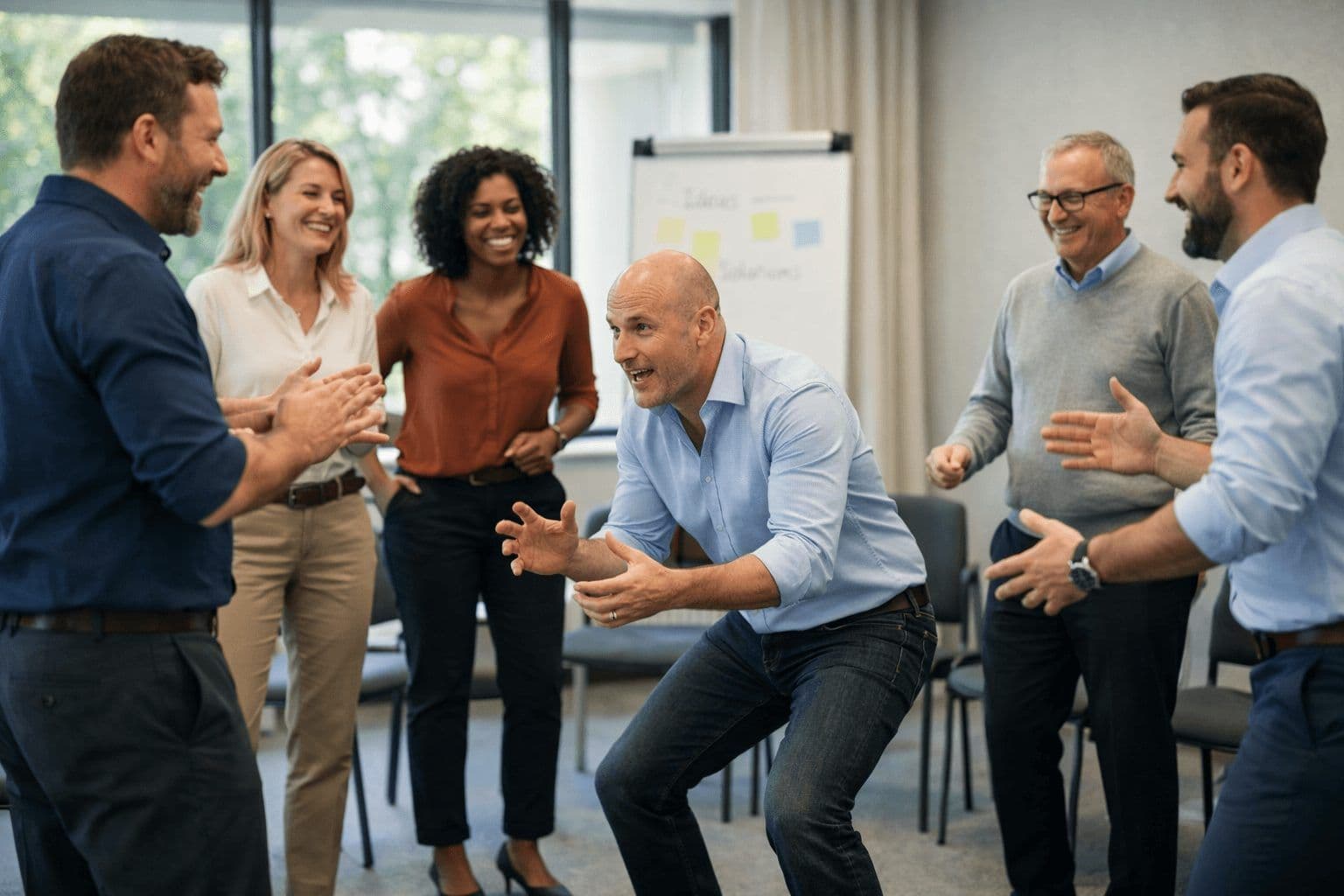

Three professionals collaborate on a modern rooftop terrace, ideal for a corporate offsite meeting.

15 essential critical thinking exercises for US teams

5 février 202612 min environ

The ability to analyze complex situations, evaluate information objectively, and generate sound solutions is critical in the modern workplace. Companies dealing with rapid change and new technology need essential critical thinking exercises for US teams to strengthen decision-making at every level.

Critical thinking is the disciplined process of actively conceptualizing, applying, analyzing, synthesizing, and evaluating information gathered from observation, experience, reflection, reasoning, or communication. For leaders implementing these exercises, the real payoff is watching theoretical knowledge become practical decision-making power.

These exercises demand analytical rigor, check biases, challenge assumptions, and turn collaboration into innovation. Below are 15 essential critical thinking exercises for adults designed to elevate team performance.

Understanding the Pillars of Advanced Critical Thinking

Before diving into specific exercises, understand the three core components that define critical thinking in a professional context:

Analytical Reasoning

Breaking down complex problems into manageable components, identifying underlying patterns, and evaluating logical coherence. Teams with strong analytical reasoning avoid jumping to conclusions based on surface-level information.

Strategic Decision-Making

Evaluating trade-offs, prioritizing options based on constraints, and anticipating long-term consequences. Most workplace challenges involve uncertainty; these skills enable teams to choose the optimal path when information is incomplete.

Collaborative Problem-Solving

In group settings, critical thinking amplifies through collaboration. This means communicating complex ideas clearly, negotiating differing viewpoints based on evidence, and synthesizing diverse perspectives into superior outcomes. If you want to explore more workplace insights on team dynamics, we encourage you to read more articles on the Naboo blog.

The RESOLVE Framework for Activity Selection

Use the proprietary RESOLVE Framework to match activity scope to skill gaps:

R: Relevance. Does the activity simulate challenges relevant to the team's daily work or industry?

E: Engagement. Is the format engaging enough to ensure active participation?

S: Scope. Does the complexity match the current skill level?

O: Objective. Is the primary critical thinking skill (analysis, strategic planning, communication) clearly defined?

L: Logistics. Can the activity be executed with available time, resources, and venue?

V: Validation. Is there a clear measure of success or failure?

E: Evaluation. Is time allocated for a structured debrief to link activity results back to real-world application?

Scenario: Applying the RESOLVE Framework

A product development team struggling with late-stage feature creep and missed deadlines decides to implement critical thinking activities focused on strategic prioritization. Using RESOLVE, they identify a need for rapid decision-making under constrained resources. With 90 minutes available and remote teams, they select the Crisis Resource Prioritization simulation—a software incident response exercise that mirrors their real project constraints. The final 30 minutes are dedicated to evaluation, where teams articulate how the resource trade-offs they made mirror their actual project choices.

15 Essential Critical Thinking Exercises for Adults

These activities are grouped by primary focus area, though all cultivate multiple critical skills.

Analytical Focus Activities

These exercises sharpen the ability to evaluate data, distinguish facts from assumptions, and identify logical flaws.

1. Bias Detection and Rhetoric Analysis

Teams review arguments, media excerpts, or internal emails containing common logical fallacies—ad hominem, straw man, appeal to emotion—and identify the specific errors present.

Why it matters: Biases and flawed logic often masquerade as strong opinions in workplace debates. Training teams to identify these flaws improves decision quality by ensuring choices are based on evidence rather than charisma or faulty reasoning.

Application: Participants work in pairs to annotate texts, highlighting claims and identifying logical errors. The debrief translates abstract concepts into real-world examples: how confirmation bias affects hiring decisions or how sunk cost fallacy impacts project cancellation.

2. Root Cause Mapping Drill

Teams use iterative questioning (the "Five Whys" technique) to uncover fundamental issues driving a problem. Starting with a defined challenge like "Customer churn increased by 15%," they map the causal chain until reaching a systemic root cause.

Why it matters: Effective problem-solving hinges on solving the correct problem. This prevents the cycle of quick fixes and teaches participants to pursue the causal chain deeper than first apparent answers.

Application: Teams document their process visually, creating a map that branches from the symptom. Success is reaching a root cause that genuinely addresses systemic failure, not assigning blame.

3. The Fact vs. Inference Audit

Teams receive a case study deliberately mixing verifiable data with interpretations and assumptions. They categorize every statement and justify why it falls into one category over another.

Why it matters: Many workplace arguments stem from treating inferences as facts. This activity improves communication clarity and documentation accuracy, especially in high-stakes reporting where objective assessment is essential.

Application: This works well in a competitive setting where judges assess accuracy of audits. The key insight is realizing how easily assumptions creep into communication.

4. Digital Evidence Scrutiny

Teams receive contradictory digital assets related to a fictional event—screenshots, social media posts, memos, images—and determine the verifiable truth using only provided evidence.

Why it matters: In an age of digital overload and misinformation, evaluating source credibility and detecting inconsistencies is essential. This hones observational skills and metadata analysis, particularly useful for cybersecurity and risk management roles.

Application: Success depends on identifying reliable evidence that contradicts all others or proves a timeline error through cross-referencing multiple formats.

5. Strategic Trade-Off Debates

Participants engage in formal debates exploring the full spectrum of consequences for two equally viable, mutually exclusive strategic choices—for example, whether a division should prioritize market share growth or long-term margin protection.

Why it matters: High-level strategy involves trade-offs, not perfect solutions. This exercise forces team members out of functional silos and builds understanding of holistic organizational impact.

Application: Teams are assigned positions regardless of personal belief. Judges score arguments based on depth of analysis into opposing viewpoints and clarity of secondary effects—financial, operational, cultural. The goal is synthesis, not victory.

Strategic Planning Activities

These exercises require structuring chaos, optimizing resources, and planning under constraints.

6. Crisis Resource Prioritization Simulation

Teams face a high-pressure hypothetical crisis—system failure across cloud regions, supply chain collapse, unexpected regulatory change—and must rank limited resources based on immediate and long-term necessity. If you are looking for event ideas for teams that promote this kind of high-stakes thinking, check out our selection of simulations inspiring event ideas.

Why it matters: This directly tests decision-making under pressure. It forces quick analytical triage, helping teams distinguish between urgent and genuinely important strategic steps.

Application: Individual rankings are compared to the final collective ranking. A facilitator compares the final decision against expert consensus—not to show they were wrong, but to analyze where they deviated and why their communication strategy influenced resource allocation choices.

7. Constraint-Driven Design Sprint

Using simple materials—paper, tape, rubber bands—teams solve a physical challenge like protecting an egg dropped from height. The critical element is a severe time limit.

Why it matters: This highlights rapid prototyping, challenging initial assumptions about material use, and managing scope creep—metaphors for product development where resources are never infinite.

Application: The value is in the process. The debrief focuses on what initial assumptions proved false and how the team adjusted strategy mid-challenge.

8. The Reverse Blueprint Challenge

One team member observes a complex pre-built structure and must verbally instruct remote teammates to replicate it exactly, without visual aids. Instructions must be perfectly logical and sequence-dependent.

Why it matters: This tests the ability to translate visual complexity into structured, unambiguous verbal instructions. Small ambiguities lead to massive failures in execution—a common issue in project handover.

Application: This virtual exercise focuses on precision language and active listening. The debrief assesses efficiency: how many instructions were needed, and where did the instruction-giver fail to anticipate receiver context?

9. Predictive Scenario Mapping

Teams develop three distinct, realistic future scenarios—Best Case, Worst Case, Most Likely—from a current trend (for example, a competitor launching a new pricing model). They detail cascading effects across departments over the next 12 months.

Why it matters: This moves teams away from reactive thinking toward proactive risk assessment and contingency planning. It synthesizes external market data with internal capabilities to forecast outcomes.

Application: Teams present their three maps, justifying feasibility and detailing necessary organizational response for each. This builds clarity on potential future challenges and strengthens strategic agility.

10. The Decision Matrix Dilemma

Participants face a multi-faceted choice—selecting a new software vendor, for instance. They define the five most important evaluation criteria, assign weightings based on strategic priorities, then score options against this custom matrix.

Why it matters: Many decisions are made on gut feeling or limited criteria. The Decision Matrix standardizes the process, ensuring choices are transparent, evidence-based, and aligned with strategic priorities.

Application: The facilitator reviews the justification for weightings, not the final choice. This reveals underlying strategic assumptions and helps teams align on metrics that define success.

Collaborative and Innovative Activities

These exercises emphasize negotiation, group synthesis, and creative idea generation stemming from analytical insight.

11. Collaborative Code Break Challenge

Teams solve a series of increasingly complex ciphers and logic puzzles. Each team member holds essential information or a key part of the solution, but no single individual has full context. They must combine knowledge and analytical skills under a strict time limit.

Why it matters: This tests structured communication and information sharing. It simulates environments where critical information is siloed, forcing teams to prioritize communication protocols.

Application: Success is achieved only through efficient collaboration. The debrief focuses on identifying communication bottlenecks and how individual data points were integrated into collective solutions.

12. The Hypothetical Merger Negotiation

Teams take roles as opposing corporate entities preparing for a merger. Each receives confidential objectives and constraints, then analyzes the other side's probable strengths, weaknesses, and objectives to formulate beneficial negotiation strategy.

Why it matters: This demands quick analysis of conflicting data, strategic planning, and adaptive negotiation. It teaches participants to separate core interests from positional demands.

Application: The activity culminates in simulated negotiation. Success is maximizing utility for the assigned organization while demonstrating analytical rigor in understanding the opponent's position.

13. Remote Mind Mapping Synthesis

Teams use collaborative whiteboard software to visually structure complex challenges—for example, "The Future of our Industry." They systematically categorize ideas, identify relationships between concepts, and assign ownership to actionable branches.

Why it matters: This structured approach moves teams past linear thinking, transforming overwhelming complexity into an organized, prioritized visual roadmap.

Application: The critical element is the synthesis phase, where teams logically connect tangential ideas into meaningful clusters. The final map serves as a shared artifact demonstrating collective ability to synthesize information efficiently.

14. Scenario: The Unpopular Mandate

Teams are presented with a new company-wide mandate that appears unpopular or detrimental to their department—for example, "All travel budgets are cut by 50% immediately." Their challenge is to articulate the strategic rationale behind the mandate, regardless of whether they agree with it.

Why it matters: This fosters empathy and systems thinking, training teams to look beyond immediate operational impact to understand strategic drivers of executive decisions. It prevents unproductive grumbling and promotes objective analysis.

Application: Teams hypothesize the organizational problem the mandate solves. This promotes sophisticated understanding of how critical thinking applies to change management and communication.

15. The Unconventional Idea Pitch

Teams design an innovative new feature for a common workplace product, incorporating three randomly assigned non-obvious constraints—for example, "Must cost less than $1 to implement," "Must appeal only to specific demographics," and "Must be implemented by robots."

Why it matters: This forces creative thinking within constraints, mirroring real-world innovation where breakthroughs come from rigid limitations. It challenges functional fixedness and seeks unconventional solutions.

Application: Teams use analytical rigor to demonstrate how their unconventional idea logically functions and meets constraints. This promotes both ingenuity and feasibility assessment.

Common Pitfalls When Implementing Critical Thinking Activities

Several implementation mistakes prevent maximum learning:

Skipping the Structured Debrief

The single biggest failure is treating the activity as merely a game. True learning happens in the debrief. Teams need dedicated, facilitated time to reflect on how they solved the problem, not just whether they solved it. Without this, skills remain confined to the artificial setting and don't transfer to the workplace.

Focusing Only on Speed or Winning

If the emphasis is solely on who finished first or won, teams prioritize speed over analytical rigor. The objective should be process quality, logical justification, and comprehensive evaluation. Over-indexing on competition discourages collaboration and risk-taking.

Lack of Contextual Relevance

If the scenario feels distant from actual work, the exercise loses impact. Effective activities must feel realistic enough that participants easily visualize applying the same thought processes to their next project or meeting.

Measuring the Impact of Critical Thinking Activities

Measuring success requires assessing the transfer of skills beyond immediate performance metrics:

Debrief Quality Score

During the evaluation phase, facilitators should grade teams on post-mortem analysis quality. Did they articulate the assumptions they made? Did they identify where their logical framework changed? High-quality debriefs correlate directly with effective skill internalization.

Decision Quality Audits

Over the subsequent three to six months, track actual workplace outcomes. Look for evidence of applied critical thinking in real projects: reduction in repetitive errors, clearer documentation distinguishing facts from projections, and decisions that successfully anticipate second-order effects.

Meeting Efficiency Metrics

Critical thinking activities often improve communication. Measure average duration of internal meetings, tracking whether teams arrive at conclusions faster. A decrease in time spent debating low-value points suggests higher critical reasoning applied in real-time.

Frequently Asked Questions

What is the primary goal of critical thinking activities in a professional setting?

Moving beyond identifying answers to developing robust, systematic, and logical processes for analyzing complex information, evaluating strategic options, and making evidence-based decisions under uncertainty.

How often should we incorporate critical thinking activities for adults into our team routine?

Consistency matters. Intensive activities can be scheduled quarterly or semi-annually, while quick exercises like "Fact vs. Inference Audits" work as 30-minute openers to weekly meetings.

Are virtual critical thinking activities as effective as in-person ones?

Yes, provided they are structured correctly. Virtual activities often excel at testing collaboration skills like precision communication and remote data synthesis, critical for distributed teams.

What is the most common mistake when running these exercises?

Failing to connect activity results back to real-world workplace application through structured, facilitated debrief. Without reflection, the activity remains isolated rather than becoming a learning tool.

How do these activities help with leadership development?

Leaders learn to model analytical discipline, improve their ability to diagnose systemic problems, and lead teams through complex decision-making processes based on logic rather than intuition or hierarchy.

Team building WorldTeam building WashingtonTeam building PhiladelphieTeam building PennsylvanieTeam building PittsburghTeam building New-York-CityTeam building New-YorkTeam building RaleighTeam building Caroline-du-NordTeam building BuffaloTeam building ClevelandTeam building AlbanyTeam building OhioTeam building ColumbusTeam building CharlotteTeam building MassachusettsTeam building BostonTeam building DetroitTeam building CincinnatiTeam building LexingtonTeam building Ann-ArborTeam building KentuckyTeam building LouisvilleTeam building IndianapolisTeam building IndianaTeam building MichiganTeam building AtlantaTeam building TennesseeTeam building NashvilleTeam building GeorgieTeam building ChicagoTeam building NapervilleTeam building MilwaukeeTeam building IllinoisTeam building AlabamaTeam building SpringfieldTeam building MontgomeryTeam building TampicoTeam building MadisonTeam building St-LouisTeam building WisconsinTeam building OrlandoTeam building MemphisTeam building FlorideTeam building TampaTeam building MissouriTeam building Saint-PaulTeam building MiamiTeam building MinneapolisTeam building Kansas-City