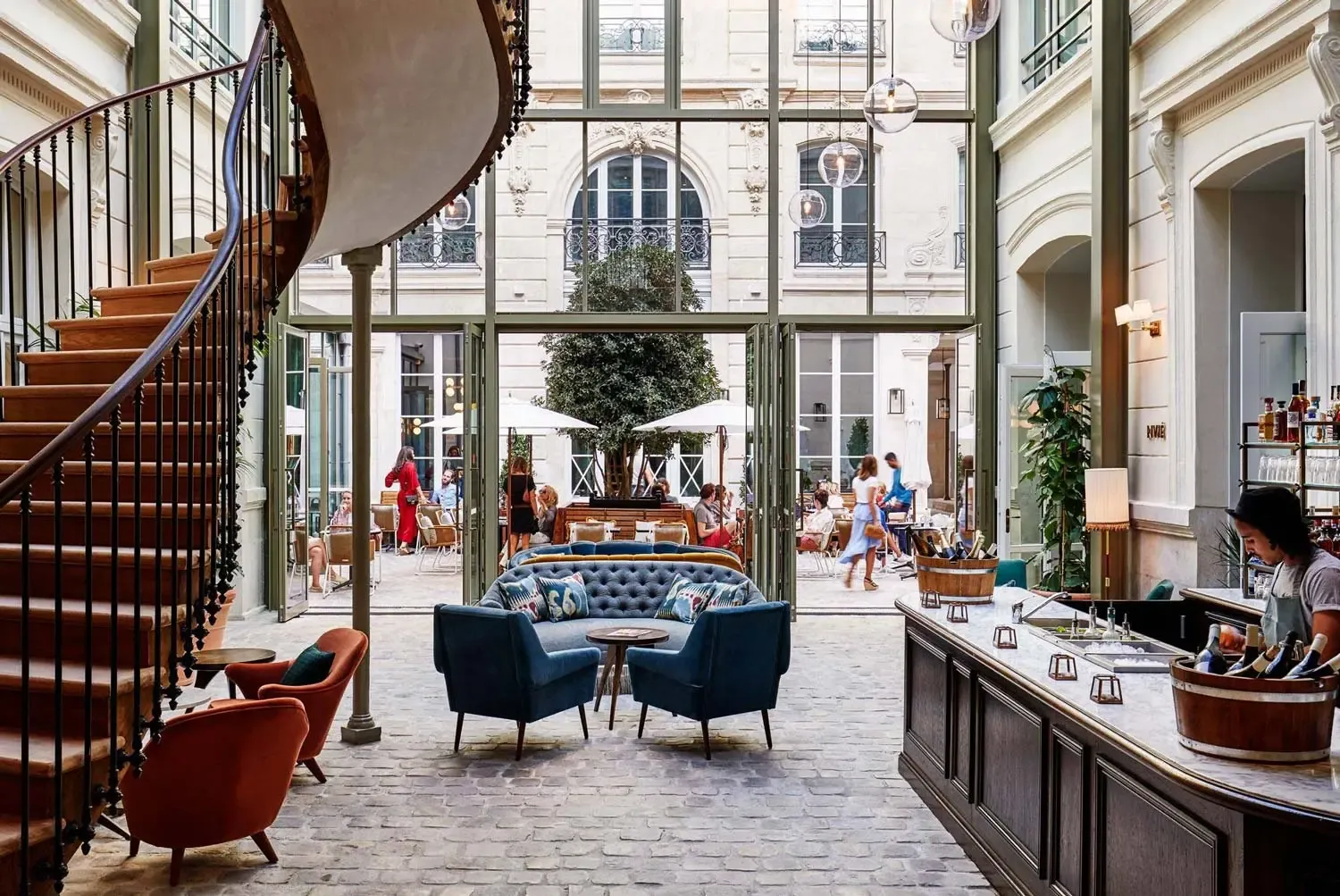
Why the Term "Boutique Hotel" Still Matters
Hilton, Marriott, and Wyndham are names most travelers recognize instantly. For frequent business travelers, sticking with a familiar brand means predictable room layouts, quick loyalty point accumulation, and consistent service. That reliability is exactly why large chains work.
But a growing number of travelers want something different. They're looking for places that feel distinctive, local, not generic. This is where boutique hotels come in—intimate, design-driven spaces deeply connected to their surroundings.
The problem is "boutique hotel" isn't a regulated category. There's no official checklist, no size threshold, no governing body that decides what qualifies. Some operate independently, others sit within large hotel groups. Some are expensive, others affordable. The term is widely used and frequently misunderstood.
What's consistent is the intent. Boutique hotels aren't defined by scale alone, but by their desire to offer a stay that feels intentional, personal, and emotionally resonant. They aim to give guests something to remember.
Understanding what a boutique hotel truly is means looking beyond marketing language and into how these properties actually operate.
What Actually Defines a Boutique Hotel Today
Ask ten hospitality professionals to define a boutique hotel and you'll get ten different answers. That ambiguity isn't a weakness. It's the point.
There's no universal checklist. Size alone doesn't make a hotel boutique, even though most are small—typically a dozen to fewer than one hundred rooms. Ownership structure doesn't define it either. Many are independently owned, but others operate under larger hospitality groups without the visual uniformity of traditional chains.
What does emerge consistently is a shared philosophy around individuality. Each property is shaped by its location, its building, and the vision behind it. Rooms aren't meant to feel interchangeable with those elsewhere. Guests should feel they could only be staying there, in that place, at that moment.
Design tells a story. Some properties preserve historic architecture and original details. Others use contemporary design to reflect neighborhood energy. What matters is coherence—every design choice is intentional, not dictated by a brand manual.
Service emphasizes personal interaction over process. Staff engage with guests, offer local recommendations, and adapt to preferences rather than follow scripts. The experience feels curated, not automated.
Boutique doesn't mean luxury by default. While some operate at the high end, others position themselves as accessible, design-forward alternatives to mid-range chains. What they share is focus on experience rather than scale.
A boutique hotel is best understood by what it deliberately chooses to emphasize: character, connection, and a sense of place.
The Core Characteristics Boutique Hotels Tend to Share
Even without formal definition, boutique hotels gravitate toward recognizable characteristics. Not rigid rules, but recurring patterns that shape how these properties look and operate.
Scale is the most visible difference. Most boutique hotels house 10 to 100 rooms. This footprint allows owners to focus on detail and atmosphere rather than volume. Public spaces feel quieter, staff interactions feel more personal, and navigation is easier.
Independence plays a central role, even within larger groups. Many are privately owned or family-run, which means decision-making without corporate approval layers. That autonomy shows up in interior design, food and beverage concepts, and how staff interact with guests.
Personalization is not an add-on, it's the product. Boutique hotels aren't designed to appeal to everyone. They target a specific guest—creatives and remote workers, wellness travelers, food enthusiasts, or couples seeking intimacy. The experience is intentional rather than generalized.
Design is expressive rather than standardized. Chain hotels rely on visual consistency. Boutique hotels do the opposite. Some preserve historic architecture. Others embrace bold, contemporary aesthetics. What matters is that design feels cohesive and reflects the property's identity.
A strong sense of place is essential. Boutique hotels embed themselves in their surroundings. Local art, regional materials, neighborhood partnerships, and destination-specific experiences are common. The hotel becomes a lens through which guests experience the city.
Amenities are curated, not exhaustive. Rather than offering every possible service, boutique hotels focus on fewer features done well. A thoughtfully designed lobby bar may replace a full restaurant. A locally owned café may substitute for room service. The emphasis is on relevance and quality.
These characteristics explain why boutique hotels feel different even at similar price points to larger brands. The difference lies in how intentionally each element is chosen.
How Boutique Hotels Emerged and Why the Category Took Hold
Small, character-driven accommodations have existed for centuries. What changed in the late twentieth century wasn't the scale of hotels, but the intention behind them.
By the 1980s, large hotel chains had achieved near-global uniformity. Travelers knew exactly what to expect from a branded property in any major city. That predictability was comforting, but it also created space for a counter movement. A new generation of hoteliers began experimenting with hotels as cultural spaces rather than standardized products.
One of the earliest examples is Morgans Hotel in New York City, opened in 1984 by Ian Schrager and Steve Rubell. The founders, best known for Studio 54, approached hospitality through design and nightlife. The hotel was intentionally small, visually bold, and socially oriented. Its lobby wasn't a pass-through space but a destination. That idea became foundational to boutique hospitality.
Around the same time, Bill Kimpton was building what would become another pillar of boutique hospitality. His first property, the Bedford Hotel in San Francisco, opened in 1981 and laid the groundwork for Kimpton Hotels & Restaurants. Kimpton's early properties emphasized design, approachable luxury, and guest experience at a time when most mid-range hotels didn't.
Today's Kimpton brand traces that lineage directly.
What made these early properties different was their cultural positioning. They weren't selling beds. They were selling atmosphere, emotion, and identity. Guests were encouraged to see the hotel as part of the city's creative life rather than neutral space.
By the 1990s and early 2000s, the concept gained traction. Travelers increasingly sought experiences that felt local and personal, especially in major cities. Boutique hotels appeared in converted warehouses, historic buildings, and architecturally distinctive spaces that traditional chains avoided.
As demand grew, larger hotel groups took notice. Rather than resist, many adapted. Boutique-inspired brands emerged within major portfolios, borrowing design language and service philosophy while retaining corporate backing. This blurred the line between independent boutique hotels and branded lifestyle properties.
What never changed is the core appeal. Boutique hotels succeeded because they responded to a cultural shift. Travelers no longer wanted to disappear into hotels. They wanted hotels that reflected where they were.
Boutique Hotels in Practice: What the Concept Looks Like on the Ground
The easiest way to understand boutique hotels is to look at how real properties apply the concept in different contexts. What they share is not a template, but a way of thinking about space, service, and identity.
In New York, The Greenwich Hotel illustrates boutique hospitality rooted in discretion rather than spectacle. Located in Tribeca and developed by Robert De Niro, it reflects the neighborhood's residential character. Rooms are individually finished with reclaimed materials and custom furniture. The property exists for this location only, and that singularity is its core appeal.
Ace Hotel demonstrates how boutique hotels function as cultural hubs. Ace properties are known for their lobbies as much as their rooms. Public spaces work as coworking areas, cafés, and social venues. Guest rooms vary in size and price, but the experience is anchored in community and creative energy.
In resort settings, The Standard takes a more provocative approach. Properties blend bold design, nightlife, and hospitality into a single experience. Rooms are intentionally minimalist, while public areas are designed to be seen and used. The hotel becomes part of the destination's social ecosystem.
Boutique doesn't require urban location. Blackberry Farm in rural settings combines high-end accommodations with farm-to-table dining, outdoor activities, and strong sense of place. The boutique experience is built around landscape, craftsmanship, and slow luxury rather than design trends.
Extended stay and boutique work together. The Hoxton structures room categories around transparency and use rather than status. Terms like "Cosy," "Roomy," and "Biggy" clearly communicate size and intent, while shared spaces encourage guests to work, meet, or relax beyond their rooms.
What these hotels share is intentional differentiation. Each makes deliberate choices about who it's for, how it fits into its surroundings, and what guests will remember. That clarity allows boutique hotels to compete effectively with much larger brands.
What Boutique Hotels Represent for B2B Travel and Business Use Cases
For B2B audiences, boutique hotels have shifted from niche to strategic assets in corporate travel, meetings, and brand positioning.
Boutique and lifestyle hotels have consistently outperformed traditional hotels in RevPAR growth in major urban markets. The reason is higher perceived value. Boutique properties command stronger rates by offering differentiated experiences rather than standardized services.
Corporate travel patterns explain this shift. Before the 2010s, business travel was dominated by large conventions and standardized hotel programs. As companies globalized and teams became distributed, travel fragmented. Shorter trips, smaller groups, and more frequent cycles reshaped demand. Boutique hotels, with their smaller inventories and flexible spaces, aligned naturally with this reality.
From a corporate travel perspective, boutique hotels are selected for specific profiles rather than entire programs. Senior executives, leadership teams, consultants, and product teams are placed in boutique properties when decision-making, discretion, or client interaction matter. The hotel becomes part of the professional narrative.
Meetings and events show a clear signal. Boutique hotels have carved out a strong position in executive offsites, board meetings, incentive trips, and leadership retreats. Industry data shows a steady increase in small-format corporate events under 50 participants, where exclusivity, privacy, and atmosphere matter more than capacity. Boutique hotels respond through buyouts, custom programming, and personalized service.
From an employer branding standpoint, accommodation choices matter. As competition for talent intensified, companies paid closer attention to the travel experience offered to employees. Younger professionals place greater value on experience quality than loyalty programs. Boutique hotels support retention by aligning corporate travel with lifestyle expectations.
On the investment side, boutique hotels follow different logic from branded assets. They are often location-driven rather than brand-driven, developed in historic buildings or architecturally distinctive spaces that resist standardization. This makes them harder to scale but harder to replicate. In strong markets, this uniqueness translates into long-term value resilience.
What this means for B2B decision makers is clarity of use. Boutique hotels are precision tools. When used intentionally—for the right travelers, events, and objectives—they offer alignment and impact that standardized models don't.
Where Boutique Hotels Fit in the Future of Hospitality
Boutique hotels have endured because they anticipated a shift in how people travel. As booking platforms have made price and availability easier to compare, differentiation has moved elsewhere. Experience, identity, and emotional connection now carry as much weight as location and rate.
Boutique hotels understood early that travelers don't only compare rooms. They compare how a place makes them feel. In that sense, boutique hospitality is less a category than a mindset. It prioritizes intention over scale and character over uniformity.
This doesn't mean boutique hotels are immune to pressure. Rising operating costs, staffing challenges, and competition from lifestyle brands and short-term rentals all shape the landscape. Many are responding by sharpening their positioning. Instead of appealing to everyone, they serve a clearly defined audience extremely well.
Larger hotel groups continue to absorb boutique principles into their portfolios. Design-driven spaces, locally inspired food and beverage, and flexible service models are now common across the industry. But true boutique hotels retain an agility and authenticity that's difficult to replicate at scale.
For travelers, the takeaway is simple. Choosing a boutique hotel works best when the hotel's identity matches expectations and travel intent. When that alignment exists, the hotel becomes part of the memory of the trip.
As travel evolves, boutique hotels are likely to remain a vital counterbalance to standardization. They remind the industry that hospitality is not only about efficiency, but about creating places that feel lived in, intentional, and worth returning to.