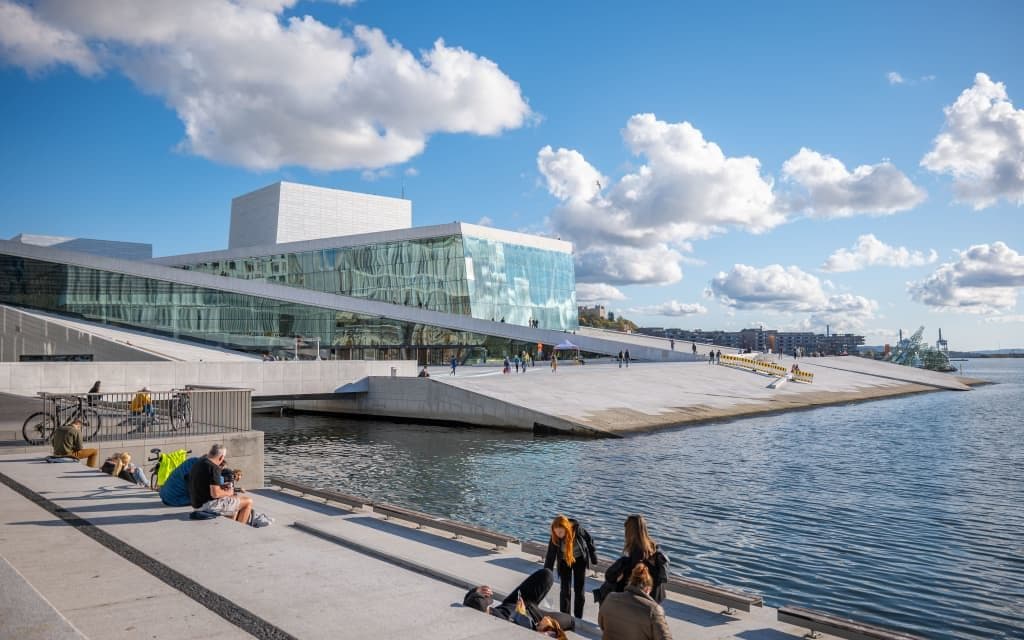
What to do in Oslo during a stay? The answer is found in the seamless integration of urban innovation and raw nature. Oslo is one of Europe’s fastest-growing capitals, currently undergoing a massive architectural renaissance along its waterfront. It is a city where you can conduct a high-level board meeting in the morning and be hiking through dense forests or sailing a fjord by the afternoon.
For business leaders, Oslo offers an atmosphere of "rugged sophistication." The Norwegian work culture is built on flat hierarchies, transparency, and a profound respect for work-life balance. Whether you are hosting a strategy session in the futuristic Barcode District or a workshop overlooking the harbor, Oslo provides a clean, focused environment that encourages teams to strip away the noise and focus on sustainable growth.
1. Nordic Wellness: The Fjord Sauna Experience
In Oslo, the "Floating Sauna" is not a leisure activity; it is a vital urban ritual that embodies the Norwegian concept of Friluftsliv (open-air life). Over the last few years, a vibrant sauna village has emerged along the harbor promenade, where high-level executives and locals alike alternate between 90°C wood-fired heat and the bracing, sub-zero waters of the Oslo Fjord. For a corporate team, this experience serves as a profound "physical reset," utilizing the science of hormetic stress to trigger endorphin release and heighten collective focus.

Strategic Benefits of the Fjord Immersion:
The Leveling Effect of the "Badstue": In the heat of the sauna, corporate hierarchies naturally dissolve. The absence of technology and formal attire creates a rare environment of "radical transparency." Norwegians frequently use these sessions for high-stakes business discussions, finding that the physical vulnerability of the heat fosters more honest, direct communication.
The Cold Plunge as Mental Fortitude: Jumping into the icy fjord is a lesson in Calculated Risk and Decision Making. The immediate physiological response requires controlled breathing and mental discipline—skills that translate directly to maintaining composure during high-pressure market shifts.
Private Fleet Buyouts (KOK & Oslo Badstuforening): We facilitate private rentals of architectural saunas like KOK—solar-powered, electric-motor rafts that can hold up to 10-12 people. These vessels can navigate away from the pier, offering a "Floating Boardroom" with 360-degree views of the Opera House and Akershus Fortress in total acoustic silence.
The "Aufguss" Ritual: Elevate the session with a private Sauna Master who leads an Aufguss ritual—using essential oils and rhythmic towel waving to control heat and airflow. This sensory experience is a masterclass in Environmental Control and the power of shared, high-intensity experiences to forge deep-seated team bonds.
Post-Sauna "Kos": The transition from the cold water back to the warmth of the wood stove facilitates a state of Kos—the Norwegian version of cozy intimacy. This is the optimal time for the "Social Debrief," where teams can reflect on their strategic goals in a state of heightened dopamine and renewed energy.
Naboo Agency’s Hand-Picked Recommendation: For larger groups (up to 100+), we recommend a takeover of SALT, a nomadic art project at Langkaia. Its largest sauna, Árdna, features a built-in bar and stage, allowing you to combine a keynote presentation with an authentic Nordic bathing ritual against the backdrop of the fjord.
This is a performance-driven wellness intervention. By integrating Oslo’s sauna culture into your retreat, you are equipping your team with a uniquely Nordic toolkit for resilience, clarity, and authentic connection.
2. Artistic Ambition: A Private Tour of the Munch Museum
The MUNCH Museum is not just a repository for art; it is a 60-meter-tall "vertical symbol" of Norwegian ambition. Rising from the Bjørvika waterfront with a distinctive "bow" towards the city, the building’s architecture—designed by Estudio Herreros—defies traditional horizontal museum norms, mirroring Edvard Munch’s own lifelong defiance of conventional rules. For a corporate team, this is an immersive lesson in Creative Courage, illustrating how a singular vision can be scaled into a monumental global legacy.

Strategic Lessons in Vertical Innovation:
The Private Dawn Ascent: We arrange for exclusive, early-morning access before the museum opens to the public. Navigating the 13 floors in silence allows your team to experience the "Vertical Museum" as a strategic journey, where each level represents a new stage of development, risk-taking, and thematic evolution.
Emotional Honesty & The St. Cloud Manifesto: Stand before The Scream or the monumental The Sun (stretching nearly 24 feet wide) and discuss Munch’s radical pivot in 1889. His rejection of "academic" painting in favor of "living people who breathe and feel" serves as a powerful prompt for Authentic Branding—challenging your team to move past superficial metrics to find the true emotional core of their work.
The Power of Experimentation: Munch viewed his paintings as "studies and preparations for new works," rarely considering a project truly finished. This mindset is a vital case study for R&D and creative teams in Iterative Thinking—the courage to fail, borrow from other disciplines, and constantly refine one’s "motif" until it achieves global resonance.
Sustainable Architecture as a Core Value: The building itself is a "Passive House" wonder, constructed with low-carbon concrete and recycled aluminum. Its facade reflects the changing light of the fjord, illustrating how a "powerful presence" can also be deeply respectful of its environment. This provides a concrete example of how Sustainability and Prestige can be integrated into the very DNA of an organization.
The Observatory Debrief: Conclude your tour at the 13th-floor rooftop observatory. With panoramic views of the Oslo Fjord and the city skyline, this elevated space provides the mental "altitude" needed for a final debrief on how your team intends to leave their own impactful, lasting "mark" on their industry.
Naboo Agency’s Hand-Picked Recommendation: Follow your tour with a private breakfast at Kranen, the museum’s top-floor bistro. The combination of high-concept design and sprawling views ensures that the insights from Munch’s artistic journey are immediately translated into high-level strategic planning.
This is a high-impact cultural deep-dive. By immersing your team in the relentless experimentation of Norway’s most famous artist, you are providing them with the creative toolkit and the structural scale needed to think—and build—bigger.
3. High-Stakes Heritage: Exploring the Holmenkollen Ski Jump
Perched high above the city, Holmenkollen is a monumental symbol of Norwegian national identity and a global benchmark for engineering excellence. More than a sports venue, the current jump—designed by JDS Architects—is a cantilevered steel masterpiece that juts into the sky, offering a 360-degree panoramic view of the Oslo Fjord and the vast Oslomarka forest. For a leadership team, this site serves as a physical manifestation of Peak Performance, requiring both the vision to see the horizon and the courage to commit to a high-stakes trajectory.

Strategic Lessons from the Summit:
The Leap of Faith Strategy Huddle: We facilitate a private "Strategy Summit" at the very top of the jump tower. Standing at the jump start—the same spot where world-class athletes begin their descent—provides a visceral setting for discussing "taking the plunge" on a new project. The altitude and exposure provide a mental "cleanse," forcing teams to move past granular details and focus on the macro-level vision.
The Ski Simulator: Tactical Risk Assessment: Give your team a taste of a 100-meter jump without the physical danger. The state-of-the-art simulator uses VR and wind technology to replicate the sensation of flight. This isn't just a "fun" activity; it is a prompt for a debrief on Calculated Risk—how to prepare for high-velocity transitions and how to recover if the "landing" isn't perfect.
Engineering Resilience: Explore the Ski Museum, located inside the mountain directly underneath the jump. It traces 4,000 years of skiing history, illustrating how a simple tool for survival evolved into a global industry of elite performance. This provides a case study in Iterative Innovation—the constant refinement of technology and technique to push the boundaries of what is humanly possible.
The "Kollensvevet" Zip Line: For teams that value high-adrenaline bonding, we can arrange for participants to "fly" down the jump on a 361-meter zip line. This activity mirrors the psychological journey of a major corporate launch: the initial tension of the start, the high-speed execution, and the final satisfaction of a successful arrival.
Forest Networking at Frognerseteren: Conclude the experience by walking a short distance to the historic Frognerseteren restaurant. This 19th-century timber building, set overlooking the fjord, is the perfect location for a "Traditional Norwegian Hearth-Side Lunch." The contrast between the hyper-modern jump and the ancient wooden architecture reinforces the importance of balancing innovation with a solid heritage.
Naboo Agency’s Hand-Picked Recommendation: Book the "King’s Room" at the Ski Museum for your private sessions. Surrounded by historical artifacts and the raw rock of the mountain, it provides an unparalleled sense of permanence and gravitas for high-level decision-making.
This is a high-altitude strategic immersion. By connecting your team with the pinnacle of Norwegian sports and engineering, you are challenging them to visualize their own "World Record" performance and providing them with the mental space to commit to it.
4. Exceptional Gastronomy: Seafood & The "New North"
In Oslo, the culinary landscape is inseparable from the freezing, nutrient-rich waters of the North Atlantic. Norwegian seafood is a global gold standard for traceability and purity, mirroring the transparency and high ethical standards required in modern leadership. Whether choosing a bustling fishmarket or a functionalist landmark perched on a hillside, your dining venue serves as a strategic platform to discuss resource management, environmental stewardship, and the "Premium" brand identity.

Naboo Agency’s Hand-Picked Recommendations:
The Authentic "Sea-to-Table" Lunch: Fiskeriet (Youngstorget) Located in the heart of the city's historical market square, Fiskeriet is a unique hybrid: one half is a high-end fishmonger, the other a vibrant, open-kitchen restaurant. For an informal team lunch, this is the ultimate "No-Nonsense" quality check. Dining here allows your team to witness the raw product before it is prepared—a masterclass in Operational Transparency.
Strategic Benefit: The casual, high-energy atmosphere is perfect for breaking down formal barriers and fostering a "get-it-done" collaborative spirit over the city's best fish and chips or creamy Fiskesuppe.
The Functionalist Masterpiece: Ekebergrestauranten For a high-prestige closing night, we host teams at Ekebergrestauranten, situated on the hillside where Munch famously found inspiration for The Scream. This 1920s functionalist building is an architectural icon of "Form Following Function." The menu is a refined exploration of modern European and Norwegian flavors, with a heavy emphasis on seasonal seafood and game.
The "Wow-Factor": The floor-to-ceiling windows offer a staggering view of the entire Oslo Fjord, the Opera House, and the Barcode district. It provides the mental "altitude" necessary for executive reflections and celebratory toasts.
The Innovation Apex: Maaemo (Oslo’s Three-Michelin Star) For teams at the absolute frontier of their industry, Maaemo (meaning "Mother Earth") offers a transformational 20-course journey. Under chef Esben Holmboe Bang, the restaurant focuses on the "raw nature" of Norway. Every dish is a study in Disruptive Excellence, challenging the team to consider how they can simplify their own products to achieve a similar level of world-class impact.
The Cultural Anchor: Integrating a traditional Norwegian seafood meal into your offsite allows your team to experience the concept of "Bærekraft" (sustainability). By understanding the history of the fjords—from the deep-sea divers to the innovative aquaculture tech—your team gains a deeper appreciation for the Norwegian values of stewardship, patience, and long-term value creation.
5. Architectural Discovery: The Barcode & Bjørvika Walk
Oslo’s Barcode District is not just a row of twelve striking high-rises; it is the ultimate case study in Urban Re-Branding. Formerly a segregated industrial port and freight terminal, this area has been radically transformed into the city’s financial and tech powerhouse. For a corporate team, a walking tour through Bjørvika provides a visceral lesson in how to manage large-scale change, foster architectural diversity within a single framework, and enter a "new market" by redefining one's core identity.

Strategic Insights from the Waterfront:
Walking the Roof of the Opera House: Begin at the Oslo Opera House, a Snøhetta-designed masterpiece that rises like a marble glacier from the fjord. Walking on the roof isn't just a photo opportunity; it is an exercise in Democratic Design. By inviting the public to walk over the "temple of high culture," the city signaled a pivot toward accessibility and inclusive innovation—a powerful prompt for discussing how your organization can lower barriers for its own stakeholders.
The "Barcode" Framework of Rules: Analyze the twelve narrow buildings that give the district its name. The master plan followed a "Dutch experimental" style where each building had to follow a strict set of "urban rules" (height, width, transparency) yet achieve a completely unique design. This serves as a perfect metaphor for Operational Flexibility—how to maintain a consistent corporate identity while encouraging individual departments or teams to innovate in their own distinct "architectural" style.
Industrial Pivot to Cultural Hub: Discuss the "Fjordbyen" (Fjord City) redevelopment. Oslo moved its container port out of the center and replaced it with a 10km-long public promenade. This is a masterclass in Asset Re-Deployment—identifying underutilized or "unseen" value in an organization and transforming it into a high-prestige growth engine.
The Deichman Library: A Nexus of Future Media: Conclude your mission at the Deichman Bjørvika, Norway’s main public library. Far from a quiet room of books, it features 3D printing labs, gaming zones, and recording studios. It illustrates the future-proofing of an institution, showing how to evolve a traditional service (lending books) into a modern community hub for tech and creation.
Visualizing the Transformation: As your team walks between the high-rises—where national banks like DNB stand alongside international consultants like PWC—use the physical space to map out your own company's "Transformation Roadmap." The narrow "passages of light" between the buildings represent the importance of Transparency and Visibility in any major organizational shift.
Naboo Agency’s Hand-Picked Recommendation: We recommend a guided architectural tour led by a local urban planner. This provides the "insider" data on the political and financial hurdles the city had to overcome to achieve this vision, making the experience relevant for senior leadership teams navigating their own complex stakeholder environments.
This is a performance-driven urban laboratory. By witnessing "The New Oslo" first-hand, your team will depart with a clearer understanding of how to orchestrate a successful pivot and build a brand that is both structurally sound and creatively bold.
Ready to plan your Oslo retreat?
At Naboo, we specialize in the logistical precision that makes a Norwegian offsite effortless. From securing a waterfront meeting space to organizing private fjord experiences, we handle the details so you can focus on your team’s transformation.
Discover more cities in US 🇺🇸
- What to Do in Boston?
- What to do in Chicago?
- What to do in Miami?
- What to do in Denver?
- What to do in Galveston?
- What to do in Gatlinburg?
- What to do in Nashville?
- What to do in New Orleans?
- What to do in New york?
- What to do in Orlando?
- What to do in San Diego?
- What to do in San Francisco?
- What to do in Savannah?
- What to do in Seattle?
- What to do in Vegas?
Discover more cities in Europe 🇪🇺
- What to do in Venice?
- What to do in Paris?
- What to do in Madrid?
- What to do in Barcelona?
- What to do in Amsterdam?
- What to do in Dublin?
- What to do in Edinburgh?
- What to do in Glasgow?
- What to do in London?
- What to do in Manchester?
- What to do in Prague?
- What to do in Liverpool?
- What to do in Berlin?
- What to do in Copenhagen?
- What to do in Stockholm?
- What to do in Oslo?
- What to do in Helsinki?
- What to do in VIenna?
- What to do in Brussels?
- What to do in Budapest?
- What to do in Luxembourg?
- What to do in Monaco?
- What to do in Lisbon?
- What to do in Rome?
- What to do in Riga?
- What to do in Bern?
- What to do in Milano?
- What to do in Frankfurt?
- What to do in Zurich?
- What to do in Porto?
- What to do in Nice?
- What to do in Florence?
- What to do in Athens?
- What to do in Valencia?