Your annual offsite doesn't cut it anymore. You need 20 game changing team retreat ideas that actually build collaboration and trust. The problem: most team-building events are repetitive, poorly conceived, and lead to eye-rolling disengagement. But the right game changing team retreat works because it's intentional, high-impact, and genuinely memorable. If you want more workplace insights, we've got them.
A real retreat pulls teams out of daily operations to build social capital. When it works, it strengthens interpersonal networks, clarifies team dynamics, and revitalizes organizational energy. This guide presents 20 retreat ideas designed to turn your offsite from mandatory attendance into an actual investment in team cohesion and productivity. For additional event ideas for teams, check our resource page.
Understanding Intent: The Retreat Objectives Quadrant
Before selecting activities, nail down your actual outcome. The most common mistake: picking activities because they sound fun, without linking them to specific needs. We categorize effective team bonding across four dimensions. Use this framework to align your selection with measurable business goals.
Quadrant Breakdown
1. Trust & Empathy: Activities that deepen personal connections, encourage vulnerability, and build reliance among teammates. Examples: sharing exercises, structured communication drills.
2. Creativity & Innovation: Challenges requiring lateral thinking, rapid prototyping, and problem-solving with limited resources.
3. Strategy & Problem-Solving: Games focused on delegation, leadership rotation, decision-making under time constraints, and resource allocation.
4. Energy & Release: Physical or recreational activities aimed at reducing stress, boosting morale, and generating shared memories.
Identify your team's deficit—poor cross-functional communication suggests a Strategy/Trust gap—and target activities that address it directly.
1. The Corporate Archetype Deck
Custom-designed cards list professional archetypes: The Architect, The Troubleshooter, The Diplomat, The Navigator. Each person selects an archetype representing their core skill, then convinces their tablemates of their choice through an elevator pitch without revealing the card. This builds self-awareness and helps colleagues understand the diverse cognitive roles in the group.
Here's how the four retreat categories compare across key planning factors.
| Retreat Category | Ideal Group Size | Budget Range (per person) | Best Season | Duration | Primary Benefit |
|---|---|---|---|---|---|
| Adventure (hiking, kayaking, ropes courses) | 8–40 people | €150–€400 | Spring, Summer, Early Fall | 1–2 days | Trust-building and problem-solving under pressure |
| Wellness (yoga, meditation, spa, nature retreats) | 10–60 people | €120–€350 | Year-round (best: Fall, Winter) | 2–3 days | Stress reduction and mental health awareness |
| Creative (workshops, art, music, improv) | 6–50 people | €80–€250 | Year-round | Half-day to 1 day | Innovation and cross-functional collaboration |
| Learning (skill workshops, leadership training, hackathons) | 12–100 people | €100–€300 | Year-round (best: Winter, Spring) | 1–2 days | Professional development and knowledge-sharing |
Choose based on your team's primary need—trust, energy, creativity, or problem-solving skill development.
2. Two Truths and a Hidden Skill
Each participant shares two factual truths and one unexpected professional skill (fluent Mandarin, certified sommelier, expert in pivot tables). The group guesses the true skill. This works especially well for hybrid teams, surfacing hidden talents useful for future collaboration.
3. Rapid Role Rotation Discussions
Participants rotate roles for two minutes at a time: one acts as "Client," the other as "Project Lead," discussing a hypothetical challenge. This forces rapid comprehension of another department's pain points and reduces silos.
4. The Human Knot Unwind Challenge
Teams untangle locked arms and hands in complete silence for the first three minutes. This focuses on non-verbal cues and tactile coordination before verbal strategies are allowed, turning a simple physical challenge into a masterclass in silent consensus-building.
5. Geo-Coded Mission Briefing (Advanced Scavenger Hunt)
Teams use GPS coordinates, QR codes hidden at local landmarks, and augmented reality apps to solve multi-layered puzzles. Success requires strategic delegation, making it one of the most effective unique retreat ideas for teams that need to practice specialized execution.
6. The Inflatable Clash Derby (Bubble Soccer Reframed)
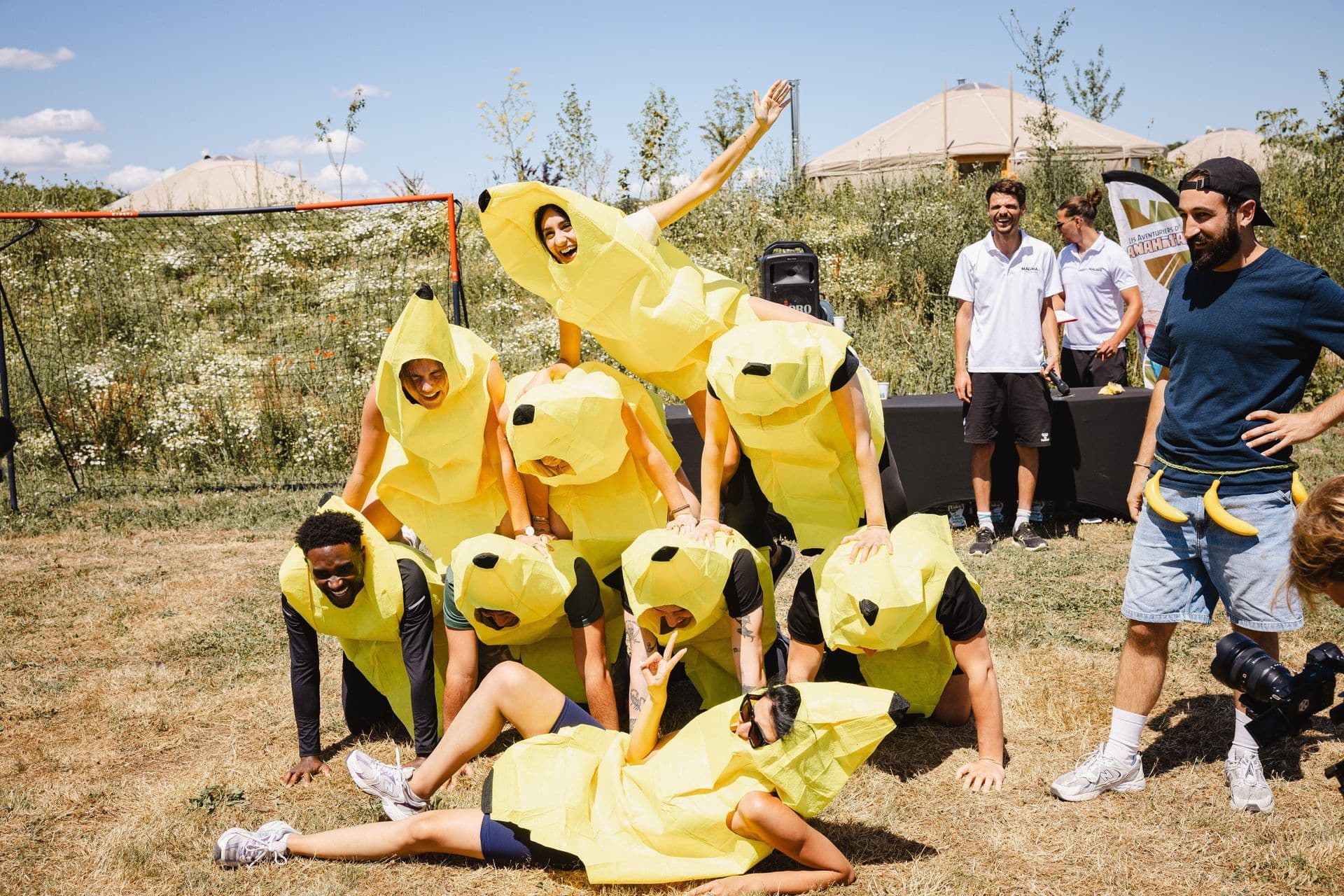
Participants in giant inflatable suits attempt to play soccer. Strategic movement becomes nearly impossible, equalizing skill levels and delivering pure shared laughter and physical release.
7. Strategy Field Operations (Capture the Flag Adaptation)
Teams spend 30 minutes in a "War Room" developing a detailed operational plan and assigning specific roles before stepping onto the field. Points go to teams that capture the flag and follow their pre-agreed strategy, emphasizing planning over athletic prowess.
8. Team Triathlon Relay (Value-Based Competition)
The triathlon includes three stages: a 10-minute brainstorming challenge (Creativity), rapid-fire company trivia (Knowledge), and a collaborative physical obstacle course (Teamwork). Competition reinforces organizational values.
9. Tactical Zone Control (Laser Tag Evolution)
Outdoor laser tag with a single designated "Commander" whose voice is amplified via headset. Teams must rely on hierarchical instruction and adapt to communication constraints under stress.
10. Sensory Deprivation Trust Hike
Teams navigate a short trail where participants rotate through being blindfolded and guided by voice commands or a shared rope. This directly targets the Trust & Empathy quadrant, requiring complete faith in your guide's judgment. Requires careful safety briefing.
11. Structural Integrity Challenge (Marshmallow Tower Redefined)
Build the tallest structure with spaghetti, tape, and a marshmallow, but the structure must withstand a simulated wind tunnel (hair dryer or fan) for 60 seconds. This shifts focus to engineering and durability, forcing teams to prototype for stability.
12. Narrative Assembly Line (Collaborative Storytelling)
Teams split into writers, illustrators, and presenters. Writers draft one paragraph, illustrators add visuals, then the next group of writers continues. This sequential process simulates organizational workflow and highlights bottlenecks between specialized groups.
13. Blueprint Relay Race (Lego Challenge Refined)
One person sees a complex Lego blueprint for 30 seconds, then verbally instructs the next person (who cannot see it) on the first 20 steps. The second person then sees the blueprint and instructs the third. This measures how accurately complex information transfers down a chain.
14. Found Sound Symphony
Teams have 30 minutes to find objects in a designated outdoor area and create three distinct instruments. They then collaboratively compose and perform a 60-second piece reflecting the team's working rhythm. This demands immediate resourcefulness and harmonious collaboration.
15. Role-Play Empathy Workshop
Participants draw cards with common workplace scenarios—critical bug during launch, scope disagreement, negative client feedback. They switch roles and act out the scenario from a different perspective. A developer plays sales, sales plays QA. This builds operational empathy.
16. Survival Priorities Debate
Assign team members fictional professional intelligence types—Data Analyst, Creative Director, Operations Manager—who must argue for their survival based on critical skills during an escalating disaster scenario. This forces strategic thinking about skill prioritization.
17. Opinion Polarization Forum (The "Hot Takes" Debate)
A facilitator introduces non-business controversial opinions: "The optimal daily standup is 4:30 PM" or "Pineapple is the best pizza topping." Participants take sides and their team crafts a persuasive defense. This develops rapid argumentation in a low-stakes environment.
18. Forced Choice Scenario Builder
Teams face difficult "This or That" choices with professional analogues: "Launch imperfectly or miss the deadline?" After choosing, they justify their rationale, revealing underlying decision-making philosophies and risk tolerance.
19. Real-Time Sentiment Mapping
Using instant digital polling tools, teams respond anonymously to strategic questions relevant to your retreat theme. The resulting word cloud or graph provides immediate, unbiased feedback and encourages dialogue on tough topics.
20. The 60-Second Feature Pitch
Teams get a common object—bottle opener, pen, whiteboard marker—and invent a revolutionary fictional feature for it. They have 10 minutes to brainstorm and 60 seconds to pitch the feature, target audience, value proposition, and competitive advantage. This hones clarity and salesmanship.
Avoiding Missteps: 3 Common Unique Retreat Idea Pitfalls
Even effective unique retreat ideas fail without proper planning. Success requires intention.
Mistake 1: Ignoring the "Why" (Lack of Debrief)
Most organizers focus only on the activity, failing to dedicate 20-30 minutes minimum for a structured debrief. The debrief is where experiential learning becomes actionable workplace insight. Ask: "What behaviors during the strategy game mirrored our recent project struggles?" or "Who emerged as an unexpected leader during the creative challenge?" Without this, the activity remains just a game.
Mistake 2: Forcing Participation or Energy
Requiring every team member to participate in highly physical or performative activities alienates introverts and those with physical limitations. Offer choice and alternative roles (scorekeeper, videographer, logistics lead) for high-energy events. Prioritize psychological safety over mandatory engagement.
Mistake 3: Over-Programming the Schedule
Retreats need unstructured time. Over-scheduling eliminates the "water cooler" moments where genuine bonding occurs. Schedule blocks of downtime—lunches, free evenings, coffee breaks—so natural connections form.
Applying the Framework: A Planning Scenario
A scaling tech company's R&D and Marketing teams struggle with communication and trust. The planning team identifies the deficit: Low Trust & Strategy.
Goal: Increase cross-functional reliance and improve tactical communication.
Selection using the Quadrant:
- Trust Builder: The Sensory Deprivation Trust Hike (#10). Physically forces immediate reliance between R&D and Marketing pairs.
- Strategy Focus: Tactical Zone Control (#9). Exposes flaws in information transmission under pressure through centralized communication requirements.
- Creative Release: The 60-Second Feature Pitch (#20). Ends the day with a fun activity that forces different departments to align on a shared outcome.
Focusing on identified deficits provides targeted solutions rather than generalized fun, maximizing ROI for these unique retreat ideas.
Measuring Success: Metrics Beyond Participation
Measure retreat success through behavioral change and team health, not just satisfaction surveys.
1. Pre- and Post-Retreat Pulse Surveys
Deploy anonymous surveys two weeks before and after. Focus on retreat objectives: "How comfortable do you feel approaching colleagues outside your team for help?" or "How clearly defined are roles during collaborative projects?" Look for statistically significant post-retreat improvement.
2. Network Analysis and Communication Flow
Track internal communication volume and diversity across departments in the month following the retreat. Increased cross-functional interaction indicates successful bonding.
3. Project Handoff Efficiency
Examine quantifiable metrics related to project execution immediately after the event. Are handoffs smoother? Have miscommunications during critical milestones decreased?
How to Choose the Right Retreat Format for Your Team's Needs
Not every team has the same dynamics or challenges. Before committing to an expensive offsite, assess your team's specific pain points, budget, and desired outcomes.
Start by evaluating primary goals. Are you strengthening cross-departmental communication, boosting creative problem-solving, rebuilding trust, or improving morale? Each calls for different structure. Teams struggling with silos might need a two-day intensive with mixed-department workshops. Remote-first organizations may find shorter hybrid formats more effective and inclusive. A 12-person startup needs different logistics than a 200-person enterprise division.
Budget and logistics matter equally when planning game changing team retreat experiences. Determine whether an offsite location is necessary or if a local venue works better for accessibility and cost. Factor in travel, accommodation, meals, and activities. Account for childcare needs or accessibility requirements. A well-budgeted retreat shows respect for actual employee circumstances.
Finally, gather genuine feedback from your team before finalizing plans. Survey employees about preferred retreat length, activity types, and scheduling. Ask about constraints. This transforms your retreat from something done to your team into something created with them, increasing buy-in from day one.
Frequently Asked Questions
What is the ideal duration for a corporate retreat focused on team bonding?
A minimum of 48 hours (two nights) is recommended. This allows time to move past superficial interactions, integrate intensive challenges, and include unstructured downtime for genuine connection.
How should we adapt activities for a hybrid or remote team?
Prioritize activities that test asynchronous communication and visual collaboration—Blueprint Relay Race or Real-Time Sentiment Mapping. Once together in person, focus on activities that capitalize on rare co-located time.
What is the most critical element of a successful team-building activity?
The structured debrief. The best activity is useless without a facilitated conversation that connects lessons learned during the game back to real workplace scenarios and behaviors.
Should we mix competitive games with collaborative ones?
Yes. Competition raises energy and exposes natural leadership. Collaboration rebuilds teamwork. Ensure competitive games are low-stakes and fun, then follow with collaborative effort to balance dynamics.
How can we ensure activities appeal to different personality types?
Structure your retreat using the Objectives Quadrant, ensuring a mix of physical, intellectual, creative, and introspective activities. Always offer alternative engagement roles and provide clarity about expected participation levels beforehand.