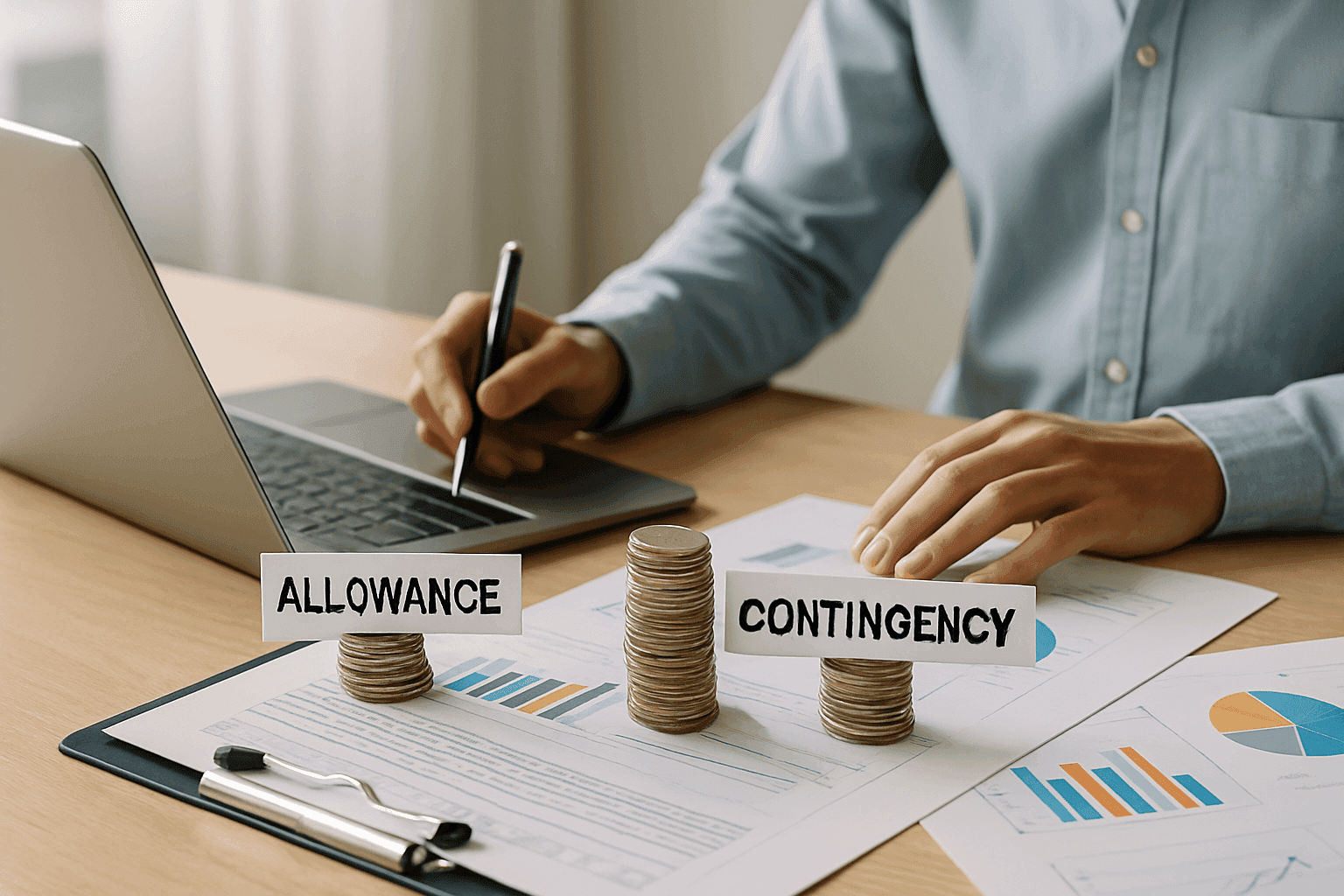
Project managers in New York, Miami, Seattle, and Denver face a familiar problem when building budgets: how to cover the known unknowns and the unknown unknowns. Two budget tools show up in almost every estimate, yet teams often mix them up. Knowing the difference between allowance vs contingency changes how you plan, talk to stakeholders, and control costs.
Understanding allowances in project budgets
An allowance is a budget line for something you know you will need but cannot price exactly yet. The need is real but the details are not decided. This comes up often in early phases when owners in Boston or Silicon Valley have not picked finishes or vendors.
Imagine a company renovating an office in Chicago. The team knows the space needs new flooring, but the facilities lead has not chosen between carpet, luxury vinyl, or polished concrete. Each choice has a different cost. Instead of stalling the budget, the estimator includes a flooring allowance based on midrange pricing for comparable Chicago projects.
Allowances act as placeholders. They let planning move ahead without forcing premature decisions that could cause costly changes later.
Common allowance categories
- Material allowances cover items waiting final selection like lighting fixtures, door hardware, cabinetry, or finish materials.
- Labor allowances estimate installation time when final products are unknown. Installing custom millwork takes more hours than modular units.
- Design allowances apply when parts of the project are still conceptual, for example a plaza water feature in a university campus in Washington DC.
- Equipment allowances cover systems where vendor choice or specs are pending, such as server hardware for an office in Austin until capacity needs are tested.
Understanding contingencies in project budgets
Contingency is different. It covers uncertainty and risk rather than still-undecided choices. Contingency funds are set aside for things that might happen, problems that could come up despite careful planning, and risks you cannot remove by design.
Think about projects in coastal cities like Miami where hurricanes and supply chain delays are real possibilities. Contingency protects the budget against those risks. A project in the Rocky Mountains might need contingency for winter weather delays and unexpected rock in excavation.
Contingency types and applications
- Design contingency covers changes during planning as architects refine drawings.
- Construction contingency pays for field surprises like hidden conditions, weather delays, or material price swings.
- Owner contingency lets the client request upgrades or additions without breaking the core budget.
- Schedule contingency converts time buffers into money for overtime, expedited shipping, or extra rentals when the timeline compresses.
The critical differences between allowance and contingency
Clear rules on allowance vs contingency cut confusion and improve communication. Allowances are specific and visible. They show up as named line items so everyone knows what the money covers. Contingencies are general reserves, often shown as a percentage or lump sum to handle whatever problems arise.
Allowances get replaced with actual costs when decisions are made. Contingency gets drawn down when risks happen. Allowances come from incomplete decisions. Contingency comes from a risk assessment that accepts surprises will occur.
Common mistakes that undermine budget control
A frequent error is treating allowances and contingencies as the same cushion. When a client in Los Angeles picks premium finishes and the flooring allowance is exceeded, some teams take from contingency to pay the difference. That leaves no money for real surprises.
Other mistakes include underestimating contingency due to optimism, failing to explain allowance limits to clients, using contingency for discretionary spending, and hiding allowances inside larger line items so they are hard to track.
The budget clarity framework: a decision model
Use four simple questions to decide if an uncertain item is an allowance or contingency. First, is the requirement certain? If no, it belongs in contingency. Second, can you define the scope? If no, use contingency. Third, is the uncertainty due to pending choices or incomplete info? If yes, it is an allowance. Fourth, will normal project progress resolve it? If yes, use an allowance. This model turns guesswork into repeatable decisions.
Applying the framework: a Seattle headquarters renovation
A mid sized tech firm in Seattle plans a headquarters refresh with workstations for 200 people, a staffed cafe, and major HVAC upgrades. Furniture for 200 employees is a clear allowance since the need and scope are known but the product choice is pending. The cafe equipment is another allowance until the food operator and menu are chosen.
The HVAC work is different. Inspections suggest ductwork may be fine but ceiling access is limited. The true condition will only be known after demolition. That is a contingency item. If the project is near the Rocky Mountains, weather delays add another contingency need.
When teams apply this framework, allowances and contingencies are set correctly and stakeholders understand what each reserve covers. For more on practical project topics, read more articles on the Naboo blog.
Measuring success: budget performance indicators
- Allowance accuracy is the variance between allowances and final costs. Large gaps mean allowances need better calibration or client expectations are off.
- Contingency utilization tracks how much contingency is released and why. Using no contingency may mean the reserve was too large or teams are absorbing issues instead of tracking them.
- Decision velocity measures how quickly selections are made and allowances are replaced with actual costs.
- Contingency drawdown rate watches how fast contingency is consumed compared to project milestones.
- Forecast accuracy compares projected final costs to current budgets as the project moves forward.
Best practices for allowance management
Document every allowance with what is included, what is excluded, and assumptions behind the dollar amount. Base allowances on current US market data and past projects in similar cities like Philadelphia or Phoenix. Communicate allowance limits clearly to clients so selections above the allowance trigger budget conversations. Track allowances separately and update them promptly when decisions are made. Set deadlines tied to milestones to avoid decision delays.
Best practices for contingency management
Size contingency with a structured risk assessment that looks at complexity, schedule length, team experience, and outside dependencies. Write down what contingency is for and require formal approval and documentation before releasing funds. Keep a log of contingency releases and separate owner contingency from project contingency so it is clear who controls each reserve. Reassess contingency regularly as risks are retired or new risks appear.
Technology tools supporting budget management
Cloud based project tools give real time budget visibility for teams across offices from Washington DC to Las Vegas. Set automated alerts for allowances nearing their limits and for contingency use that exceeds thresholds. Use historical data to improve future allowances and contingency sizing. Integrate scheduling and cost systems so that schedule impacts surface possible contingency needs early. Dashboards give leaders quick views of allowance status, contingency remaining, and forecast accuracy. For team activities tied to budgets and morale, check inspiring event ideas to help plan meaningful moments without surprise costs.
The future of project budget management
AI and machine learning are improving allowance estimates and contingency recommendations based on large US project datasets. Predictive analytics spot patterns that indicate which allowances will likely be exceeded. Building information modeling and digital twins let teams price more items early which reduces the need for allowances. Real time market feeds can update allowances for material and labor price changes. Technology helps but clear thinking about allowance vs contingency is still essential.
Implementing change in your organization
Start with team education so everyone uses the same definitions. Standardize templates that separate allowances and contingencies, use the Budget Clarity Framework, and require approval forms for contingency releases. Study past projects in your region whether that is Los Angeles, Dallas, or the Northeast to learn where allowances and contingencies failed. Set clear decision rights for who sets allowances and who can approve contingency use. Measure and report on allowance and contingency performance to drive steady improvement.
Frequently asked questions
What is the main difference between an allowance and a contingency in project budgets?
An allowance covers a known need that is not yet fully specified or priced, like flooring that will definitely be installed but where the product choice is pending. A contingency covers unknown risks that may or may not happen, like hidden site conditions or weather delays. Allowances cover incomplete decisions. Contingency covers uncertainty and risk.
How much contingency should be included in a project budget?
Set contingency based on a risk assessment. Early stage projects often need more contingency, commonly 10 to 20 percent in US practice. Well defined projects may need only 3 to 7 percent. Consider complexity, schedule length, team experience, and outside dependencies when deciding the right level.
Can unused contingency be returned to the project owner at completion?
Yes. Unused contingency usually goes back to the owner at closeout. Returning unused contingency shows good financial stewardship and builds trust for future work, though contract terms sometimes specify other arrangements.
Who decides when an allowance has been exceeded and additional funds are needed?
The project manager should flag when actual costs will exceed an allowance and raise the issue with the owner or client. The owner then decides whether to approve the extra cost, pick a cheaper option, or drop the item. Clear allowance limits make these conversations less painful.
Should allowances and contingencies be visible to all project stakeholders?
Allowances should always be visible because they are specific items waiting decisions. Contingency visibility depends on your governance. Some owners want contingency shown to build trust. Others keep contingency less visible to avoid it being treated like extra budget for scope increases. Either approach can work if rules are clear and applied consistently.