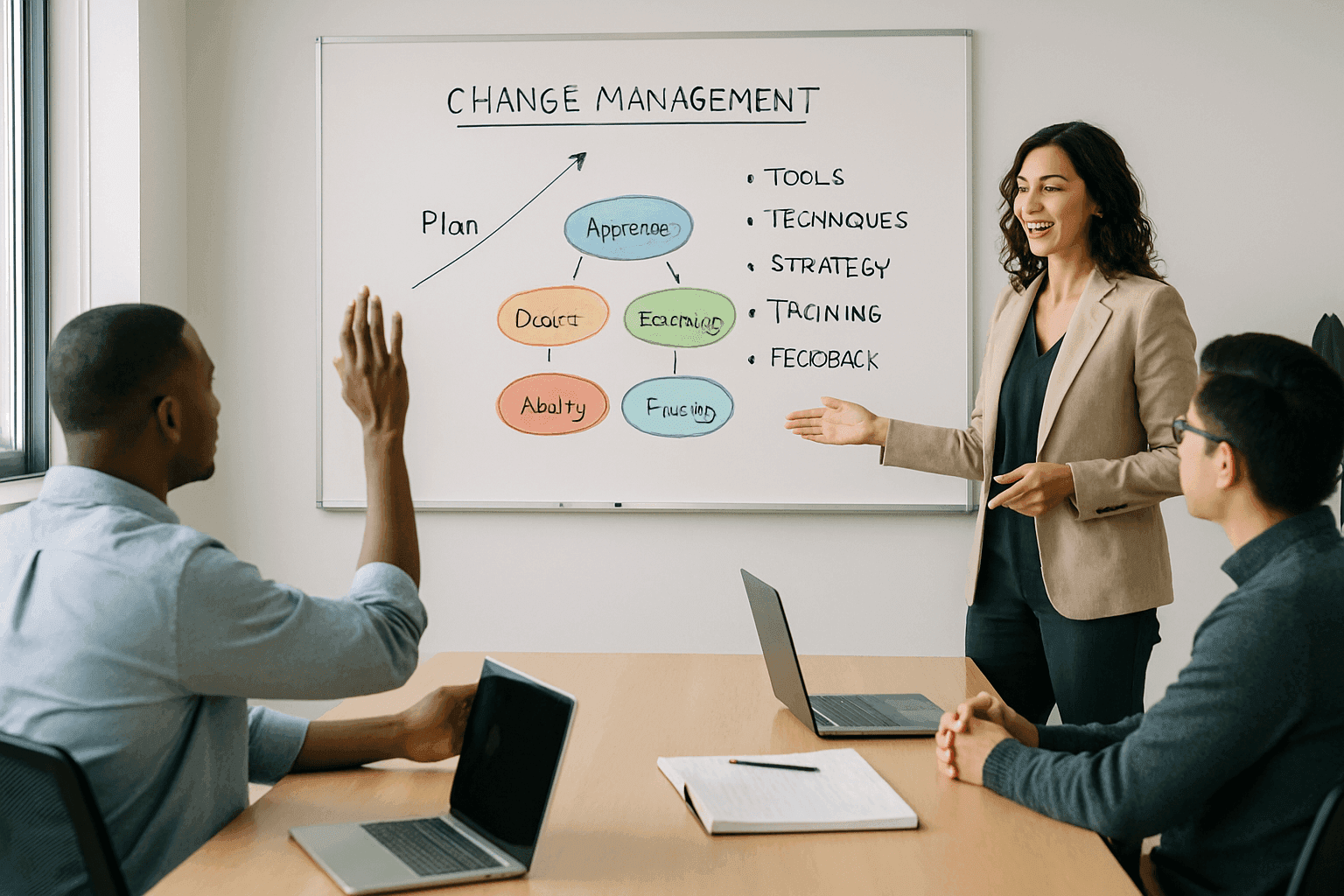
Every large US organization from a New York headquarters to a Denver operations center faces constant transformation. Cloud platforms replace legacy systems, operating models shift to meet customer expectations in Miami and Los Angeles, regulations change in Washington, and workplace culture evolves across regions from the Rust Belt to the Rocky Mountains. Most initiatives stall not because of bad strategy or weak tech, but because employees are not ready to work differently. A focused change management workshop builds the skills, clarity, and confidence teams need to make change stick.
Well-run workshops do more than present frameworks. Participants practice stakeholder mapping, draft real communication plans, role play resistance conversations, and use practical templates tied to their local context. That hands-on approach produces ready-to-use artifacts and a common language that speeds adoption, lowers confusion, and protects your investment.
Why companies run change management workshops
Companies with multiple business units and offices in cities like Chicago, Seattle, and Dallas need a consistent way to get everyone on the same page when change arrives. Without structure, employees view projects through narrow lenses and resist new ways of working. Workshops create alignment by showing how each role fits into the bigger picture and by teaching techniques that work in US workplaces.
Workshops build understanding of what change management actually does compared to project management or internal communications. Participants learn the psychology of change so they can anticipate resistance and respond with empathy. That skill set improves stakeholder conversations and helps teams keep momentum during big efforts like ERP rollouts or operational redesigns.
Beyond awareness, workshops teach practical skills such as stakeholder analysis, communication planning, resistance management, and adoption measurement. These tools lead to higher adoption rates, fewer last minute fixes, and more predictable timelines. Teams that know how to manage change lower operational risk and avoid costly delays.
Core components of an effective workshop
Good workshops follow a clear curriculum that keeps content practical and applicable. Include these core modules and tailor examples to regional needs such as frontline teams in manufacturing hubs or customer service centers in Miami.
Define change management and boundaries
Clarify how change management works alongside project teams. Project managers deliver outputs on time while change teams ensure people adopt new behaviors. Drawing this line prevents duplicated effort and improves collaboration.
Understand the psychology behind change
Discuss how people process change, why resistance shows up, and common emotional patterns across stakeholder groups. Use local examples so participants recognize the behavior you want to address.
Enterprise governance and decision flow
Teach how approvals move through the org, how risks escalate, and how progress is tracked. Use a sample approval map that fits matrixed companies with regional leads in places like Atlanta and San Francisco.
Stakeholder identification and mapping
Show participants how to create impact maps, influence grids, and stakeholder profiles. These visuals guide outreach and help teams prioritize effort where it matters most.
Communication planning and execution
Practice writing clear messages for different audiences and pick channels that people actually use. Exercises should include drafting initial emails, manager talking points, and town hall agendas tailored to local office cultures.
Resistance management techniques
Teach how to spot early signs of resistance and resolve concerns before they grow. Practice active listening, coaching conversations, and simple troubleshooting methods that work in everyday US workplaces.
Role clarity across the change ecosystem
Define responsibilities for sponsors, change champions, project managers, business leads, and front line staff. Clear roles avoid gaps and duplicated tasks.
Benefits realization and adoption measurement
Show how to define adoption metrics, track behavior change, and measure value. Encourage simple dashboards that compare adoption across regions like the Northeast and the Southwest.
Designing a high impact workshop
Design with respect for people time and different learning styles. Start with purpose and outcomes and ground examples in current initiatives, whether that is a CRM rollout in Boston or a process change for a Las Vegas call center.
Use interactive learning: small group exercises, role plays, and case studies tied to local teams. Include templates such as stakeholder maps and communication planners so participants leave with ready tools.
End with action commitments where participants name next steps and owners. That follow through turns workshop energy into results.
To see ways other teams approach workplace learning, read more articles on the Naboo blog and consider practical in-person or remote activities you could pair with training by looking at event ideas for teams.
ADAPT framework for workshop design
The ADAPT framework helps standardize workshop design. Align objectives with the initiative, Develop content that reflects your culture, Apply concepts to real work, Practice skills in safe settings, and Track results over time.
Align by getting sponsor agreement on goals. Develop by customizing examples to your decision making and communication style. Apply by having participants produce usable artifacts during the session. Practice through role play and peer feedback. Track by collecting feedback, checking tool usage, and measuring adoption in the months after the workshop.
Realistic scenario
Imagine a US retailer rolling out a new inventory system across stores in Atlanta, Denver, and Phoenix. The transformation team uses ADAPT to build a workshop that helps store managers and regional ops teams map local stakeholders, draft 90 day communication plans, and rehearse conversations with long tenured employees who prefer legacy processes. After the workshop, teams use the tools in launch meetings and tracking shows faster adoption in regions that completed the workshop.
Common mistakes to avoid
Do not treat a workshop as a single event without follow up. Skills grow with coaching and practice. Avoid one size fits all content that feels irrelevant to local teams. Keep focus on application not theory and get visible sponsorship from leaders who can reinforce the work.
Measuring success
Use participant surveys for immediate reaction, track tool usage to confirm behavior change, and measure adoption metrics in supported initiatives. Sponsor observations add useful qualitative insight. Compare outcomes between trained and untrained regions to show value.
Scaling workshops across the enterprise
Standardize a core curriculum, then localize examples for regions from the Midwest to the Pacific Northwest. Train internal facilitators with a train the trainer program and use virtual or hybrid delivery to reach remote teams without losing practical practice time.
Building a change capable organization
A workshop is an investment in practical skills that pay off across projects. When workshops are tied to learning pathways and leadership reinforces the work, teams respond to change with less friction and greater confidence. Over time this builds resilience and keeps your organization competitive.
Frequently Asked Questions
How long should a change management workshop last?
Most effective workshops run one to two full days depending on depth and roles. Executives often attend a condensed half day focused on sponsorship while project teams benefit from longer sessions that include practice. Virtual delivery usually splits content into shorter sessions to keep people engaged.
Who should attend a change management workshop?
Invite anyone with a role in supporting change such as project managers, business analysts, change champions, HR partners, communications staff, and sponsors. Role based breakout sessions help keep content relevant while building shared understanding across teams.
What is the difference between training and a workshop?
Training often focuses on knowledge transfer. A workshop emphasizes hands on application and produces artifacts like stakeholder maps and communication drafts that participants can use right away.
How do you measure return on investment?
Measure ROI with participant feedback, evidence of tool use, adoption metrics for supported projects, and business outcomes such as faster time to proficiency or fewer support tickets. Track results over 12 to 18 months to capture lasting change.
Can workshops be delivered virtually?
Yes. Use breakout rooms for small group work and collaboration tools for maps and plans. Shorter repeated sessions work better than a single full day online. Hybrid models let teams do virtual instruction and meet in person for practice exercises.