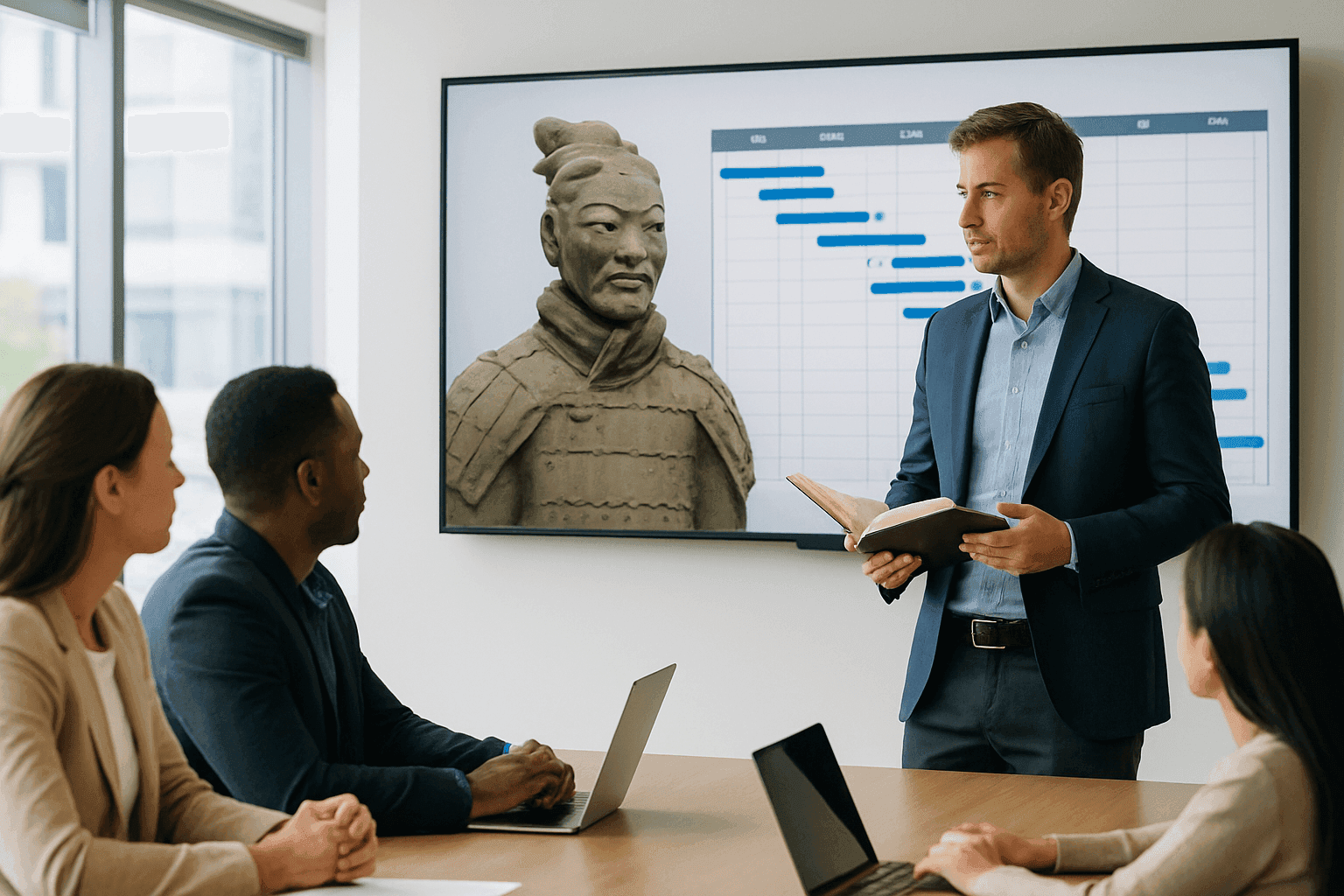
For more than two thousand years leaders have used Sun Tzu to think clearly under pressure. The Art of War is often read by military historians, but its lessons map directly to modern project work. Project managers in offices from New York to Miami, remote teams across Mountain time in Denver and Phoenix, and tech squads in Seattle and San Francisco face similar problems: tight deadlines, limited budgets, shifting priorities, and cross-functional teams that must coordinate across distances. Using Sun Tzu as a practical playbook helps project leaders plan, move, and win without burning out the team.
Strategic planning: win before work starts
Sun Tzu wrote that battles are decided before the first attack. The same is true for projects. Too many teams jump into action and confuse activity with progress. Good planning means defining what counts as success before spending a dollar or scheduling a sprint.
Start with clarity. What outcome matters to stakeholders in Washington or Chicago? Who needs what by when? Where will work stall? Teams that spend 15 to 20 percent of a project on planning usually avoid the chaos that eats the other 80 percent of the timeline.
Risk assessment is the planning backbone. Sun Tzu said commanders study terrain and weather. In projects you map politics, technical dependencies, vendor reliability, and market shifts. That lets you build mitigations instead of scrambling when problems show up.
leadership that gets teams moving together
Sun Tzu emphasized the general's role. Project managers are the general. They set direction, make choices under pressure, and keep people aligned. Strong leaders mix confidence with humility. Teams need to trust the plan and the person guiding it, and leaders must listen to the people doing the work.
Define roles clearly. When everyone knows how their work links to others, coordination becomes routine instead of chaotic. Practical tools like RACI charts and short playbooks cut confusion in fast-moving programs across offices in Boston or Los Angeles.
Make decisions fast. Sun Tzu valued speed. In city offices or distributed remote teams, slow choices create bottlenecks and missed chances. Create decision rules up front so people know who decides what and what information they need to act.
environmental intelligence: know your operating ground
Sun Tzu said knowing yourself and the enemy makes victory certain. In projects the enemy is inertia, complexity, and change. Know your stakeholders beyond titles. What keeps a VP in Houston up at night? What are customer support teams in Atlanta worried about? Treat stakeholder work as ongoing intelligence gathering, not a one-time update.
Know your team too. Honest skills inventories show real strengths and gaps. Use that information to assign the right people to high-risk work, and train or hire to fill critical holes.
Watch the market and internal shifts. A competitor in Las Vegas changing pricing or a sudden organizational restructure in your Seattle office can change project priorities overnight. Stay aware so you can adapt before small problems become big ones.
adaptive execution: flexible plans win
Sun Tzu compared strategy to water: adapt the shape while keeping the goal. Rigid plans break when reality changes. Agile methods follow this idea with short feedback loops and iterative delivery. Define direction, then refine the path as you learn.
Normalize adjustments. Teams that treat change like failure will freeze. Leaders should reward smart pivots and corrective learning, especially in cross-country projects where local feedback matters.
Keep strategy steady while changing tactics. The destination stays the same even if the route changes. That balance stops aimless drift and keeps teams focused.
speed and efficiency: move with tempo
Sun Tzu prized speed. Long projects drain budgets and people. Realistic schedules, contingency buffers, and clear workflows keep momentum. Identify where work stalls the most, whether approvals in headquarters or handoffs between remote teams, and remove those bottlenecks.
Act on good enough information. Waiting for perfect data kills progress. Train teams to judge when they have enough to move and when to pause for a deeper look.
the RAPID project command framework
Inspired by Sun Tzu, the RAPID Project Command Framework gives a simple structure to lead projects in 2026 US workplaces. The five parts help teams assess readiness, align stakeholders, and keep momentum.
Reconnaissance: Gather facts about stakeholders, risks, and resources before committing. Use stakeholder interviews in locations like Dallas offices, short risk workshops, and capability checks for contractors. Document assumptions so you can test them.
Alignment: Make sure everyone shares the same objectives, success measures, and approach. Go beyond a kickoff call. Use visual roadmaps or short alignment sessions to resolve conflicts early and build shared understanding across teams in different cities.
Positioning: Put resources where they matter most. Assign top talent to the riskiest work, like data migration or security integrations. Keep fallback options ready and plan contingencies for known risks.
Initiative: Keep offensive momentum. Deliver value early and often, communicate proactively, and solve problems before they escalate. Teams that show working results every sprint build trust with stakeholders from Atlanta to San Diego.
Discipline: Stay focused on the goal while adjusting tactics. Protect core scope, keep quality standards, and run regular retrospectives so learning sticks.
For practical examples and templates you can adapt for your next rollout, read more articles on the Naboo blog.
apply RAPID to a CRM rollout
Imagine a mid-sized company rolling out a new CRM with teams in Chicago, Miami, and the Rocky Mountain region. During Reconnaissance the project lead interviews sales, customer service, and marketing to learn real workflows and concerns. They find sales fears productivity dips during transition and service teams worry about losing historical tickets.
During Alignment the team runs workshops to set success metrics like adoption rate and migration accuracy. A visual roadmap shows which teams will be affected each phase and highlights schedule conflicts before they become problems.
In Positioning the project manager assigns the best data engineer to migration, schedules training in slower months, and keeps the legacy system read-only as a safety net. They also set up a small rapid-response support crew to handle early issues.
For Initiative the team ships working features every two weeks and adjusts quickly to user feedback. When field teams in Detroit report a clunky mobile workflow, the team implements a simplified flow instead of waiting for a big release. That responsiveness builds credibility.
Throughout, Discipline keeps the team from adding nonessential features. The manager runs weekly risk checks and monthly retrospectives so the team learns while staying on course.
If you want hands-on ways to bring teams together during a rollout, consider inspiring event ideas to keep stakeholders engaged and aligned.
common misconceptions
Teams sometimes think strategic work means endless planning. The point is not to predict everything but to set clear intent so people can make good tactical choices as conditions change.
Others mistake flexibility for chaos. Real adaptability needs a firm strategy. Without it teams drift. Give teams boundaries and goals so they can adapt without losing direction.
Some leaders take Sun Tzu literally and treat colleagues as enemies. That creates friction. The real opponent is complexity and uncertainty. Build coalitions, not turf wars.
measure victory: what success looks like
Sun Tzu expected clear victory conditions. Projects need the same. Track delivery metrics like schedule and budget, but also measure outcomes such as customer satisfaction, operational gains, and revenue impact.
Use leading indicators to catch trouble early: velocity trends, defect rates, team morale, and stakeholder engagement. Learning metrics are also vital: what assumptions failed, what worked, and what you will change next time.
risk management: find opportunity in uncertainty
Sun Tzu found chances in chaos. Treat risk as continuous. Do more than mitigate threats; spot opportunities like vendor changes or available talent and use them to accelerate value.
Build resilience through people and culture. Teams that solve problems together and feel safe speaking up handle surprises faster than teams that try to plan for every contingency.
team unity: the multiplier
Cohesive teams outperform fragmented groups. Invest in relationships so people communicate better under pressure. Psychological safety helps people raise problems early and learn from mistakes.
Ownership turns assigned work into real commitment. Involve people in planning, give them autonomy in execution, and show how their work connects to outcomes.
conflict resolution: stop internal drain
Address conflicts early. Small disagreements grow if ignored. Set norms for constructive debate and step in quickly when tensions rise.
Find underlying interests, not just stated positions. Two engineers arguing about tools may actually be worried about workload or recognition. Solving the root concern usually fixes the surface fight.
sustainable success: win without burning out
Sun Tzu preferred winning without long fights. In projects this means delivering value with minimal waste, keeping stakeholders aligned, and turning project lessons into lasting capability.
Manage stakeholders so resistance never becomes a fight. Invite input, be transparent about tradeoffs, and use focused excellence to surprise and delight where it matters most.
Capture knowledge through documentation, training, and post-project reviews so the next team can move faster. That turns each project into an investment in future wins.
frequently asked questions
how is this different from traditional project management?
Traditional approaches focus on process and plans. Applying the art of war adds continuous assessment, adaptability, and practical competitive awareness. It treats projects as dynamic efforts that require judgment and adjustment, not just process compliance.
do these ideas scale to small projects?
Yes. The same thinking applies. Scale the effort to the project size. Even a two-week initiative benefits from clear objectives, quick risk checks, and team alignment.
how do you balance flexibility with promises to stakeholders?
Commit to outcomes, not fixed methods. Tell stakeholders what you will deliver and why it matters, and update them frequently about changes in approach as you learn more.
what skills should project managers build?
Develop systems thinking, emotional intelligence, clear communication, and judgment. These skills help managers make timely choices in changing situations and bring different groups together.
how can organizations tell if this approach works?
Track both project outcomes and portfolio-level results. Look at time-to-value, initiative success rates, team engagement, and stakeholder satisfaction. Those signals show whether strategic project management is paying off.
closing
Sun Tzu gives practical ideas for modern US workplaces in 2026. Apply these principles in plain, local terms for teams in New York, Los Angeles, the Rocky Mountains, or anywhere your organization operates. Use strategy to reduce rework, keep teams healthy, and deliver outcomes that matter.