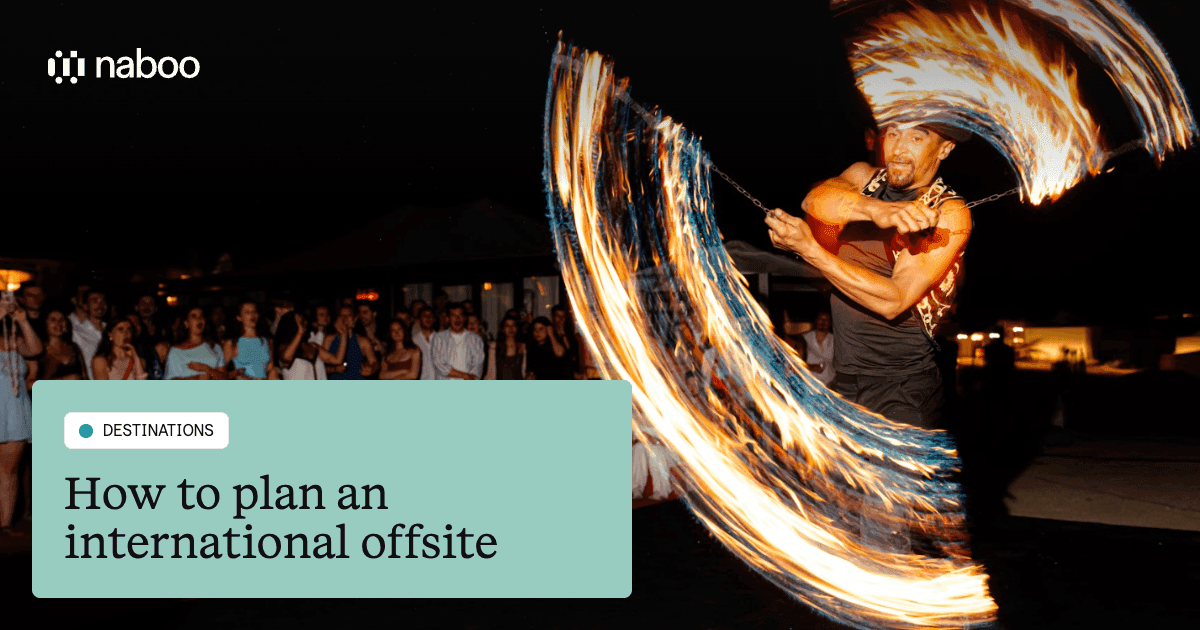
Planning an International Offsite : What it Taught Us
What Marrakech Taught Us
We plan offsites for clients all over the world, sometimes with attendees flying in from more than twenty countries. Then it was our turn: bringing together the teams from our eight offices, spread across eight countries and three continents, in Marrakech. An international company deserves an international offsite. Especially when that’s exactly what it sells. We knew how to plan the trip. We were about to find out what it feels like to wait for it.
When your job is planning other people’s events, your own offsite comes with a little extra pressure.
It’s hard to tell your coworkers the logistics are complicated. They know. Some of them spend their days making it look easy for our clients. It’s also hard to hand them a so-so agenda and hope nobody notices. You’re bringing together an entire company, a good chunk of which has a professional opinion on the subject. And the unspoken, very real right to share it with you at breakfast.
So we picked Marrakech.
The idea felt like us: bringing together a company that works remotely, spans time zones and is growing in several countries, long enough to share something other than meetings and Slack threads. Finally putting a laugh to a voice you only know from video calls. Finding out that your Singapore colleague, the one you have a standing call with every Tuesday at 9 a.m. New York time (9 p.m. for him), is a much better dancer than he is a dashboard narrator.
On paper, all we had to do was get everyone to the same city. In reality, “everyone” covers an impressive number of individual situations: different passports, flights that don’t leave on the same day, dietary restrictions, kids who need a sitter, colleagues who’d never set foot in North Africa and others who have family there.
This article is about what we learned from the other side of the table. It draws on our own offsite, but also on the day-to-day work of Naboo Agency, the team that designs and runs our biggest events: real proposals built in 2026 for 3,500 attendees in Marrakech and for a five-day, 275-person retreat in California, plus events we’ve delivered, like Ipsos BVA’s 50th anniversary (more than 1,000 employees) and Canonical’s offsite in Marrakech, where 2,200 attendees were welcomed in two waves at a fully bought-out convention center.
Each time, with the numbers, the prices and the tradeoffs hiding behind one very simple sentence: “We’re all going together.”
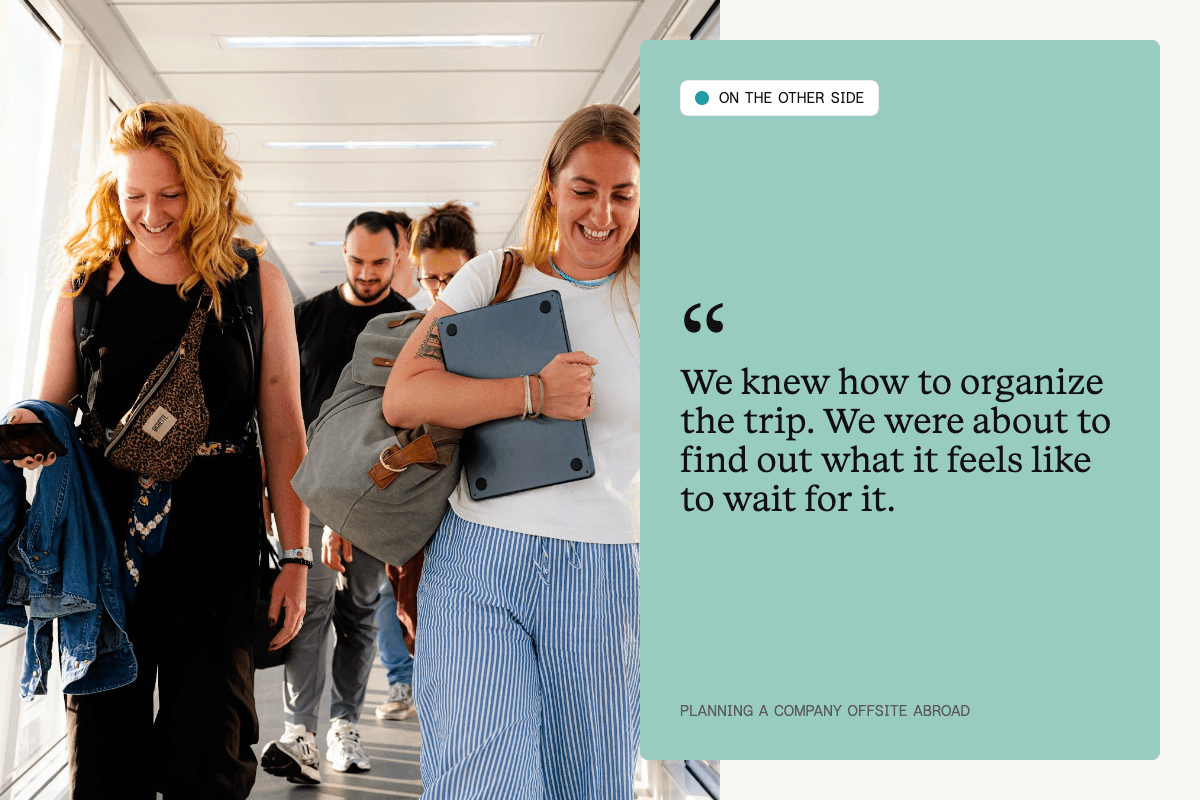
Going abroad is an adventure. And it’s completely doable.
Let’s start with the good news, the part people forget when they open the first spreadsheet: an international offsite isn’t a stunt reserved for huge corporations or fifty-person events teams. It’s a project that takes method, good partners and a real view of the big picture. Not a miracle.
First, there’s what travel gives you that no meeting room ever will. A change of scenery, literally and figuratively. Coworkers getting to know each other in a souk while haggling over the price of a teapot, instead of in a meeting haggling over a deadline. An evening where nobody checks their email because the show is happening somewhere else, under a Berber tent or by a pool facing the mountains.
Then there’s what our proposals show in black and white: scale isn’t an obstacle in itself.
In Marrakech, our team designed a three-day offsite for a client, May 7 to 9, 2027, for 3,500 attendees. No single hotel can house a group that size: the proposal splits them across four hotels with 1,241 rooms in total, all within a 5 to 10 minute walk of each other and 13 minutes from the airport.
In California, a five-day retreat for 275 people at Ojai Valley Inn, a 220-acre resort with 308 rooms, with arrivals coordinated through three airports.
In Paris, for Ipsos BVA’s 50th anniversary, Naboo Agency brought together more than 1,000 employees from three cities, housed in two hotels, for two days at the Folies Gruss, a historic circus venue.
Three formats, three scales, one logic: start with the people traveling, not with the destination.
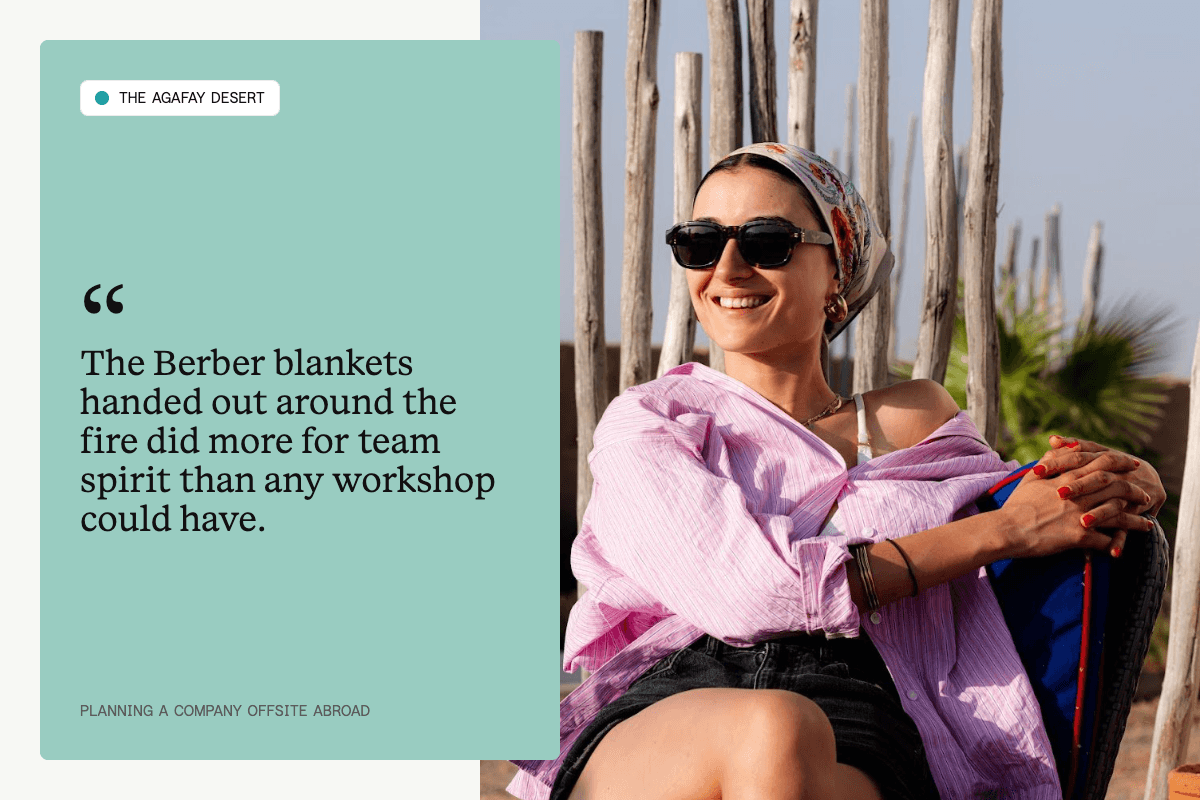
And then there’s what Marrakech taught us. When you plan for other people, you think in volumes: rooms, seats, covers. When you’re the one packing, you think in very concrete questions. What time is my flight? Who’s meeting me when I land? Am I sharing a room? Will it be cold at night? On the first night in the Agafay Desert, a good part of the London team found out that yes, the desert gets seriously chilly once the sun goes down. The Berber blankets handed out around the fire did more for team bonding than any workshop ever could.
The adventure lives in that gap. Our conviction, after experiencing it from both sides: you can embrace it, as long as you hand the complex part to people who know how to hold it together.
An international company deserves an international offsite. But where?
We plan events in Mexico, the US, France, Norway and plenty of other destinations. British teams meeting up in France, Spanish teams heading to Norway, attendees whose tickets have to be booked from more than twenty countries: international is just part of our day-to-day.
That completely changes how you pick a destination.
When everyone is flying out of New York, you can start by looking at what’s a short flight or a drive away. When your teams are spread across several continents, things get beautifully complicated. An offsite in Paris is a subway ride for headquarters and a red-eye for the US team. An offsite in London is a quick Eurostar ride from Paris and a lot less simple from Singapore. An offsite in New York just flips the problem. Headquarters becomes one departure point among many, and the question “is it far?” needs a follow-up: far for whom?
A comfortable trip for headquarters can mean a layover and an extra night for another team. A cheaper hotel can be in a destination that costs more to get to. And a late-afternoon arrival doesn’t mean the same thing for someone coming off a short flight as it does for someone who’s been traveling since yesterday.
So to plan an international offsite, we start with a map of departure cities before we ever open the hotel map. How many people are coming from each city? What routes are realistic? When can they actually arrive and leave?
Marrakech checks a box people often underestimate: the distance between the airport and the bed. In our proposal for 3,500 people, the four hotels are 13 minutes from the airport. For a group arriving in waves, that changes everything: each shuttle makes the round trip quickly, and nobody waits an hour in a parking lot for the next bus to fill up.
Compare venues like a buyer, not a tourist
For the 275-person California retreat, our team didn’t propose one venue, but four. All gorgeous. All very different once you read them through the right lens.
| Resort | Rooms | Event capacity | Nearest airport | What you need to know |
|---|---|---|---|---|
| Ojai Valley Inn (California) | 308 | Up to 400 | ~45 min from Santa Barbara (SBA) | Full buyout possible; the whole program fits on property |
| Cheyenne Mountain Resort (Colorado) | 316, across 8 lodges | Up to 600 | ~15 min from Colorado Springs (COS) | 38 meeting rooms, a private 35-acre lake with a beach |
| Rancho Bernardo Inn (San Diego) | 286, including 41 suites | 1,000 seated in the largest ballroom | ~35 min from San Diego (SAN) | Plenty of room to spare: the whole group fits in single rooms |
| Boulders Resort & Spa (Scottsdale) | 205 | Up to 300 | ~45 min from Phoenix (PHX) | Only one room fits the whole group; zero margin at 275 |
The Boulders is the perfect example of the trap experience teaches you to avoid. In the photos: 12-million-year-old granite boulders, casitas scattered across the Sonoran Desert, a 33,000-square-foot spa. On paper, a maximum capacity of 300 for a group of 275. It fits. But with no margin at all: only one indoor space can host the general session, and in January, the only available dates, the desert gets noticeably cold after dark. Our team spelled that out in the proposal and flagged the enclosed El Pedregal courtyard as the reliable spot for evening events.
The Rancho Bernardo Inn, on the other hand, offers a ballroom that seats 1,000 for 275 guests. There, the extra room isn’t a luxury: it’s the ability to move everything indoors if the weather changes its mind.
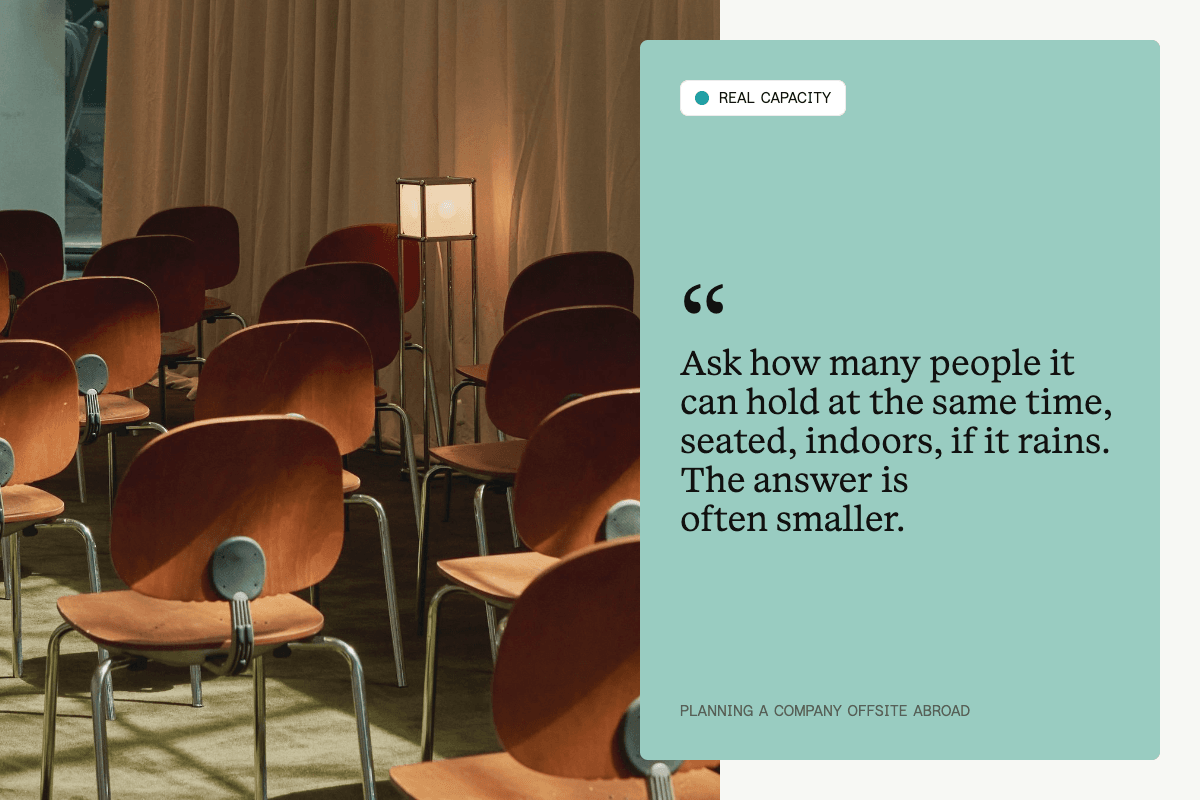
Our advice: never just ask “how many people can you host?” Ask how many you can host at the same time, seated, indoors, if it rains. The answer is usually shorter.
A few standout venues from our international catalog
The same reflex applies to the most prestigious addresses: a dreamy name tells you nothing about real capacity. Here are a few venues we know well, and what you need to know before picturing your event there.
| Venue | Destination | Capacity | What you need to know |
|---|---|---|---|
| La Mamounia | Marrakech, Morocco | 209 rooms, up to 400 people | A legendary palace hotel in the heart of the city, near the Koutoubia Mosque and Menara Airport |
| Grand Mogador Agdal 5* | Marrakech, Agdal district | 610 rooms | The largest of the four hotels in our 3,500-attendee proposal; views over the Agdal gardens or the Atlas Mountains |
| Jaal Riad Resort 5* | Marrakech, Boulevard Mohammed VI | 220 rooms | Riad style, several restaurants and bars, a full spa, indoor and outdoor pools |
| Palm Plaza Hotel & Spa 5* | Marrakech, Agdal | 232 rooms, 5 meeting rooms | Every meeting room gets daylight: a real plus for a three-hour general session |
| Rawabi Hotel & Spa 4* | Marrakech, Agdal | 179 rooms | Two pools, a hammam and flexible meeting rooms; the perfect overflow hotel for a big group |
| Atzavara Hotel & Spa | Santa Susanna, between Barcelona and Girona | 500 attendees for Bizzdesign Ignite 2026 | A three-day convention run by Naboo Agency to celebrate three organizations merging into one company |
| Palácio do Governador | Lisbon, Portugal | 60 rooms, 5 meeting rooms from about 290 to 2,100 sq ft | A palace on a human scale: perfect for a leadership team, too tight for a convention |
| Marrakech Congress Center | Marrakech, Morocco | 2,200 attendees for Canonical | Fully bought-out convention center, with teams welcomed in two back-to-back waves |
The four Agdal hotels add up to 1,241 rooms and sit a 5 to 10 minute walk from each other: that proximity, more than the prestige of any single one, is what makes a 3,500-person offsite possible.
The offsite starts long before the welcome drink
For the planner, transportation looks like a list of bookings to confirm. For the attendee, it’s already the start of the experience.
People need to know when to leave, where to show up, who’s meeting them when they land and what to do if their trip changes. Simple questions. They take up a lot of space when the answers are scattered across three emails, a PDF and a WhatsApp group where half the messages are emojis.
That’s one of the things our own trip made very real. We knew what goes on behind the scenes. And yet, like any attendee, we needed clear information without having to rebuild our own itinerary. So we put everything on a single page per person: flight, transfer, room, coordinator’s number. One delayed flight from New York was all it took to see why it mattered: at 2 a.m., a driver was still waiting for our colleagues outside the airport, name sign in hand, without anyone having to chase anybody.
For an international group, one general announcement isn’t enough. Shared information covers the agenda, the venues and the contacts. Individual information covers the flight, the transfer, the room and the activity each person picked. Both have to stay in sync when something changes. And something always changes.
What “we’ll see you at the hotel” really means
The California proposal spells out what’s hiding behind that innocent sentence. For 275 people:
Shuttles timed to real flights. Arrivals come through three airports: Los Angeles (LAX), Santa Barbara (SBA) and Burbank (BUR). Transfers are staggered to each guest’s flight time, in a dedicated fleet of coaches, never shared with other travelers.
Personal itineraries. Before leaving, every attendee picks their activities through forms in the Naboo app. The result: a personal schedule matched to their room and transfers, instead of the same generic run of show for everyone.
Instant ID on site. Group wristbands and badges showing each person’s personal schedule. At a multi-activity, multi-zone event, that’s what tells you in one second who needs to get on which bus.
A live list. A master attendee list is kept up to date throughout the event, at every transfer and every activity, across all the zone leads.
Vehicles on standby 24/7. Vans available day and night for unplanned, late-night or accessibility-related trips, plus a loop shuttle around the property so nobody misses a session because they didn’t feel like a ten-minute walk.
This is a planning proposal, not the story of an event that’s already happened. But it shows a rule we apply everywhere: everything is locked in before anyone gets on a plane. 275 personal itineraries, room assignments and the headcount for each activity are all checked before arrival.
The first fifteen minutes count double
Arrival is often underestimated. Yet it’s the moment each attendee subconsciously decides whether the trip will go smoothly. In Ojai, the first afternoon includes a welcome box, a branded travel bag, personalized wine bottles and a pop-up swag shop. Then a word from the CEO, a cocktail reception and a local band.
In Marrakech, in the 3,500-person proposal, choosing four neighboring hotels follows the same logic: an attendee who knows they can walk over to colleagues in the other hotels in under ten minutes feels like they’re at one offsite, not four parallel vacations.
Bringing the offices together isn’t enough to mix the teams
Once everyone has arrived, you’d think the main challenge was behind you. The flights are done, the rooms are assigned, the company is finally in one place. That’s actually where the real reason for the trip begins.
When you work across several countries, you can know a colleague’s role perfectly without knowing the person. You work on a project together, you see each other on video, you match a first name to a job title. An offsite gives those relationships some depth. You just have to leave room for that to happen.
In a big group, the natural reflex is to stick with the people you already know. It’s comfortable, and there’s no reason to ban it. But if every office stays in its own bubble for the whole trip, you’ve paid for plane tickets to recreate the org chart in the sun.
The agenda can help, and Marrakech offers seriously effective formats for that. Two examples from our 3,500-person proposal:
The Souk Challenge. Teams are formed, each one gets a different-colored turban, an envelope of dirhams and a shopping list for the medina. The challenges stay secret until kickoff. The winning team brings back the most goods, spends the least and does it in the shortest time. Nothing beats watching a CFO and an intern haggle together over the price of a lantern.
The Berber Olympics. In the heart of the Agafay Desert, facing the Atlas Mountains, fun, physical and brain-teasing challenges played in pairs and refereed by a camp chief. Accessible to everyone, which matters as much as the scenery.
Language matters too. A company that works in several languages has to think about the people who are less comfortable in the one used for instructions and speeches. In Marrakech, general sessions were held in English, with materials also available in French, and dinner seating was planned in advance. An unspoken rule quickly made the rounds: never eat dinner with your own office two nights in a row.
Filling the agenda is easy. Finding the right rhythm isn’t.
When you plan a trip abroad, it’s tempting to want to make every minute count. Since everyone made the trip, why not add one more activity, one more presentation, one last surprise? You quickly end up with an agenda you’d be very proud of, if attendees didn’t need to sleep.
The Marrakech catalog shows that temptation perfectly: our proposal lists sixteen possible activities, from ATVs in the Atlas foothills to wakeboarding on the lake at Atlas Gardens, karting at the Marrakech circuit, yoga in the desert, argan, bread or Berber beauty workshops, the Ourika Valley, hot-air ballooning or lunch in the desert. Plus two evenings: a Fantasia under Berber tents, with its charge of riders in traditional dress, and a private festival in the paddock of the Marrakech racetrack. Nobody does everything. And that’s exactly the point: sixteen options is a menu, not an agenda.
Five days, one story
The California proposal shows how you turn a menu into a trip that breathes. The principle: alternate moments when everyone comes together with moments when each person chooses.
| Day | Morning | Afternoon | Evening |
|---|---|---|---|
| 1 | Staggered arrivals | Check-in, welcome box, CEO welcome | Cocktail reception on the lawn, local band |
| 2 | Yoga, general session, local farmers market | 4 activities to choose from: horseback riding, jeep tour, surfing, golf | Family-style dinner, DJ, pool party |
| 3 | Sunrise hike, working sessions | 2 outings to choose from: winery visit, off-road expedition | Big outdoor barbecue, food trucks |
| 4 | Working sessions, cooking class | Free time: pool, tennis, spa | Concert, drone show, after-party |
| 5 | Brunch, closing remarks | Airport transfers, timed to flights |
Look at day 4, afternoon: free time, written down in black and white. It’s not a hole in the agenda. It’s what lets that night’s concert be a party instead of an endurance test.
In return, this approach takes precise prep: knowing everyone’s choices ahead of time, sizing the groups, organizing the transfers and assigning coordinators. An “activity of your choice” should never turn into a person nobody can place on a bus.
The destination has to show up in what people experience
Going to Marrakech only to sit in a meeting room you could find next to any airport would be a very elaborate way to move a meeting.
The place has to bring something: a setting, a cuisine, people, a different way of spending time together. That doesn’t mean piling on excursions. Every outing comes with schedules, transfers and one more thing to coordinate. Sometimes, one well-chosen local experience beats a whole day of racing from one site to the next.
In Ojai, California comes into the trip through a farmers market (wine, honey, olives), a local deli for lunch and outings rooted in the area. In Marrakech, it comes in through a mechoui under the tent, a foot-bath ritual, Jemaa el-Fna square and its storytellers.
The question to ask, for Marrakech as for every destination: what are we going to experience here that we wouldn’t have experienced by staying at the office? The answer should be more specific than “the weather should be nice.”
The budget starts from the departure cities
Comparing hotel prices gives you a first data point. For an international company, it’s only part of the equation.
You have to add travel from each departure city, baggage, transfers, any extra nights due to flight times and getting around on site. Two destinations with the same local costs can end up with very different budgets.
So a real comparison looks more like this:
| What you’re comparing | What to look at |
|---|---|
| Travel | Cost and travel time from each city, layovers, change policies |
| Lodging | Rooms needed, single or shared occupancy, extra nights, meals and spaces included |
| Transfers | Staggered arrivals, distance from the airports, private or shared vehicles, getting around during the stay |
| Program | Activities, staffing, AV, backup plans for bad weather |
| Coordination | Planning ahead of time and on site, security, special needs, a cushion for adjustments |
An activity price never stands on its own
Here are a few ballpark prices from our Morocco proposal, converted to dollars. They speak for themselves, as long as you multiply them.
| Activity in Marrakech | Listed price | What it becomes for 3,500 people |
|---|---|---|
| Guided tour of the medina and souks | About $205 per guide for 20 people (about $10 per person) | 175 guides to line up, roughly $36,000 |
| Jardin Majorelle | About $40 for the combined ticket + about $23 round-trip transportation | Roughly $220,000 |
| Spa and hammam | About $90 per person | Capacity to check well before the budget |
| Hot-air balloon ride | About $230 per person, liftoff around 5 a.m., about an hour in the air, Berber breakfast | About $805,000 and a weather forecast to negotiate with |
Three takeaways we’re always happy to share with clients:
Cost per person is misleading for big groups. Ten dollars to explore the medina is a no-brainer. A hundred and seventy-five guides to coordinate on the same day is a project in itself. At that scale, the real constraint is often local capacity, not budget.
Some experiences are built for smaller groups. The balloon ride is unforgettable. It’s not built for 3,500 people, and it depends on the wind. That’s exactly why our proposals list it as an add-on: a highlight for a leadership team or a group of top performers, not a required line in the agenda.
Read the logistical fine print. For the Ourika Valley excursion (four hours with a local guide), transportation is included from 15 people. The ATV ride lasts two hours within about 25 miles of Marrakech, gear included. Those details are the difference between a “starting at” price and the real price.
Where the savings are hiding, and where not to cut corners
This way of reading the numbers keeps you from labeling a destination “budget-friendly” too fast. An attractive room rate can lose its edge once you add several transfers or an extra night. On the flip side, a resort that houses everyone and hosts the whole program on site, like the ones we proposed in California, can cost more per night and a lot less in buses.
It also lets you negotiate on the right scope. If your headcount or dates are still up in the air, flexible cancellation and change terms are worth real money. The initial price doesn’t tell you everything about what you’ll pay in the end.
What we never compromise on: coordination, safety and a contingency for the unexpected. Those are the first lines people are tempted to trim. They’re also the ones you regret cutting the fastest.
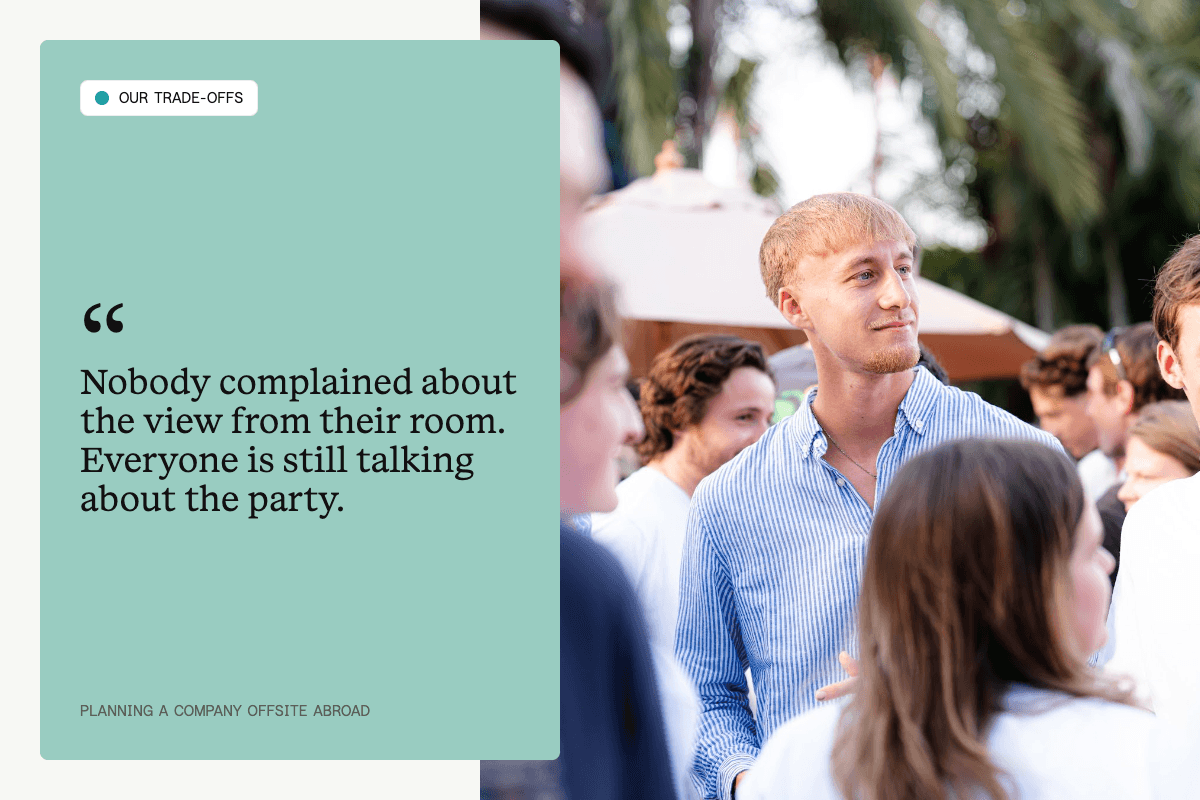
For our own offsite, we made a deliberate call: a less spectacular hotel, but a few minutes from the airport, so we could put the savings into one big shared party and some free time. Nobody complained about the view from their room. Everybody still talks about that party.
Trust the right people
An international event brings together trades that don’t naturally work on the same calendar: transportation companies, hotels, restaurants, AV crews, guides, Fantasia riders, yoga instructors. Each of them can deliver flawlessly without the whole thing working.
That’s the job of coordination: connecting all the pieces. If a flight lands late, someone has to know what that means for the transfer, the welcome, the dinner and the seat at the table. If an activity runs long, someone has to push back the buses that depend on it. That someone has to exist, have a name and a phone that picks up.
One lead, a team around them
The Ojai proposal makes that structure very clear:
A Lead Producer, a dedicated Naboo event manager, who runs operations for all five days. A single point of contact, responsible for everything from arrivals to the last airport transfer.
A technical production specialist, for the stage, sound, lighting and the LED screens for the concert and after-parties.
Four coordinators and event managers, one per zone or activity track, backed by an on-the-ground team dedicated to transportation flows: meeting the shuttles, gathering attendees, making sure nobody gets left behind.
Around them, the things you don’t see that put everyone at ease: medical staff on property for the entire program, including the concert and late nights; city permits and coordination with the fire department and police when needed; a contingency fund and emergency protocol for weather, medical incidents or last-minute changes.
Not every offsite needs a team like that. But every offsite needs to know who’s holding the big picture.
Complexity doesn’t start at the border
Our references show it. For Ipsos BVA’s 50th anniversary, Naboo Agency brought together more than 1,000 employees from Paris, Lyon and Toulouse, housed in two hotels, for two days at the Folies Gruss. Same country, and the coordination work was already huge. Attendees rated it 5 out of 5, and Hélène Duong, their head of communications, put it this way: they had asked for an unforgettable 50th, and they got “pure magic.”
Adding international departures brings other constraints: time zones, currencies, local partners you need to know before you need them. In Marrakech, they’re the difference between a Fantasia and a Fantasia done right: the venue, the riders, the performers, the mechoui, the campfire and the bus ride back at a reasonable hour.
What it felt like on the other side
We know what it takes to prepare an offsite. We know the quotes, the headcount changes, the attendee lists and the agendas reworked until the last minute. But there’s a difference between knowing that work and depending on it being done right.
In Marrakech, we did what we ask our clients to do: let go of what other people handle better than us on the ground. On day two, a storm threatened the outdoor lunch. We only found out afterward: the on-site team had already moved the meal under a tent and pushed the shuttles back forty minutes. That day, we were attendees like everyone else, and that’s exactly what we’d come for.
When you work with Naboo, having an event manager on site is part of the turnkey events option. It’s a level of support to decide on when you scope the project, not the night before departure.
International trips get planned one person at a time
Eight offices in eight countries don’t add up to eight identical administrative situations. Where someone works doesn’t tell you, on its own, which documents will let them travel.
Before confirming bookings, entry and transit requirements have to be checked based on each person’s nationality, documents and itinerary, with official sources. Flight times and hotels don’t do much good if someone can’t board. Our advice: run that check before you lock in the destination, not after the invitation has gone out.
The same care applies to individual needs: accessibility, dietary needs, mobility constraints, ability to take part in a physical activity. An ATV ride in the Atlas or a camel trek in the Agafay makes a fantastic memory, as long as everyone can pick an alternative without having to explain themselves. That’s also why accessible vehicles appear in the California proposal right next to the coaches. That information gets collected early, with a named contact and proper handling of personal data.
This work feels far from the creative side of the event. And yet it decides who will actually get to enjoy it.
Look at the carbon footprint at the group level
For a company spread across several continents, the environmental tradeoff also means stepping outside the headquarters’ point of view.
You have to compare the trips of every attendee, using the same calculation method, then look at the alternatives: another destination, the train when the route allows it, less travel on site, or several group gatherings rolled into one. On that last point, the logic of a resort where everything happens on property, like Ojai or Cheyenne Mountain, also cuts down on bus miles during the stay.
To run that first comparison, our carbon calculator is free. You enter the number of attendees, distances, length of stay, meals, mode of transportation and lodging, and it gives you the event’s CO₂ footprint in total and per person, with ideas for reducing it. Try two or three destinations: the gap between them often says more than the absolute number.
A longer stay doesn’t make travel emissions disappear. It can free up more time for working together, but it adds nights and services. The decision has to be looked at as a whole.
So the case for bringing an international company together deserves to be spelled out. What do we need to do together? How often? What format justifies the planned travel? In Marrakech, our project met a real need for our teams to meet. That intention matters, but it doesn’t excuse us from looking at what it took to make it happen.
In Marrakech, we were also the people being planned for
You understand the value of clear information differently when you’re the one waiting to leave. The value of an organized transfer when you’ve just landed. The value of a well-paced agenda when you finally want to talk to that colleague you usually only see on video.
That’s what Marrakech gave back to us: the point of view of the people who will live what we prepare. We pulled off bringing our teams together. Above all, we understood our clients’ expectations better. Behind a request for a destination, rooms or activities, they’re trying to create a moment that matters for their company.
If we had to sum up what we learned, on both sides of the suitcase, it would come down to a few rules:
- Start from the departure cities, not the destination.
- Ask for real capacity: seated, indoors, if it rains.
- Multiply every price by your headcount before you fall in love with an activity.
- Leave some white space in the agenda. That’s where connections happen.
- Name one person who holds the big picture, and trust them.
An international offsite is still an adventure. That’s the whole point. But an adventure doesn’t have to be improvised. An international company deserves an offsite that lives up to the connections it needs to build. And sometimes, to understand your own job even better, you have to get on a plane and sit in the seat of the people you do it for.
That behind-the-scenes work is what Naboo Agency does: eight areas of expertise behind a single point of contact, from design to logistics and on-site management, local partners in more than 30 countries, and every venue, restaurant, hotel and transfer checked in person before attendees leave. If your next adventure is starting to take shape, that’s where it all comes together.
Sources: Naboo Agency proposals “Votre prochain événement d’entreprise, Marrakech” (3,500 attendees, May 7 to 9, 2027) and “Your full exclusive 2027 Corporate Retreat” (275 attendees, California); references from the Naboo Agency page (Ipsos BVA, Bizzdesign, Canonical); venue listings, destination pages and the carbon calculator on naboo.app, accessed November 9, 2026. Prices are ballpark figures from proposals and subject to change; Moroccan prices were quoted in euros and converted at roughly $1.15 per euro, then rounded. Totals for 3,500 people are calculations based on those prices, not quotes.