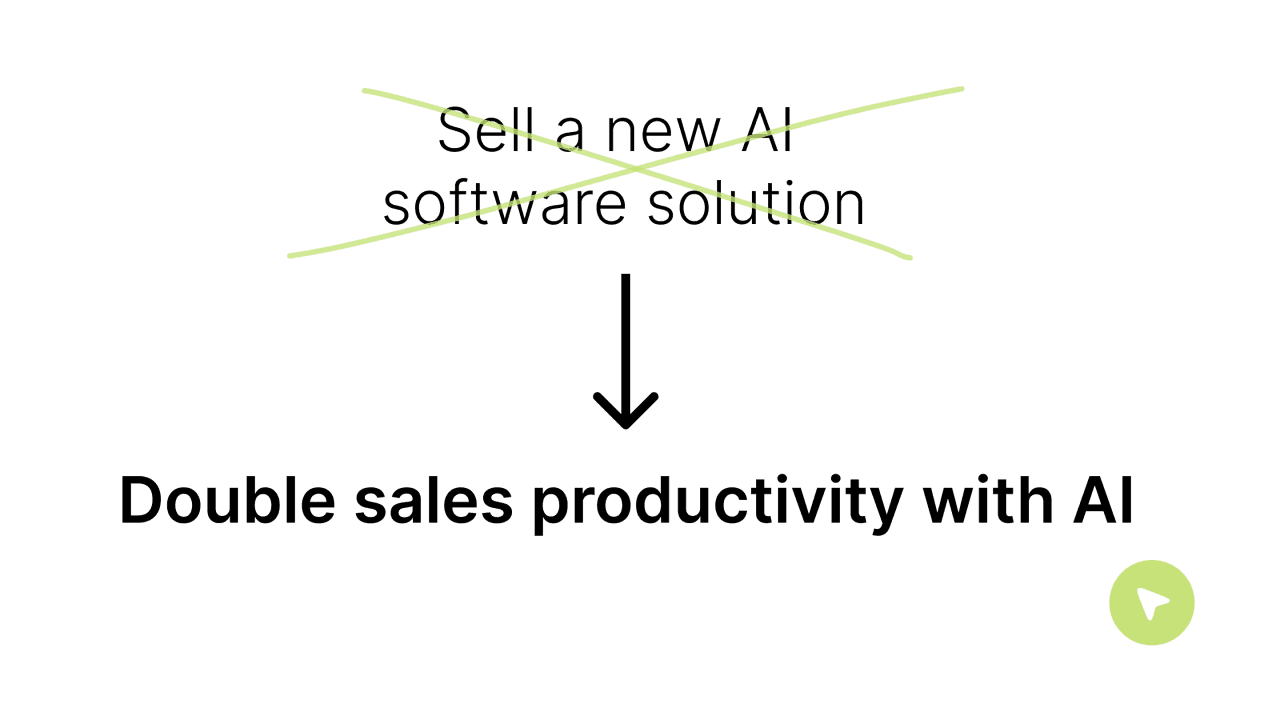
AI is not a product category. It took us €200k to understand that
In my last post I mentioned that we killed a product that was actually working. Several people asked why we built it in the first place. This is the long answer.
A real problem, and the obvious answer
Naboo is one of the very few players that covers all of a client's events under one frame contract. The €200 team dinner and the €5M annual seminar, same vendor, same promise. It's a big reason clients sign with us. It's also expensive: a lot of those events are small, and a Sales spends nearly as much time on a team dinner as on a €10K seminar.
So the problem was clear and it was ours: become far more efficient on the long tail of small events, without dropping the promise.
By early 2026, AI was already running inside Naboo. In our search, in how we qualified requests, in how we matched briefs to venues. And at the time, one model of success was everywhere: Cursor, Lovable, Gemini. AI-first software, a strong interface, users who come on their own. We had just raised $70M, we had the data, the partner network and the technical skills.
So the answer looked obvious: give clients an AI that lets them handle the small events themselves, and free our Sales for the big ones.
Right problem. Wrong path. That's the whole story.
What the AI Planner did
With the AI Planner, we went after the clients who wanted self service. They described their event to a chatbot, and the chatbot took it from there.
Not a search engine with a chat window. A planner. It advised on how to organise the event, challenged the brief when something didn't add up, read the partners' conditions and explained what mattered in them, and negotiated the quotes. The kind of support a client usually gets from an experienced Sales, delivered by software, end to end.
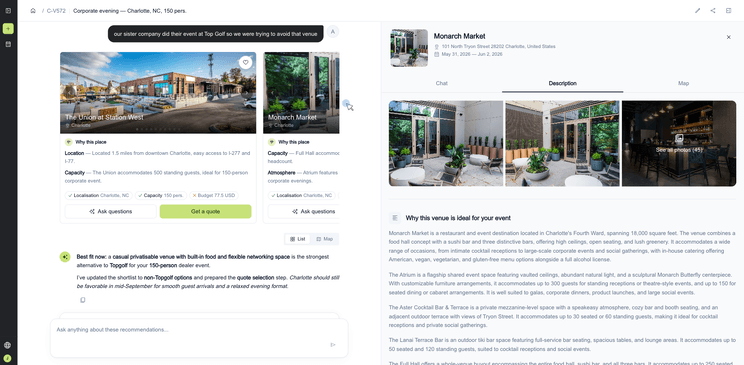
Everything it knew about what a good event looks like came from the discovery interviews we ran with our clients and prospects. They told us what they expected from a proposal. We built that into the product.
Three months and €200k of development after launch: 4,000 users, 17,000 conversations. On paper, it was a success.
It worked, on the wrong side of the problem
It even sold. Hundreds of events went through the AI Planner, small ones, exactly the segment we were aiming at.
But the data told two different stories, one per client type.
Our marketplace clients, the ones without a corporate contract, used it and spent little. Self service attracts the clients who want to pay less, and the average basket stayed well below what our Sales close on comparable events. Our Enterprise clients used it too, and kept asking for the same thing: could someone at Naboo take it from here. They had signed a frame contract precisely so that they wouldn't have to handle their events themselves, the small ones included. A very good tool was still handing them the work.
Neither segment gave us what we were after. The first one wasn't worth serving with a Sales. The second one didn't want anything else.
The question we should have started with
Then the founders laid out where Naboo was going: Service as a Software. Not a platform where clients organise their events. A company that organises them, with software doing most of the work. Against that, the AI Planner was on the wrong side. So I asked Maxime Eduardo, our CEO, to stop it and put the same intelligence behind our Sales instead of in front of our clients. He said yes.
The hardest part wasn't the pitch. It was telling the developers who had built the AI Planner that we were stopping. I expected disappointment. I got the opposite. The same team moved to the new challenge, more excited than they had been for the first one. The product was gone, the team and everything it had learned went straight into the next one.
Doing AI doesn't tell you what to build. It's a capability, not a product. The market shows one shape, the AI software with a great interface, because it's the shape that raises the biggest rounds. For a service company, the answer is probably not giving a software to your client.
The question we should have started with was already the right one, we had just answered it from the wrong side. If AI is going to make Naboo more profitable, how does it make each Sales handle more events, small ones included, without losing the service? Revenue per FTE, not users per month.
An AI in front of the client competes with their attention. The same AI behind a Sales removes the problem: the small event gets handled at the cost of a few minutes of Sales time, the client keeps the person they signed for, and we price the service, not the software.
That's the product we build today. How we built it, and what it changed for our Sales, is the subject of one of the next editions.
Three things the AI Planner taught us
Three things we learned from its users and kept. They apply to any AI product you put in front of people who don't work in AI all day.
1. Users don't know what to ask next
Early on, conversations died after one or two turns. A brief, a shortlist, and the user left. Not because the answer was bad. Because they had no idea what a good follow-up question was.
So we made the AI Planner suggest it. After each answer, a few next steps: narrow the budget, change the region, add a team-building activity, check availability. One click and the conversation moved. Messages per conversation tripled.
The AI had to carry the conversation. The user wasn't going to.
2. Not everyone works in Claude all day
The one I underestimated the most.
We assumed our users were comfortable with agentic tools. Our clients are from startups to large corporates, and a lot of them use AI the way most people do: occasionally, for a specific task. They don't think in workflows or agents. Every AI-forward feature we were proud of was one more thing for them to interpret.
3. Split view is for people who are already in
We used the layout everyone was using: the Lovable-style split screen, conversation on one side, live result on the other.
It works for a developer deep in their code for hours. It doesn't work for an office manager planning a seminar between two meetings. When the user is not fully engaged in the project, two panes to follow at once is not power, it's cognitive load. We simplified, and it helped. But the gap in engagement didn't go away, because it wasn't a design problem.
Read together, the three say the same thing. Our clients didn't want to operate an AI. They wanted the result. The AI Planner kept asking them for a level of engagement they never signed up for. The twin doesn't ask them for anything.
AI is not a product category
Could we have gone straight to the twin? Technically, yes. But the strategy wasn't decided when we started, and building for clients gave us three months of conversations with them about what a good proposal looks like. That knowledge, the search and the quote system all moved into the twin.
€200k bought one lesson: your AI doesn't have to look like everyone else's. It has to do the work your company promises.