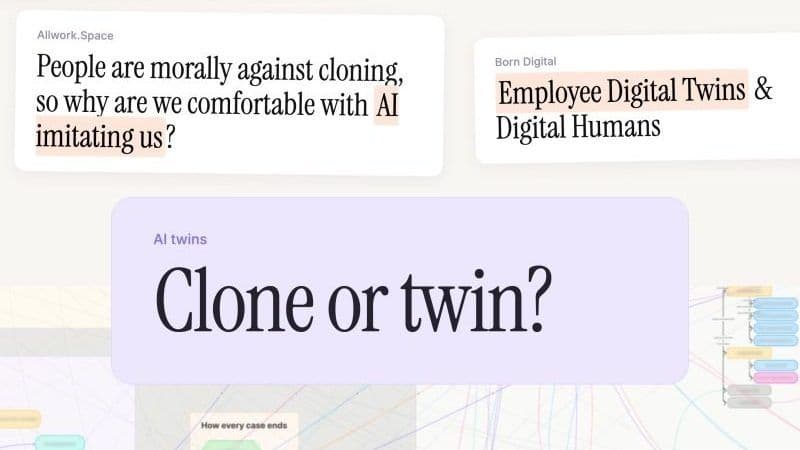
AI twin or AI clone? What we are learning building a twin of how a team works
An AI clone copies one person: their voice, their style, their output. An AI twin mirrors how the work gets done: the decisions, the rules, and the handovers, usually for a whole team. People use the two terms as if they mean the same thing. They do not, and the difference shapes what you build.
Sasha Briffaux, Data/AI Product Manager at Naboo, is the product manager on our AI Brain and is building a twin for our Supply team. Here is what that work is teaching us.
What is the difference between an AI clone and an AI twin?
A clone is about one person. It learns how someone writes and speaks, then produces more output that sounds like them. That is how the headlines frame it too: executives cloning themselves, an AI double already at work.
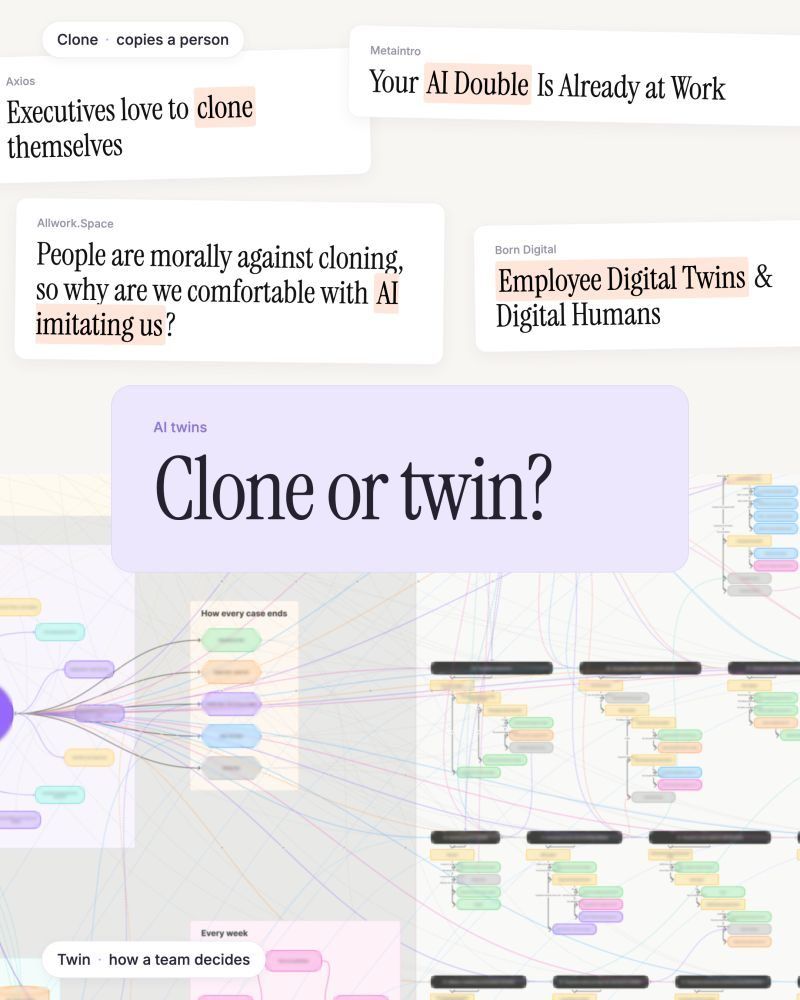
A twin is about a team. It maps how a group actually decides: which rules they apply, in what order, and when a case moves from one person to the next. The output matters less than the reasoning behind it.
So the useful question is not "can AI copy me?". It is "can it learn how we decide?"
Why we build a twin, not a clone
At Naboo, AI works behind our teams rather than in front of our clients. We explained why in AI is not a product category: our clients want the result, not another tool to operate. A twin fits that choice. It carries the way a team works, so the people in that team can spend their time where judgment matters.
A clone of one person only scales that person. A twin of how the team decides supports everyone in it.
What building a twin for a team teaches you
No single person holds all the rules
As Sasha Briffaux, Data/AI Product Manager at Naboo, says:
"No single person holds all the rules. They're spread across the team, and the twin needs all of it."
If you interview one expert, you get one view of the work. The full picture only appears when you map how the whole team handles its cases, including the exceptions each person knows and nobody wrote down.
Mapping how a team decides is the real work
Sasha put the difference in effort plainly:
"Copying how someone writes is easy. Mapping how a team decides is the real work."
Style shows up in every message. Decisions do not. They sit in the steps between a request and an answer, and they have to be made explicit before a twin can follow them.
A twin has to know where it stops
On limits, Sasha is clear:
"A twin has to know where it stops, and who to hand over to."
A good twin handles the cases it understands and passes the rest to the right person. Knowing its boundaries is part of the design, not an afterthought.
The team owns it
And on ownership:
"The team owns it. When their judgement and ours differ, theirs wins."
The people who do the work every day are the reference. When the twin and the team disagree, the team is right, and the twin is updated.
Context is designed, not collected
Earlier in the same week, Sasha wrote that context is designed, not collected. A twin is what you get when you do that work: you do not pour every document into a model and hope it finds the rules. You decide what the team knows, how it decides, and where each case ends, then you build that in on purpose.
Questions to ask before you build an AI twin
- Which team's decisions do you want to support, and who in that team holds which rules?
- Have you mapped how a case moves from request to answer, including the exceptions?
- Where does the twin stop, and who does it hand over to?
- Who owns the twin, and how does the team correct it when it gets something wrong?
Frequently asked questions
What is an AI twin?
An AI twin is a model of how a team works, including the decisions it makes, the rules it follows, and the handovers between people. It is built for a whole team, not to copy one person.
What is the difference between an AI twin and an AI clone?
An AI clone copies one person's voice, style, and output. An AI twin reflects how work gets done across a team, including its decisions, rules, and handovers.
Is an AI twin the same as a digital twin of an organization?
The ideas are close, but they are not the same. A digital twin of an organization models how a company's processes run. An AI twin, as we use the term, applies that idea to how one team decides, so AI can support that team's day-to-day work.
Who should own an AI twin?
The team whose work it mirrors should own it. They know the rules best, and when their judgment differs from the twin's, theirs wins.