
Tail Spend: Too Complex to Manage, Too Big to Ignore
A small expense has one big advantage: it can fly under the radar. A few thousand small expenses have exactly the same advantage, and a very different price tag. At Naboo, where we help companies get their savings and spend under control, we surveyed 88 procurement leaders to understand why this slice of spend stays so hard to manage, what it really takes to handle it and how to start getting a grip on it.
Ask any procurement team whether all those scattered small purchases deserve better management. You’ll have a hard time finding anyone who says no.
Now ask who owns it, with what resources and what targets for the year. That’s where the conversation gets interesting.
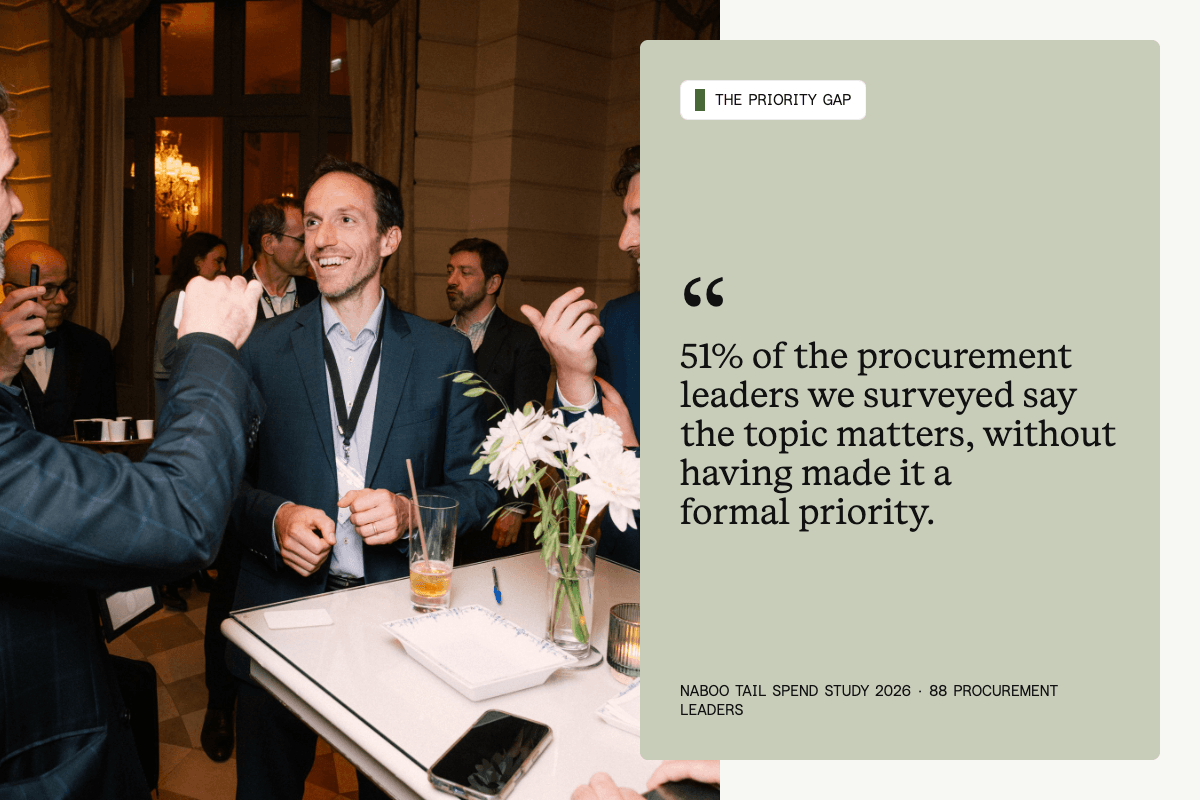
In our Tail Spend Study 2026, 51% of the procurement leaders we surveyed say the topic matters, without having made it a formal priority. Only 28% rank it among their top five strategic priorities for 2026.
That gap says a lot. Everyone knows the problem exists. But to put resources behind it, you have to be able to explain what it costs, what you stand to gain and who’s going to do the work. With tail spend, those three answers rarely live in the same place.
“Small purchase” doesn’t mean “little work”
Tail spend is the long list of low-value or infrequent purchases that sit outside your big, structured categories. It’s often linked to Class C purchases, although the scope and thresholds vary from one company to the next.
It might be a maintenance call, a training session, a rush print job, a software subscription or a one-off consulting engagement. Different needs, raised by different people, with suppliers whose only common ground is showing up in your accounts payable.
From a procurement team’s seat, the tradeoffs make sense. You start with the multimillion-dollar contracts, the critical suppliers and the negotiations where you can show results. The $1,400 request can wait. Then another one shows up. And another.
Each order stays small. The work it takes to find a supplier, onboard them, get the purchase approved and process the invoice doesn’t necessarily shrink at the same rate. The quote gets smaller. The form usually keeps the same number of boxes.
Laurence Laroche, a former chief procurement officer at companies including La Poste (France’s national postal service), Rockwool and Verallia, pointed out in our interviews that this focus on the big-ticket items naturally leaves tail spend on the sidelines, even though its combined cost and the risks that come with it can be significant.
For me, that’s where the problem starts: we prioritize based on how much we spend, when part of the problem is how much work it takes to spend it.
Everyone owns a piece. Who’s looking at the whole thing?
In 28% of the responses to our survey, each category buyer manages their own share of tail spend. In 22%, nobody is clearly in charge. So one response in two describes ownership that’s either scattered or missing.
Splitting it up isn’t necessarily a problem in itself. A specialized buyer may be best placed to handle the small requests in their category. But someone needs to be able to see what’s happening across the whole company: how many suppliers are in play, which purchasing channels are being used and which tasks keep repeating.
Pascal Pelon, who spent more than fifteen years leading procurement at AXA, summed up the paradox in our interviews: because tail spend is everywhere, it ends up being nobody’s responsibility.
Finance has a direct stake in fixing it. Setting up supplier records, processing invoices and making payments all tie up their teams too. Yet only 19% of respondents say their finance leadership treats the topic as a priority shared with procurement.
Naming an owner is a start. Giving them access to the data, allies in the business and the authority to change how things get bought is the essential next step. Otherwise, you’ve mostly handed them a problem everyone will now be delighted to forward their way.
The cost is real. It just doesn’t have its own budget line.
Asked “Have you ever calculated the cost of processing your small suppliers?”, 38% of procurement leaders say no. Only 27% say they’ve run a dedicated internal study.
Under those conditions, it’s hard to make the case for an investment. You know how much you spend, but much less about the time it takes to make that spend possible: collecting information, checking documents, creating accounts, resolving discrepancies and chasing people down.
Among respondents who gave an estimate, the median cost of setting up a new supplier comes to about $700 (€600), and the annual cost of managing one to about $575 (€500). Those figures are based on 43 and 36 responses respectively. They’re benchmarks from the survey, to be tested against each organization’s own processes.
To put that in perspective, applying the $575-a-year assumption to 2,000 suppliers comes to roughly $1.15 million in management costs. At 5,000 suppliers, the math reaches about $2.9 million. That’s not an extra invoice the company receives. It’s an estimate of the resources tied up in keeping things running.
And be careful about what you call savings afterward. Cutting admin work can free up time without immediately cutting payroll. That time has value, but Finance will be right to ask what happens to it: a shorter backlog, more requests handled, more capacity for strategic sourcing?
So the first job is to measure a few real transactions. How many people touch a new supplier setup? How much time do they spend on it? Which requests need several rounds of back-and-forth? That gives you a far more useful baseline than a theoretical cost applied across your entire supplier base.
Visibility doesn’t start with a dashboard
Lack of visibility and control tops the list of challenges in the study, at 26%, ahead of compliance risks and process costs, both at 21%.
You could conclude that what’s missing is a reporting tool. But before you can display the spend, you have to be able to recognize it.
The same service can be recorded under several descriptions, paid by different entities and filed under different categories. On the flip side, a single supplier can sell several types of services. So their name alone doesn’t always tell you what was actually bought.
To get a first usable view, you have to group purchases around shared data points: supplier, type of service, amount, entity, requester and purchasing channel. On a limited scope, that work already lets you separate recurring needs from truly one-off purchases.
That distinction matters. If ten teams regularly buy the same service, there may be room to consolidate it or set up a preferred supplier. If the ten purchases are all different and one-off, the priority is more likely to make them easier to process.
Without that work, you can produce a beautiful chart. You’ll just know, in more colors, that you’re still missing information.
One single channel for everything? Good luck.
Tail spend covers needs that are far too different to force them all down the same path. Buying a monitor, bringing in a technician and selecting a consultant don’t call for the same information or the same level of expertise.
Our survey reflects that range. Respondents could select several channels:
| Channel used for small purchases | Share of respondents |
|---|---|
| Direct purchase by users, with no central process | 37% |
| Internal marketplace or punch-out catalog | 31% |
| Corporate card below a set threshold | 30% |
| Consolidator for one-off suppliers | 26% |
| Standard procurement process, regardless of amount | 23% |
Having several channels side by side can make perfect sense. The trouble starts when nobody knows which one to use, or when the data collected no longer lets you track purchases together.
A clearer setup starts with a rule the requester can understand: for this kind of need, here’s the path, the approvals required and who to call when something doesn’t fit.
A catalog can work for standardized products. A preferred supplier panel can make certain expertise easier to access. Specialized support can handle a more complex category. The paths differ, but the ownership rules and tracking data need to stay consistent.
And you have to look at what the person buying actually goes through. If the official process takes three days for a need they can solve in twenty minutes, they’ll find another way. Before calling it a discipline problem, it’s worth understanding what the process really asks of them.
Why not just hire someone?
Lack of internal resources is the top reason given for why tail spend gets so little attention, cited by 39% of respondents. But 24% also say the ROI isn’t high enough compared with other priorities.
The two go hand in hand. The topic takes work, while the benefits are hard to prove before you start.
Hiring can strengthen oversight. It doesn’t automatically make handling every small request by hand sustainable. And the new hire isn’t going to become an expert in industrial maintenance, legal services and marketing procurement between two meetings.
So you have to decide what deserves specialized attention and what can be standardized. A recurring, well-defined request doesn’t need to be rebuilt from scratch every time. An unusual, sensitive or technically complex service deserves more attention, even if the amount is small.
The dollar threshold is still useful. It works better when you add the nature of the need and the risk involved. A small purchase might, for instance, give a vendor access to company or customer data, or involve work at a sensitive site, which brings security, privacy and anti-corruption due diligence into the picture.

AI gets interesting when you know what you’re asking it to do
In our survey, 49% of procurement leaders are exploring AI for tail spend without a concrete plan. 18% have a pilot underway and 6% say they’re already using it in production.
The interest is clearly there, as Deloitte’s 2025 Global Chief Procurement Officer Survey also shows. Getting to execution is another story.
To start in a useful way, you need to pick a specific task: categorizing spend lines, pulling information out of a request, spotting missing documents or preparing a bid comparison. Then you can measure the time saved, the errors and the checks still required.
AI also needs rules. Which information is mandatory? Which criteria let you compare two proposals? When should a buyer be brought in? If nobody knows who approves a purchase, AI won’t settle the disagreement by reading the documents faster.
Olivier Villard, CPO of Mexens, stressed the productivity gains AI brings in our interviews. With tail spend, that’s the heart of it: reducing the work needed per request lets the team take on purchases it used to have to leave on the table.
That’s where I see the real value. You can expand the service you provide without multiplying the admin work at the same rate. Experts keep their time for judging a proposal, handling an exception or negotiating what deserves to be negotiated.
Pick a first battleground where you can prove something
In the study, Meetings & Events, professional services and maintenance each received 23% of first-place votes among the categories that contribute most to tail spend. Marketing and communications follow at 18%, then IT at 12%.
Those results give you leads, but the right place to start depends on your organization. You have to weigh the size of the spend against your real ability to improve it.
| Category | First question to ask |
|---|---|
| Maintenance and operations | Which needs are recurring, and which depend on the technical constraints of each site? |
| Professional services | Can you build a relevant supplier panel without losing the ability to pick specific expertise? |
| Marketing and communications | Which services come up often enough to be standardized or consolidated? |
| IT | Which purchases can go through an existing catalog, with the right technical approvals? |
| Meetings & Events | Can you bring sourcing, approvals and supplier admin together in a single path? |
I’d start with a category where you can get to the data, bring in a business owner and test a change on a defined scope. Picking the biggest line item doesn’t help much if nobody can help you understand what’s in it.
The goal of the first project is to produce results solid enough to decide what comes next. That means a measured starting point, a clear way of working and requesters who are genuinely involved.
Corporate events make the point clearly
At Naboo, we obviously have a point of view on this category. Mostly, it gives a concrete example of what a pile-up of small requests can add up to.
In the model built from our client data, €1 million (about $1.15 million) in Meetings & Events spend breaks down into 218 events, with a median of about $1,600 each. When everything is booked directly, the model assumes roughly 174 new supplier accounts created per year.
Combining avoided processing costs and procurement levers, the business case estimates a gross annual value of about $255,000 (€220,000), assuming full centralization. Roughly half comes from procurement levers, and the other half mostly from avoided admin work.
That result is still a model, and it depends on its assumptions. But it shows why it’s worth looking at the price of the service and the cost of buying it at the same time. If you want to see how that works in practice, from budgets to deposits and invoices, take a look at how Naboo helps you manage your MICE spend.
Before you sign up for savings, agree on how they’re calculated
Performance-based pricing can make it easier to get a project off the ground. You still have to define what counts as a result.
Is a price drop measured against the first quote, the last purchase or a comparable offer? Is the scope the same? Are the partner’s fees deducted? How much spend actually flows through the new channel?
At a minimum, I’d separate three kinds of value: savings on purchases, external costs avoided and internal time freed up. All three can justify the project, but they don’t show up the same way in the books or in the team’s workload.
For a pilot, a handful of metrics is enough to make the conversation concrete:
- The share of in-scope purchases that actually go through the intended channel.
- The time it takes to process a request, back-and-forth included.
- The number of new supplier setups avoided.
- Price differences for comparable services, after fees.
- Exceptions and pain points reported by requesters.
Adoption matters as much as theoretical potential. A setup that performs brilliantly on paper but handles a small fraction of purchases will deliver a small fraction of the expected results.
Those observations are what let you expand the scope, fix the process or pick another category. And then you’ll have something more useful than agreement in principle: proof that a different way of handling these purchases works.
Almost everyone already agreed that tail spend deserves attention. The next meeting should be about what you’ve actually changed.

About the study
Naboo’s Tail Spend Study 2026 is based on a survey conducted in June and July 2026 among 88 procurement leaders from 75 organizations across 12 industries, supplemented by interviews with Laurence Laroche, Pascal Pelon and Olivier Villard.
Response bases vary by question: 84 respondents for purchasing channels, 82 for the category ranking, 43 for the cost of setting up a supplier and 36 for the annual cost of managing one. Multiple-choice questions can total more than 100%.
The Meetings & Events business case uses aggregated, anonymized Naboo client data covering April 2025 to September 2026. It presents a modeled gross value, before solution fees and internal rollout effort. Survey and model amounts were collected in euros and converted to US dollars at roughly $1.15 per euro, then rounded.
Read the full study: “Tail Spend: too complex to manage, too big to ignore.”