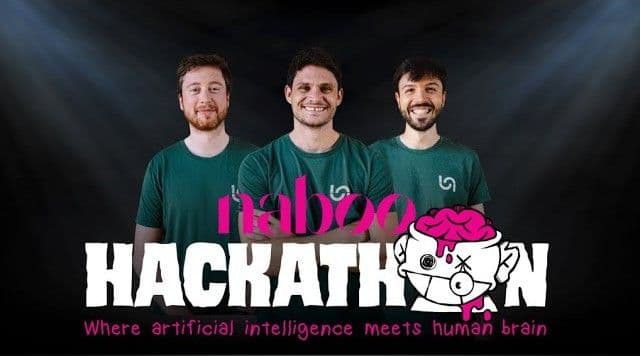
Last year, as Halloween approached, our CTO Jean-Louis came to me with a request that was original and, for the season, perfectly timed: organize a hackathon, the first in Naboo's history.
We liked the irony immediately. We were about to talk about artificial intelligence at the time of year when people play with fear, monsters, and whatever hides in the dark. At the time, AI still felt like that to some of our employees. Everyone was talking about it. Some were already using it every day. Others were watching it move fast without really knowing what it would change in their jobs.
Rather than organizing another talk about why they should care, we chose the opposite: stop talking about it for a few days and build with it instead.
Three days. Seven teams. Developers working on the concrete problems of Marketing, Sales, Finance, Supply, and the other teams at Naboo. One mission: find something their colleagues hated doing and make it disappear.
That is how the hackathon began.
Want to see how it felt? Watch the film of those three days on our YouTube channel: Hackathon Naboo 2025.
AI was moving too fast to stay a Tech topic
In the age of AI, every company is dealing with a shift whose scale is still hard to measure. It is closer to the move from the typewriter to the personal computer than to a small software update, except this time the change does not take twenty years. In some cases, a few months are enough for a way of working that felt normal to start looking outdated.
What was once a topic for technical teams has become a question of productivity, organization, and company culture. With agents entering the picture, it is no longer enough to ask employees to use ChatGPT or another tool. You have to look at the work itself and ask what still deserves to be done by hand, what should disappear, and where people truly add value.
So Jean-Louis did not come to me with a Halloween idea. He came with a problem.
"We're talking about AI a lot, and we really think it can be a solution for us, because we have a very time-consuming activity."
Jean-Louis Villeminot, CTO at Naboo
Naboo wanted to speed up AI adoption and become an AI-native company. Behind that goal was another one that mattered just as much to me: bringing the tech team back to the center of the company and having it work directly with the business teams.
When a company grows quickly, departments build their own walls. Sales knows frustrations that developers never see. Finance may spend hours on a manual process nobody else notices. Marketing builds its own workarounds to deal with a repetitive task. And sometimes, only a few meters away, someone already knows how to automate half the problem.
The hackathon was built to break down those walls for 72 hours.
One tech team, one department, one problem to solve
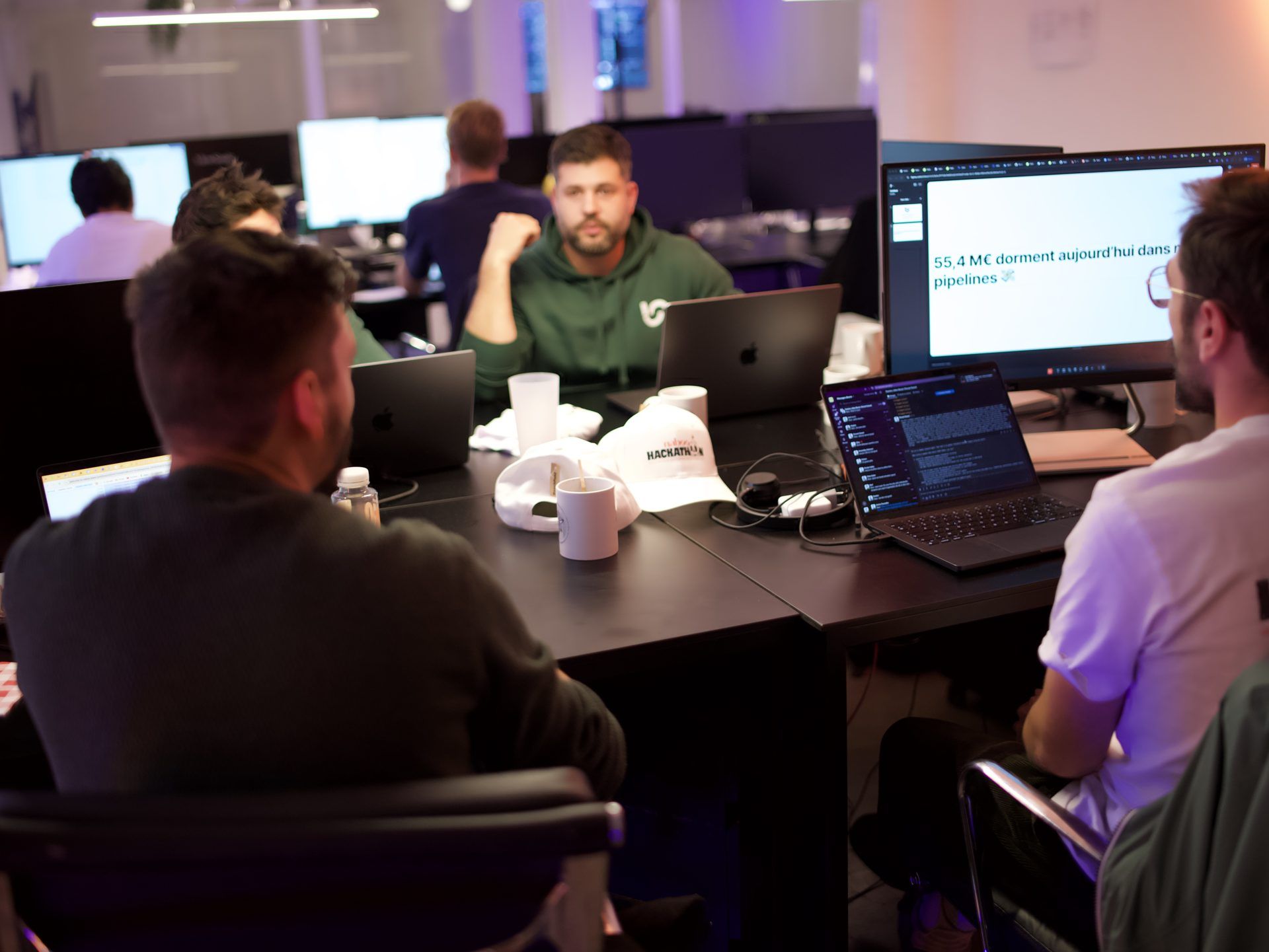
We divided the tech team into seven groups, each one paired with a Naboo function. The rule was straightforward: learn how that team works day to day, find one real source of friction, and build a solution in three days that the whole company could see in a demo.
Lucien described the setup clearly during the event:
"All the teams are related to an aspect of the job here, and all the teams are experimenting with new AI solutions to bring their creativity, to bring new solutions to their teams."
Lucien Bredin, CPMO at Naboo
Before we wrote a line of code, we started with listening.
The first morning was spent talking with the business teams over breakfast. What takes up your time every day? What are you still doing by hand? Which task makes you roll your eyes when it lands on your desk? Where do the pointless back-and-forths happen? What creates friction between two departments?
Those questions are less flashy than asking what we could invent with artificial intelligence, but they lead to better products.
We did not want to start with a striking technology and then search for a use. We wanted to start with a plain pain point, something daily and familiar, sometimes so old that no one thinks to question it anymore.
That is also where the hackathon did something I had not expected: for three days, Tech became the center of gravity at the company.
"We feel that we are really the priority of the company during these three days. We can ask anything about anything to anyone at any time."
Alice, Developer at Naboo
Then the clock started.
And suddenly, our developers became as competitive as our Sales team
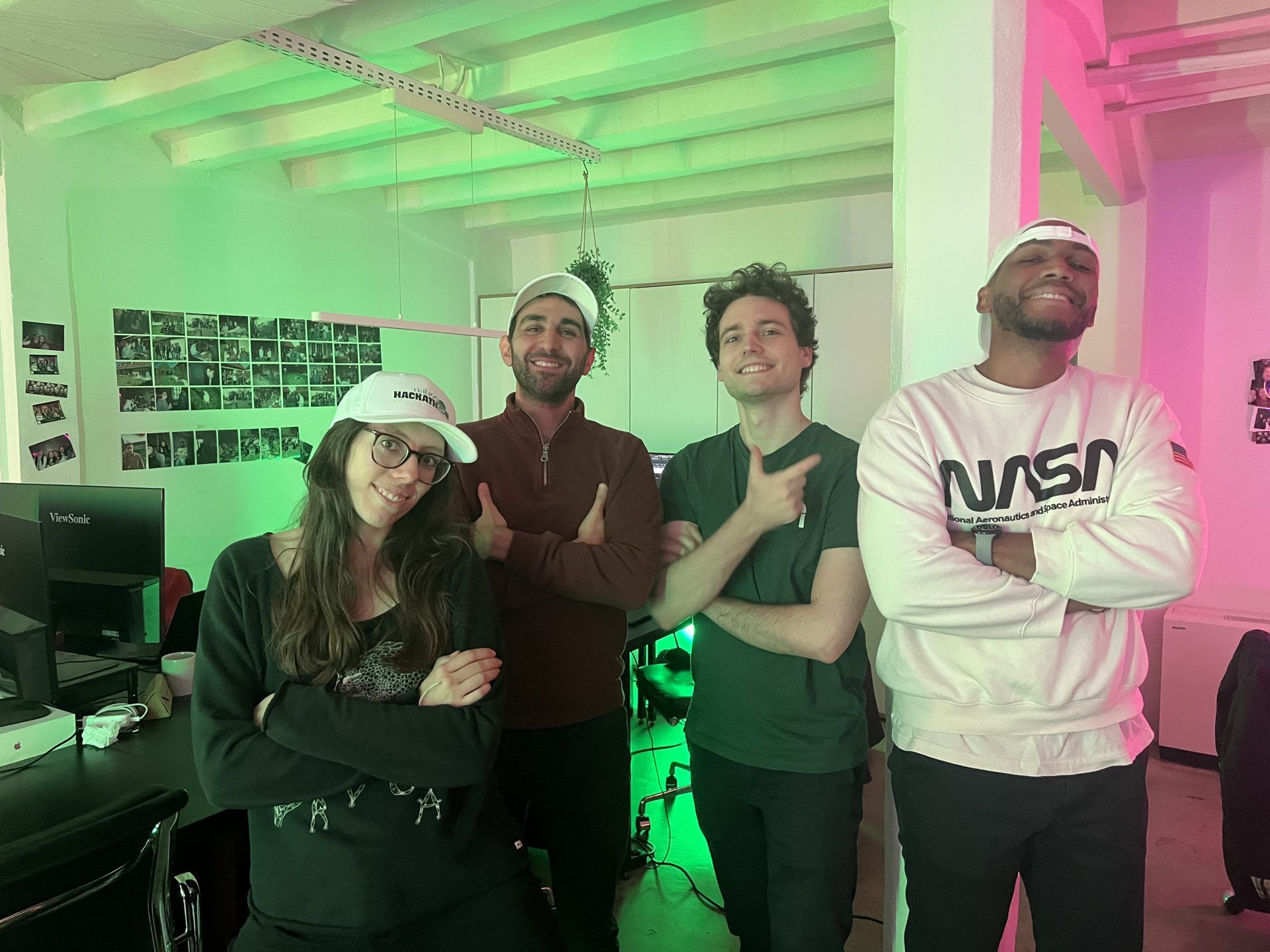
People often assume tech teams are calmer, more rational, and less drawn to competition.
Give them 72 hours, a trophy, and six rival teams, and that idea disappears fast.
Once the problems were set, the office turned into a nonstop workshop. People built, tested, deleted, and started over. A feature imagined in the morning could be gone by the afternoon. An idea that looked secondary could become the core of the project a few hours later.
As the final gong got closer, the mood changed too.
"We don't want to stay on the same level, we always try to go further."
Basile, Senior Developer at Naboo
That is what I like about competition when it is used well. It brings out an energy that a simple objective in Notion never does. First you want to finish. Then you want to do better. Then you see what the team next door is building and, suddenly, you want to win.
The hackathon had found its engine.
Our job was to keep it running for three days.
If you want people to stay, make them want to stay
Asking employees to work intensely for 72 hours is easy enough on a slide. Getting them to stay in the office after the normal workday is over is another matter.
That is where Field Marketing came in.
Our job was not just to manage a schedule, order food, and set up a few tables. We had to make the office a place people wanted to spend those three days, even if they were not developers.
The stakes were even clearer in a world where so many of our work habits were built remotely.
"In a world where there is remote every day, this is amazing to see our teams gather for the first time."
Maxime Eduardo, CEO at Naboo
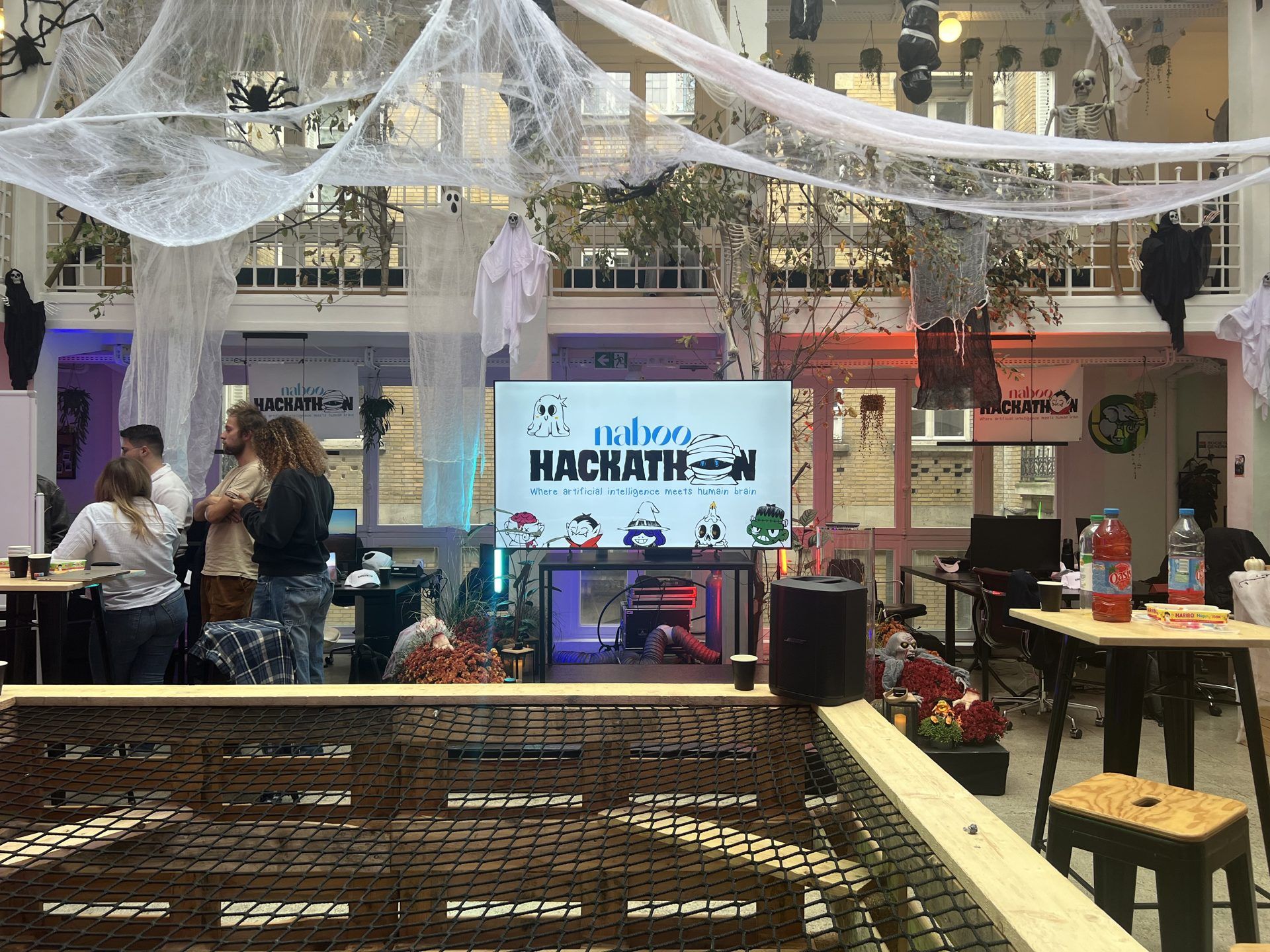
We put a significant share of the budget into the venue. And when I talk about Halloween decorations, I do not mean three plastic pumpkins, two spider webs bought the day before, and an orange light in the entrance.
If we wanted employees to see those three days as different, we had to start by making the setting different.
With the set design and decoration teams we also work with on Naboo Agency events, the office got a full makeover. You had to walk in the morning into a place where you work all year round and feel, for a few seconds, like you were somewhere else.
That conviction has only grown since: the setting gives people permission to change how they act. An office that looks exactly like it did yesterday puts people right back into yesterday's habits.
Art direction is not packaging, it is part of the event
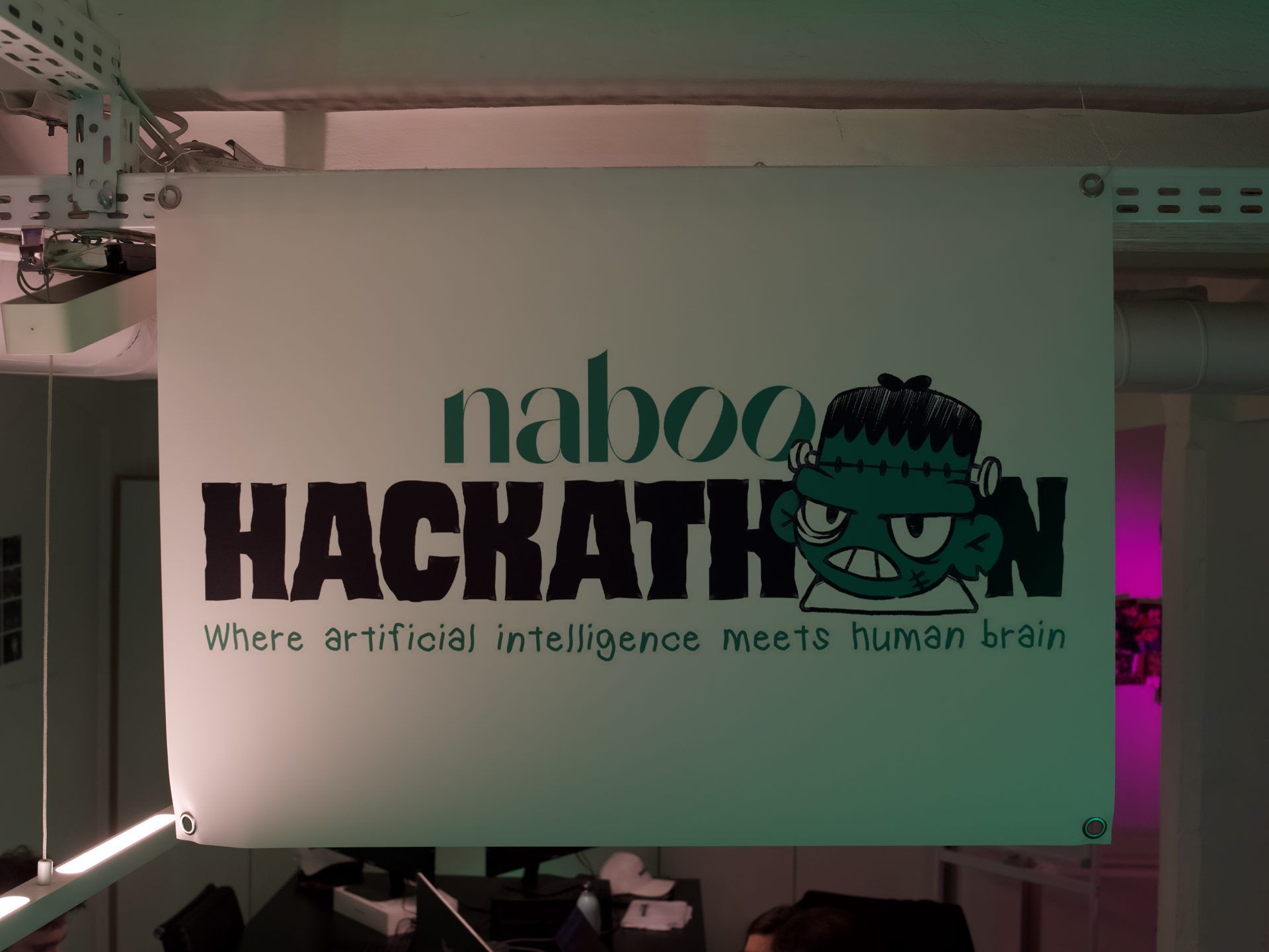
We carried that logic through to a real identity for the hackathon: "Hackathon Naboo 2025: Where AI meets human brain".
Halloween gave us a strong setting. Little monsters, a look specific to the event, colors, and above all a different identity for each team. The Naboo Studio created the logos, flags, materials, merch, and everything that helped each group start seeing itself as a camp.
The office spaces were marked out. Colors and neon lights made the teams easy to tell apart, T-shirts and caps extended their identities, and little by little, three days of work took the shape of a real event.
This is still something I see too often underestimated in internal events. Art direction is not the thin coat of paint you add once everything else is done. It is what gives the memory its shape.
So we did not want to put a logo on a T-shirt.
We wanted to create a world coherent enough that, months later, a single image would be enough to take participants back to those three days.
Above all, don't leave Tech alone in the dark
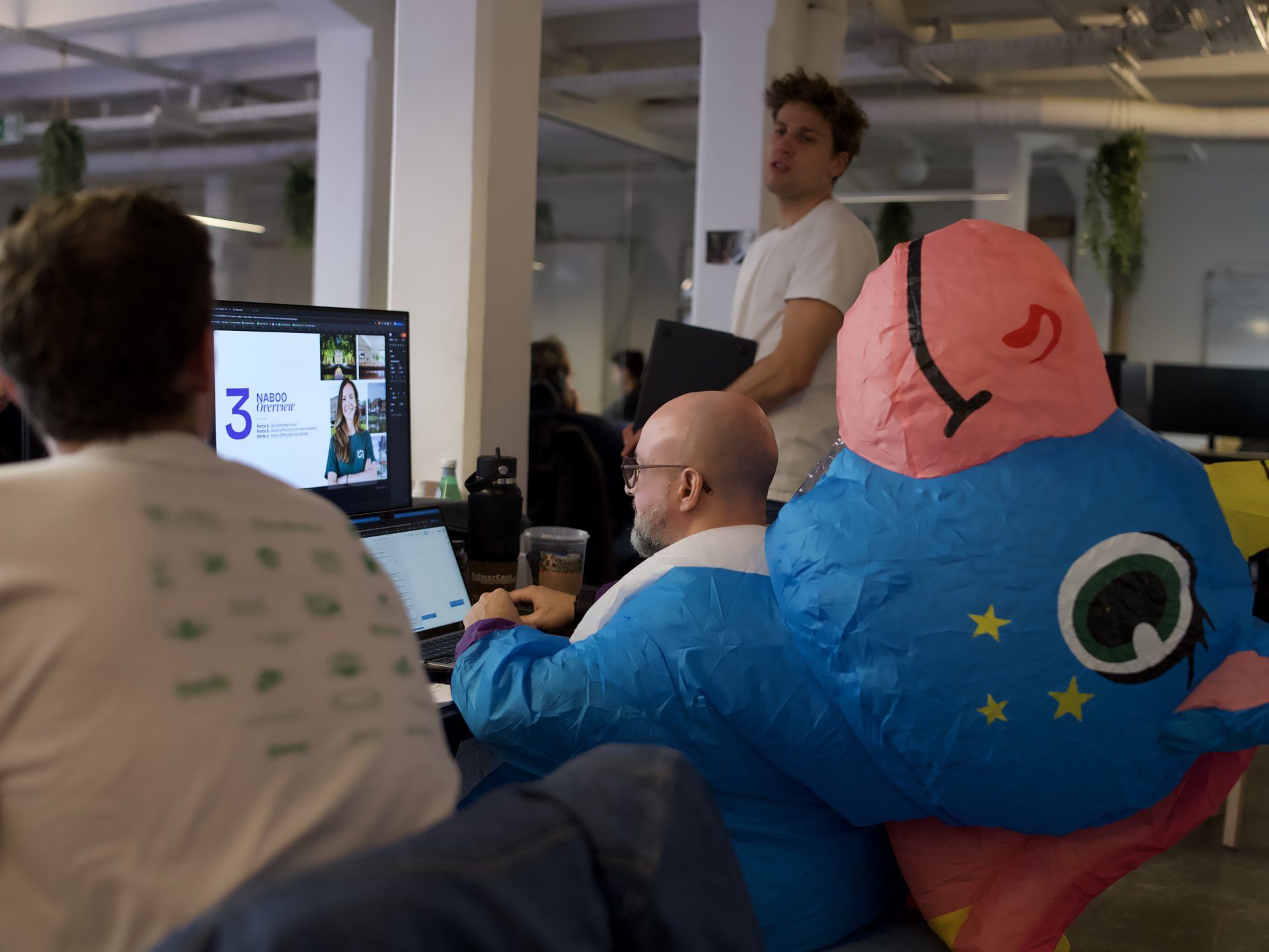
A polished set means little if, at 7 p.m., the office clears out and fifteen developers are left eating cold food in front of their screens.
We wanted the hackathon to belong to the whole company from the start.
So we gave people reasons to stay even when they were not working directly on a project: giant foosball, ping-pong, darts, Jenga, Connect 4, consoles, buffets, a sushi night, a quiz night, and video games. The point was not to pad the schedule. It was to turn the office into a place people used for a few days, not just a place they passed through.
Salespeople could stop by to see their tech team. Finance team members could come back to talk through a feature. Someone could stay for dinner, play for twenty minutes, then return to check on how their department's project was moving.
That is the moment the hackathon stopped feeling like a Tech event.
"There are no rules, and this is what I love! I see sales people, HR people, finance people going to their tech team, giving them ideas, sharing things, discovering what the tech team has done."
Maxime Eduardo, CEO at Naboo
Having people around the teams also changes how the work is seen. Developers are no longer building something that will sit in a roadmap for three months before anyone talks about it. The people who will use the solution are a few meters away, watching it take shape and reacting right away.
Jérôme, a senior developer, said it plainly:
"They are working as if it was not only a job, but something bigger."
Jérôme, Senior Developer at Naboo
How do you win?
A competition has to answer one question fast: how do you win?
If people cannot explain the rules in a few seconds, the format is too complicated.
For us, the rule was simple. Each team had 72 hours to build the strongest solution that improved the day-to-day work of the department it was paired with.
On the final day, teams presented live to a jury of industry experts. The project had to work, and it had to solve a problem important enough to deserve life after the event.
The prize also had to keep people in it until the end: a night in one of our partner hotels, trophies, merch, and the recognition that comes with a strong demo in front of the whole company.
Then comes the part anyone who has taken part in a hackathon knows well. Time runs out. A feature breaks. Someone wants to add one last thing. The demo has worked for three hours, then stops working fifteen minutes before you go on stage.
In the middle of all that, the team next door looks calm. That is usually the most worrying sign.
"The tech team is very ambitious: we want to build things, and we want to build them fast."
Jean-Louis Villeminot, CTO at Naboo
Then Jean-Louis rings the final gong.
We stop building.
We start showing.
A successful hackathon should not die on Monday morning
This is the point I care about most.
It could have been a good internal event: three intense days, a nice video, a few photos, a trophy on a shelf, and five repositories nobody opens again.
That was not the deal.
Before it even started, Lucien set one clear rule:
"The hackathon is really useful because we are going to integrate into our roadmap the coolest and most successful projects of this hackathon."
Lucien Bredin, CPMO at Naboo
That is the difference between a hackathon that feels like an exercise and one that changes how a company works.
By the closing ceremony, several projects had already gone far beyond the small prototypes we expected at kickoff.
"For our first hackathon, our teams delivered AI projects that went far beyond anything we expected."
Maxime Eduardo, CEO at Naboo
One team built a solution that automates event information entry into our back office. Another analyzed client briefs so sales teams could produce proposals faster. A third worked on financial data and suggested priority actions, including automating certain payments.
Other ideas from those three days fed the next stages of our AI work, especially in Sales, Marketing, and the friction between Finance and event organizers.
Not everything was meant to become a product. That is fine.
A hackathon is about giving yourself room to build things that fail.
But instead of spending four weeks in meetings only to learn an idea is weak, you can find that out in three days, with something real in front of you.
What if the best AI product was the one you no longer see?
Looking back, this is the lesson from the hackathon that stayed with me most.
We set out to speed up the use of artificial intelligence across the company. So you might have expected the strongest projects to be the ones where AI was the most visible.
Working on the teams' real problems showed us something else.
Being AI native does not mean putting an "AI" button everywhere.
Often, the best use of AI is to make it disappear.
When a tool removes a thankless task, cuts five exchanges down to one, or removes twenty minutes of manual data entry, users do not need a tour of what happens behind the scenes. They just need to feel that their work is lighter and faster.
That idea has become central to how we think about Naboo.
Maxime said it clearly at the end of the hackathon:
"AI is a massive change, so we now want to transform the way people here think about AI, and the way they use AI, as a solution to every problem they may have."
Maxime Eduardo, CEO at Naboo
In the end, we came back to the monster under the bed from the beginning.
To make AI less intimidating, we did not need to explain it for three hours.
We needed to bring it into the open, give it a real problem, and show what it could take off the painful side of a workday.
Alice put it best:
"It's very satisfying to see that our work is so useful."
Alice, Developer at Naboo
And the ROI didn't stop at the products
There was another result we hoped for, even if we did not know how large it would be: the hackathon drew interest well beyond the people taking part.
Talent started paying attention to Naboo after seeing the teams at work. Investors and people from our network came by to see what was happening. For a few days, our internal culture, usually invisible from the outside, became something people could watch in real time.
That is where the return on investment of this kind of event becomes easier to measure. The same budget helps speed up technology adoption, bring together teams that do not work together enough, test products, strengthen the employer brand, produce content, and make the company's culture tangible.
Few internal events touch so many goals at once.
Why I think more companies should run a hackathon
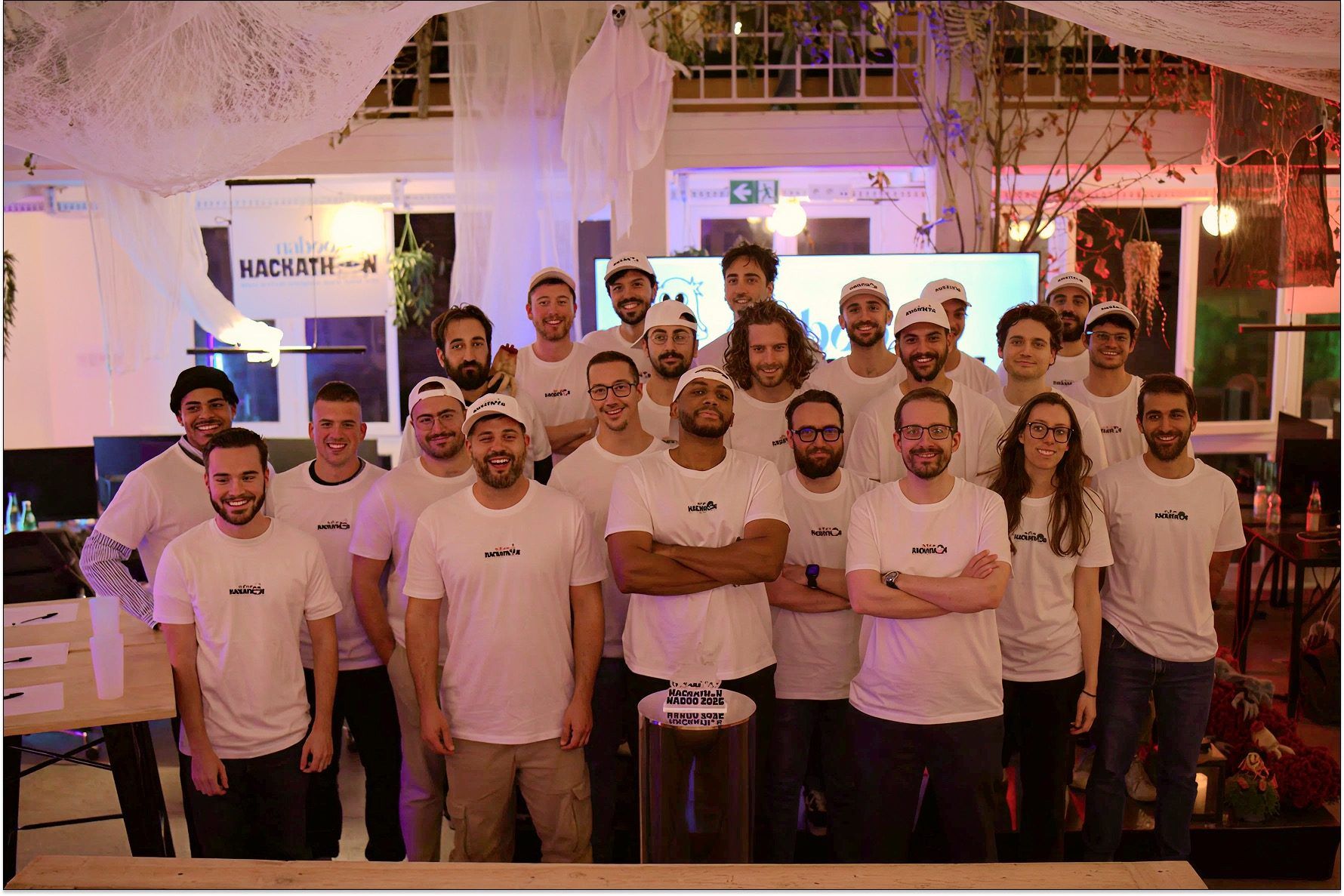
Not every company needs to copy what we did at Naboo. You do not need three full days, seven teams, elaborate set design, or an office full of neon lights for the idea to work.
The point of a hackathon is simpler than people make it.
Bring together people who do not work together enough. Give them a real problem, enough room to step outside the usual process, and a deadline short enough to keep the work from getting buried in meetings.
Then let them build.
In a few days, business teams have to explain their problems clearly. Tech has to understand before building. Ideas meet reality fast. People also see, often for the first time, what the colleagues a few meters away actually do.
That is why, despite the set design, the merch, the games, the evenings, and the prizes, the most important part of our hackathon was the simplest one: for three days, people who were used to working side by side started working together.
The rest was there to make them want to go all in.