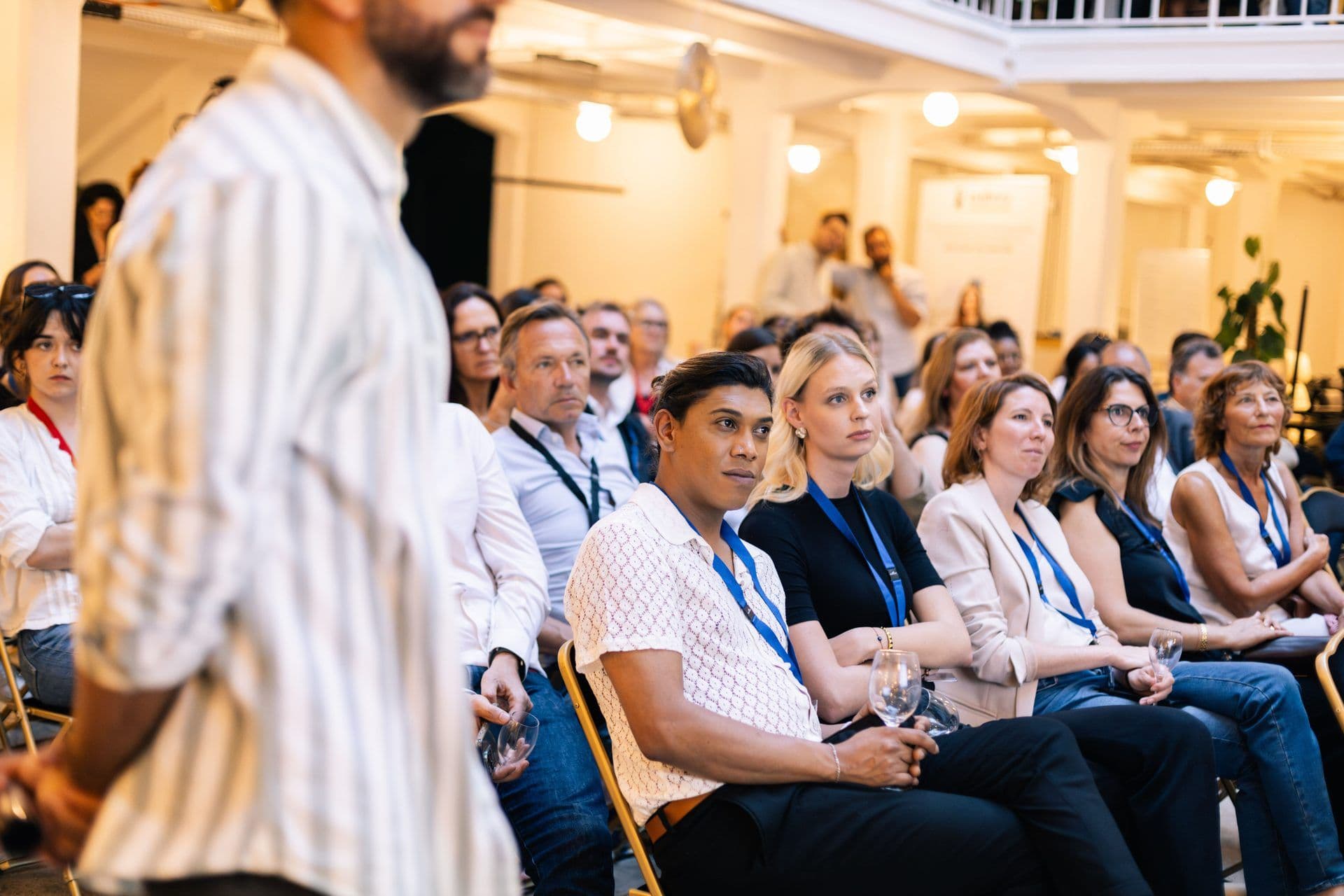
MICE stands for meetings, incentives, conferences and exhibitions, the four formats that make up corporate business events. The acronym matters because each format is bought, budgeted and run differently. A quarterly leadership meeting for 20 people and a three-day exhibition for 4,000 share almost nothing except the word "event" on a budget line.
This guide explains what each format is, what it costs in planning effort, where programs usually break, and how to choose a partner to run them.
Key takeaways
- MICE covers four distinct formats: meetings, incentives, conferences and exhibitions.
- Meetings are the highest volume and lowest complexity. Exhibitions are the opposite.
- Analyst estimates place the global MICE market between 1.03 and 1.34 trillion dollars in 2026, and that spread shows how differently firms draw the category's boundaries.
- Most MICE budgets fail on sourcing and supplier coordination, not on the event itself.
- The practical test of a MICE partner is whether they handle sourcing, contracting and on-site delivery, or only one of the three.
What does MICE stand for?
MICE stands for meetings, incentives, conferences and exhibitions. It covers business events a company buys for its own people, its customers, or its market, rather than consumer events sold by ticket.
Meetings
Meetings are structured working sessions such as strategy offsites, sales kickoffs, board sessions, team seminars, and project reviews. They usually run from half a day to a week, often for 10 to 200 people, and they drive most corporate event volume. Each one takes limited planning, but the total workload is high, which is why meetings absorb more procurement time than any other format.
Incentives
Incentives are trips a company gives as a reward for performance, most often to a sales team or another top-performing group. The goal is motivation and retention, so the experience matters more than the agenda. These programs take the longest to plan because destination, air travel, ground handling, and qualification rules all have to line up months ahead. Our guides on incentive travel and incentive travel trends for 2026 go deeper on program design.
Conferences
Conferences are multi-day knowledge events where speakers, delegates, and sponsors gather around a theme. They include a content program, a speaker roster, registration, and often sponsorship revenue. A conference run internally by one company is different from a congress run by an industry association, and a convention sits closer to the association side.
Exhibitions
Exhibitions are floor-based events where companies take stands to present products and meet buyers. For the organizer, the product is floor space and traffic. For the company taking a stand, the cost sits in stand design, build, staffing, and lead capture, and the planning window is long because floor plans sell out early.
How big is the MICE market?
Analyst estimates for 2026 range from 1.03 trillion dollars, according to Grand View Research, to 1.14 trillion from Precedence Research and The Business Research Company, and 1.34 trillion from Straits Research, with forecast growth of roughly 5.5 to 10.9 percent a year.
The spread is the point. Firms do not agree on whether air travel, hotel room nights, and food and beverage belong inside the category, so the figure you use depends on the boundary you accept. For internal planning, your own three-year spend across meetings, incentives, conferences, and exhibitions is a better baseline than any market total.
Why companies run MICE events
Companies run MICE events for four results that are hard to get any other way.
Meetings drive decisions. Put a distributed team in one room for two days, and work that would otherwise drag across a quarter gets handled fast.
Incentives change behavior. A trip people want to qualify for moves sales performance in a way a cash bonus of similar value usually does not.
Conferences build authority. When you own the room where your market talks about its problems, you hold a position that advertising rents.
Exhibitions produce pipeline. A well-run stand gives you a concentrated week of qualified conversations with buyers who are already shopping.
What each format costs you in planning effort
Budget is the obvious cost. Planning time is the one people miss, and it decides how much a small team can actually run.
| Format | Typical size | Lead time | Where the effort goes |
|---|---|---|---|
| Meetings | 10 to 200 | 4 to 12 weeks | Venue sourcing, catering, AV, travel for a distributed group |
| Incentives | 20 to 300 | 6 to 12 months | Destination selection, air and ground, qualification rules, duty of care |
| Conferences | 100 to 5,000 | 6 to 18 months | Content program, speakers, registration, sponsorship, production |
| Exhibitions | 500 to 50,000 | 9 to 24 months | Floor plan, stand design and build, logistics, staffing, lead capture |
Read the table by column, not by row. A team that runs 40 meetings a year and one conference will spend most of its hours on the meetings, which is why sourcing is where the pressure sits for most programs.
Where MICE events go wrong
Most MICE programs do not fail on event day. They fail earlier, in three places.
Sourcing runs on email. A planner sends the same brief to 15 venues, gets back 15 differently formatted quotes, and rebuilds them into a spreadsheet to compare. That comparison is where days disappear.
Suppliers are coordinated one thread at a time. Venue, caterer, AV, transport and entertainment each get their own email chain, and only the planner keeps the full picture in mind.
Spend is invisible until the invoices land. Without one view of committed spend across events, finance sees the program only after the fact, and procurement cannot negotiate on volume it cannot see.
Fix those three and the on-site work gets easier on its own.
What is changing in 2026
Sustainability has moved from a line in the RFP to a selection criterion. Buyers now ask for carbon reporting at the sourcing stage, and venues that cannot answer are dropped earlier.
AI has entered sourcing. You describe an event in plain language and get matched venue options back in seconds, instead of paging through directories to build a brief.
Attendee expectations are higher. The standard set by consumer events now applies to internal ones too, and that shows up in production quality, food, and how much of the agenda is participation rather than presentation.
Procurement has arrived properly. Events used to be bought locally by whoever was organizing; in companies of any size, they are now a managed category with contracts, preferred suppliers, and reporting.
How to choose a MICE partner
Start with ownership. Some partners handle sourcing, others handle contracting or delivery, and too often you are left to cover the rest.
- Coverage. Can they source venues and suppliers in the markets where you actually run events, not only in their home market?
- Comparability. Do proposals come back in a format you can compare side by side, with pricing you can audit?
- Contracting. Who signs with the venue, and who carries the risk if something falls through?
- On-site ownership. Is there a named person on site who owns the run of show?
- Reporting. Can you see committed spend across the program, or only per event after the fact?
For a wider view of the category and the vocabulary buyers use, see our overview of the MICE industry, and our list of the best incentive travel companies if incentives are the piece you are buying first.
How Naboo supports MICE programs
Naboo is an event platform for corporate events. Teams describe an event once and get back real venue options with transparent quotes, sourced from a network of more than 170,000 vetted venues and suppliers, then run sourcing, supplier coordination, and proposal comparison in one place instead of across email and spreadsheets.
When a program needs people rather than software, Naboo Agency handles strategy, creative, production, and logistics for bespoke corporate events, including congress management and trade show presence. On the procurement side, Naboo MICE gives finance and procurement a single view of meetings and events spend from sourcing through to payment.
Naboo is ISO 27001 certified, SOC 2 Type II compliant, an IATA accredited travel agent, and a member of the French Tech Next40/120.
Frequently asked questions
What does MICE stand for?
MICE stands for meetings, incentives, conferences and exhibitions. These are the four types of business events companies buy for employees, customers, or the market.
What is the difference between a conference and an exhibition?
A conference is built around knowledge and access to a content program. An exhibition is built around floor space and buyer traffic. Conferences are judged by attendance and content quality; exhibitions by leads and stand return.
Is a corporate seminar a MICE event?
Yes. A seminar falls under the M in MICE, along with offsites, sales kickoffs, and team meetings. In most corporate programs, it is the highest-volume format.
How far ahead should I plan a MICE event?
Plan four to twelve weeks ahead for a meeting, six to twelve months for an incentive trip, six to eighteen months for a conference, and up to two years for a large exhibition presence. Floor space and venue availability usually go first.
Who buys MICE events inside a company?
It depends on company size. Smaller companies buy locally through whoever is organizing. Larger companies treat events as a procurement category, with contracts, preferred suppliers, and reporting handled by procurement or a central events team.
Are MICE events worth the cost?
They are when the result is something you cannot buy another way: a faster decision, a stronger sales team, a market position, or a quarter of pipeline. They are not worth it when the event exists only because it existed last year. Set the result before you set the budget.