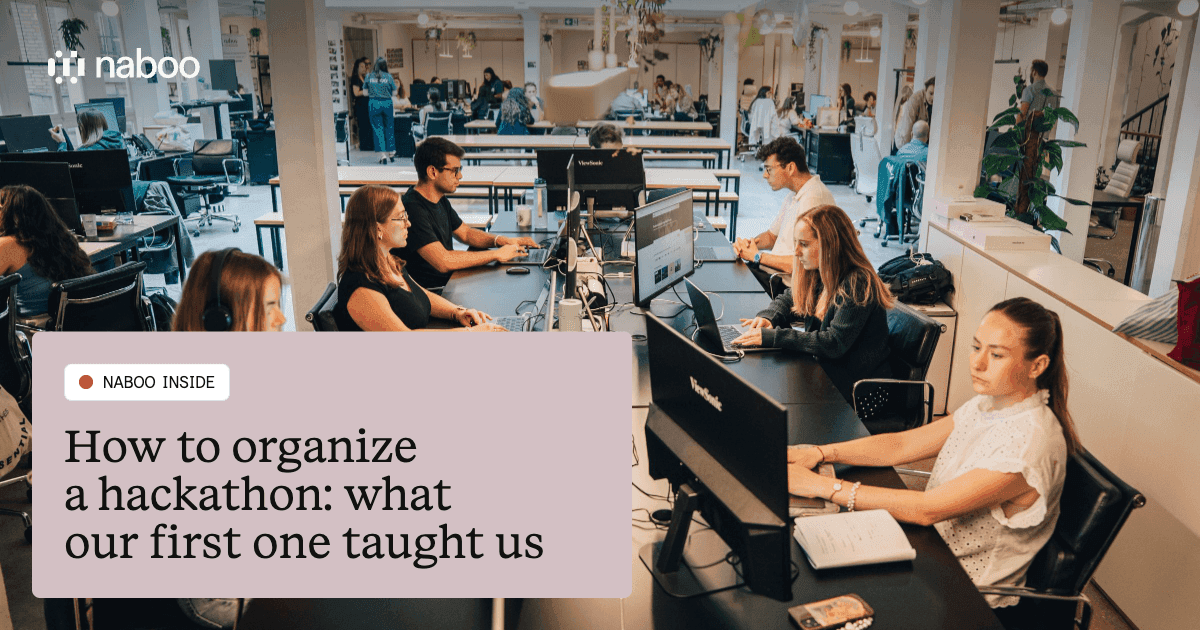
How to organize a hackathon: what our first one taught us
How We Ran Our First AI Hackathon (and Made Sure It Didn’t Die on Monday Morning)
Last year, right before Halloween, our CTO Jean-Louis walked up to my desk with a simple request, and honestly, the timing was perfect: let’s run a hackathon. The first one in Naboo’s history.
The idea got a yes on the spot. We were going to talk about artificial intelligence at the exact time of year when everyone plays with fear, monsters and whatever is hiding in the dark. And for some of our people, that’s still what AI looked like back then. Everybody was talking about it. Some were already using it every day. Others were watching it move fast without really knowing what it would change about their jobs.
Instead of adding one more all-hands presentation about why everyone should care, we went the other way: stop talking about AI for a few days and build with it.
Three days. Seven teams. Developers dropped into real problems from Marketing, Sales, Finance, Supply and the rest of Naboo. One clear brief: find the thing your colleagues hate doing, then make it disappear.
That’s how the hackathon started.
Want to feel the vibe? Watch the film of those three days on our YouTube channel: Naboo Hackathon 2025.
AI isn’t just a tech problem anymore
In the age of AI, every company is going through a shift that’s hard to size up. It’s closer to going from the typewriter to the personal computer than to a regular software update, except this time it doesn’t take twenty years. Sometimes a few months are enough for a way of working that felt perfectly normal to start looking dated.
What used to be a topic for the engineering team has become a question of productivity, organization and company culture. With AI agents in the picture, it’s no longer enough to tell people to use ChatGPT or some other tool. You have to look at the work itself and ask what still deserves to be done by hand, what should go away, and where people actually add value.
So Jean-Louis didn’t come to me with a Halloween party idea. He came with a problem.
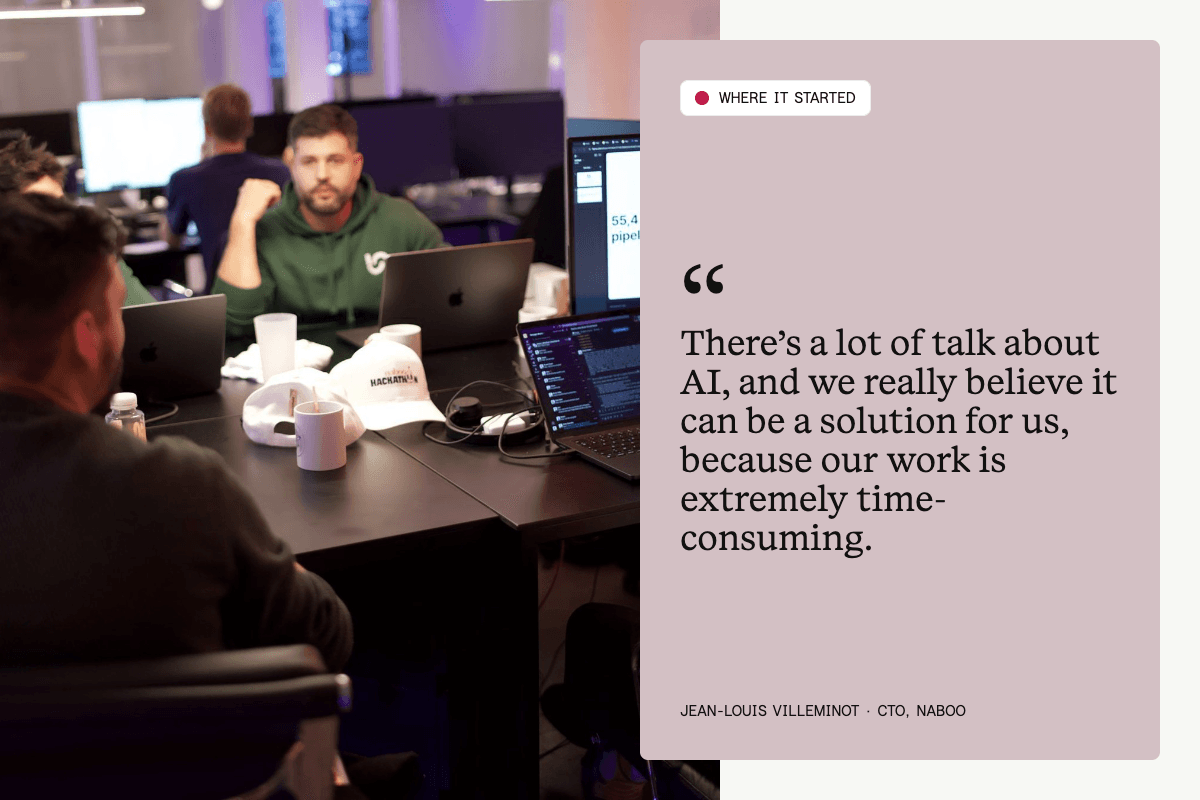
“We talk about AI a lot, and we really believe it can be a solution for us, because our business is extremely time-consuming.”
Jean-Louis Villeminot, CTO at Naboo
Naboo wanted to speed up AI adoption and become an AI-native company. Behind that goal was another one that mattered just as much to me: putting the tech team back at the center of the company and getting them to work side by side with the business teams.
When a company grows fast, departments build their own walls. Sales knows about pain points developers never see. Finance can burn hours on a manual process nobody else notices. Marketing comes up with its own workarounds for some repetitive task. And sometimes, twenty feet away, someone already knows how to automate half the problem.
The hackathon was designed to knock those walls down for 72 hours.
One tech team, one department, one problem to solve
We split the tech team into seven squads, each paired with a function at Naboo. The rule was simple: understand that team’s day-to-day, find a real source of friction, then build a solution in three days that the whole company could see in a live demo.
Lucien framed it in one sentence during the event:
“Every team is tied to one part of the work here, and every team is testing new AI solutions to bring their creativity and new answers to their colleagues.”
Lucien Bredin, CPMO at Naboo
Before writing a single line of code, we listened.
The first morning happened over breakfast, with conversations alongside the business teams. What eats up your time every day? What are you still doing by hand? Which task makes you roll your eyes the second it lands on your desk? Where are the pointless back-and-forths? What creates friction between two departments?
Those questions are a lot less flashy than “what could we invent with AI?” But they lead to better products.
We didn’t want to start with a shiny piece of tech and then go looking for a use case. We wanted to start with real pain, something simple and everyday, sometimes so old that nobody even thinks to question it anymore.
That’s also where the hackathon gave us something I hadn’t planned for: for three days, Tech became the center of gravity of the entire company.
“You really feel like you’re the company’s top priority for those three days. You can ask anyone anything, at any time.”
Alice, Developer at Naboo
Then the clock started.
And suddenly, our developers got as competitive as our sales team
We tend to picture engineering teams as calmer, more rational, less into competition.
Give them 72 hours, a trophy and six rival teams, and that idea goes out the window fast.
Once the problems were on the table, the office turned into a nonstop workshop. Build, test, delete, start over. A feature dreamed up in the morning could be gone by the afternoon. An idea that looked like a side quest could become the heart of the project a few hours later.
And as the final gong got closer, the mood shifted too.
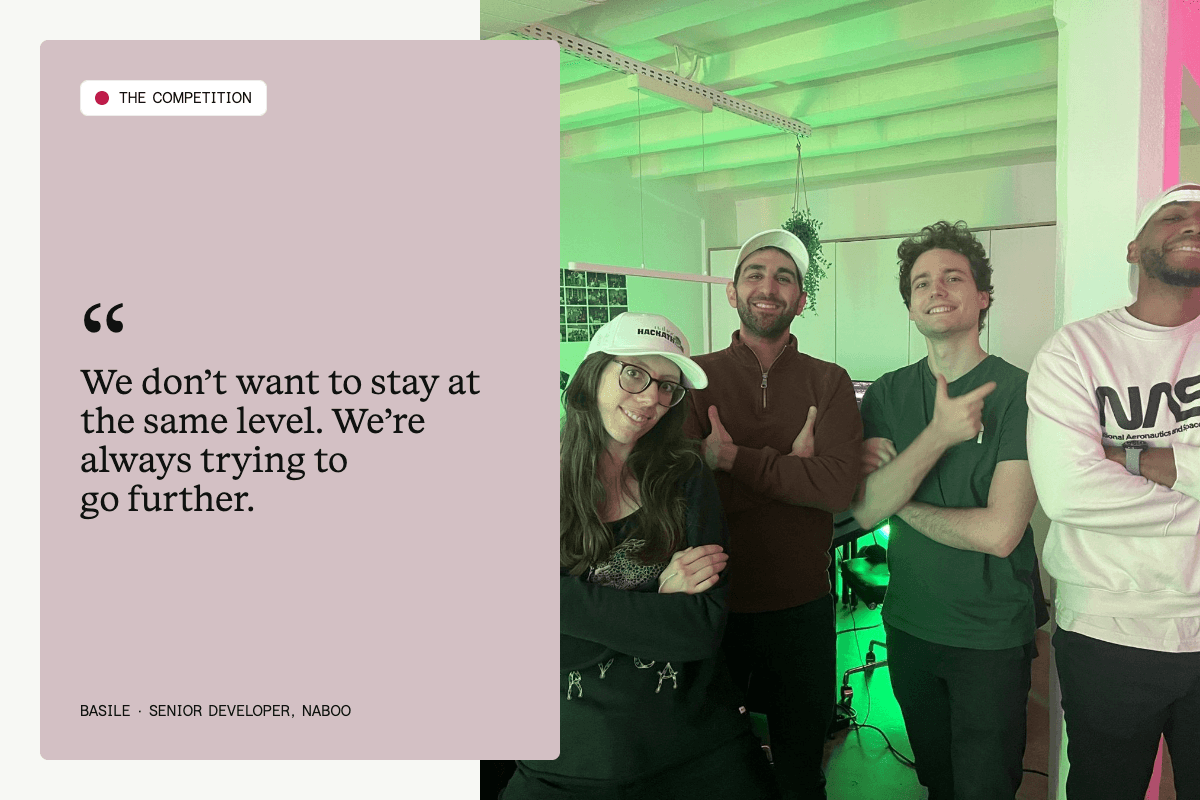
“We don’t want to stay at the same level. We’re always trying to push further.”
Basile, Senior Developer at Naboo
That’s what I love about competition when it’s used well. It brings out an energy that a goal sitting in Notion never will. First you want to finish. Then you want to do better. Then you see what the team next to you is building and, all of a sudden, you want to win.
The hackathon had found its groove.
Our job was to keep it running for three days.
If you want people to stay, give them a reason to stay
Asking people to work flat out for 72 hours looks easy on a slide. Getting them to stick around the office once the workday is over is another story.
That’s where Field Marketing came in.
Our role wasn’t just managing a schedule, ordering food and setting up a few tables. We had to turn the office into a place people actually wanted to spend those three days, even if they weren’t developers.
That mattered even more because so many of our working habits had been built remotely.
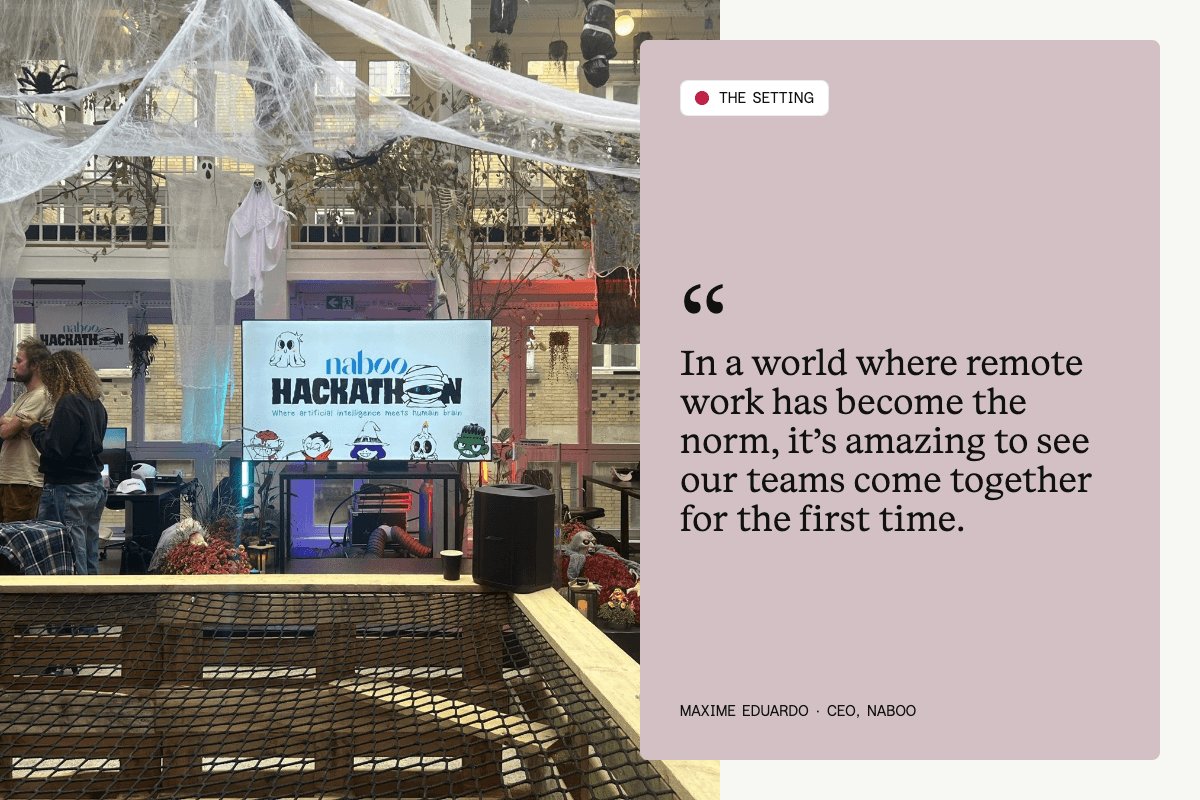
“In a world where remote work has become the norm, it’s amazing to see our teams get together in person for the first time.”
Maxime Eduardo, CEO at Naboo
We put a big chunk of the budget into the space. And when I say Halloween decorations, I don’t mean three plastic pumpkins, two spiderwebs from the party store the night before and an orange light by the door.
If we wanted people to experience those three days as something different, the setting had to be different first.
Working with the same set designers and decorators we use on Naboo Agency events, we gave the office a whole new look. The idea was that you’d walk into the place where you work all year long and, for a few seconds, feel like you were somewhere else.
We’ve seen it confirmed ever since: the setting gives people permission to change gears. An office that looks exactly like it did yesterday sends everyone straight back to yesterday’s habits.
Art direction is part of the event
We pushed that logic all the way to a full identity for the hackathon: “Naboo Hackathon 2025: Where AI meets human brain.”
Halloween set the scene. Little monsters, a world built just for the event, its own colors, and then a separate identity for each team. Naboo Studio designed the logos, the flags, the print materials, the merch and everything that helped each squad see itself as its own camp.
The office was split into zones, colors and neon signs made the teams easy to tell apart, T-shirts and caps carried each team’s identity, and three days of work slowly turned into a real event.
In internal events, this part is still underrated way too often. Art direction isn’t a layer you slap on at the end. It’s what gives the memory its shape.
So we didn’t just want to print a logo on a T-shirt.
We wanted to build a world consistent enough that, months later, a single picture would still take people right back to those three days.
Don’t leave Tech alone in the dark
A great-looking space is pointless if, at 7 p.m., the office empties out and fifteen developers end up eating cold takeout in front of their screens.
We wanted the hackathon to belong to the whole company from day one.
So we gave people reasons to stay even when they weren’t working directly on a project: giant foosball, ping-pong, darts, Jenga, Connect Four, gaming consoles, buffets, a sushi night, a trivia night and video games. The point wasn’t to fill the schedule. It was to turn the office into a place you actually use for a few days, not just pass through.
Sales reps could swing by to check on their tech team. Finance folks could come back to talk about a feature. Someone could stay for dinner, play for twenty minutes, then go see how their department’s project was coming along.
That’s when the hackathon stopped looking like a tech event.
“There are no rules, and that’s what I love! I see sales people, HR people, finance people going to see their tech team, giving them ideas, sharing things, discovering what the tech team built.”
Maxime Eduardo, CEO at Naboo
Having people around the teams also changes how the work feels. Developers aren’t building something that will sit on a roadmap for three months before anyone mentions it. The people who’ll use it are standing right there, watching it take shape and reacting in real time.
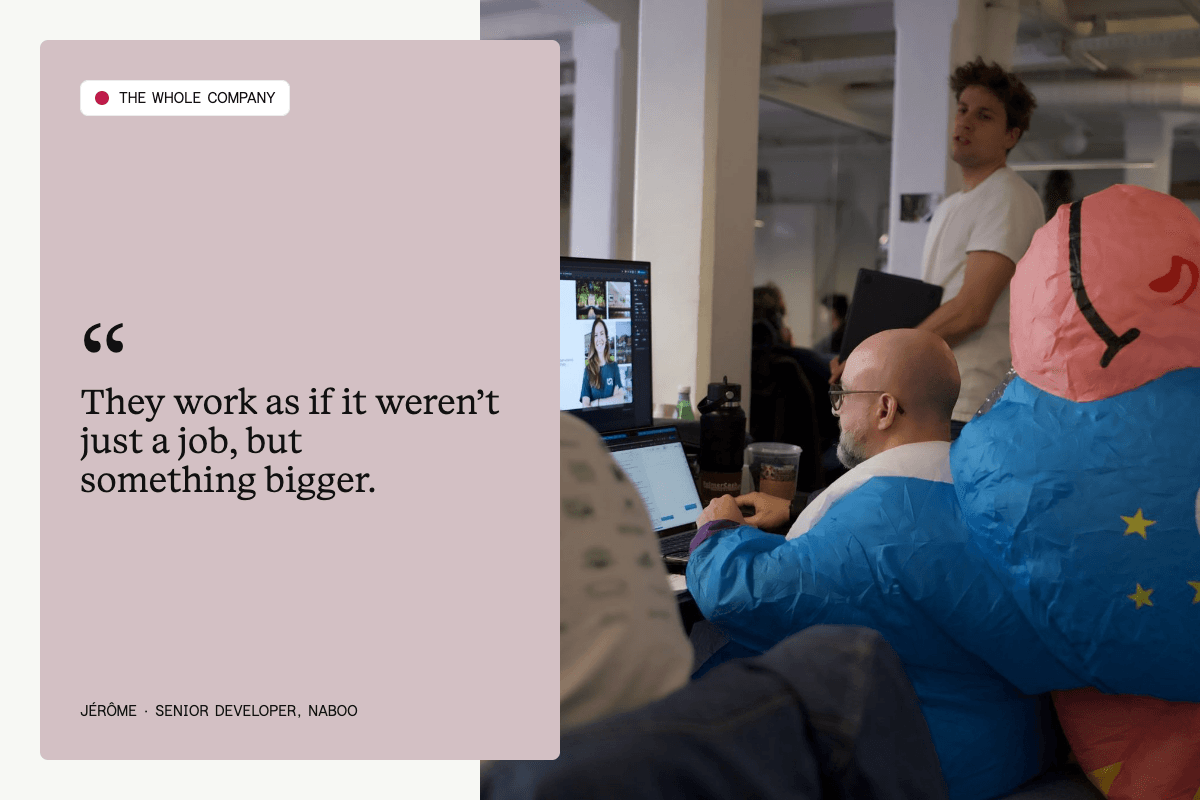
Jérôme, one of our senior developers, put it simply:
“They’re working like it’s not just a job, but something bigger.”
Jérôme, Senior Developer at Naboo
How do you win?
A competition has to answer one simple question, fast: how do you win?
If people can’t explain the rules in a few seconds, the format is too complicated.
For us, the rule was clear. Each team had 72 hours to build the strongest solution to make life better for the department it was paired with.
On the last day, the teams presented their projects live in front of a jury of industry experts. It had to work, and it had to solve a problem big enough to deserve a life after the event.
The prize also had to make people want to go all the way: a night at one of our partner hotels, trophies, merch, and the bragging rights that come with nailing a demo in front of the whole company.
Then comes the moment anyone who’s ever done a hackathon knows by heart. Time is running out. A feature breaks. Someone wants to squeeze in one last thing. The demo worked for three straight hours, then dies fifteen minutes before you go on stage.
Meanwhile, the team next door looks totally calm. That’s usually the most worrying sign of all.
“The tech team is very ambitious: we want to build things, and we want to build them fast.”
Jean-Louis Villeminot, CTO at Naboo
Then Jean-Louis hits the final gong.
Building stops.
Showing starts.
A good hackathon shouldn’t die on Monday morning
This is the part that matters most to me.
We could have settled for a great internal event: three intense days, a nice video, a few photos, a trophy on a shelf, and then five repositories nobody ever opens again.
That was never the goal.
Before we even kicked off, Lucien set one simple rule:
“The hackathon is genuinely useful because we’re going to put the coolest and most successful projects from it on our roadmap.”
Lucien Bredin, CPMO at Naboo
That’s the difference: on one side, a hackathon that feels like an exercise. On the other, a hackathon that changes the way a company works.
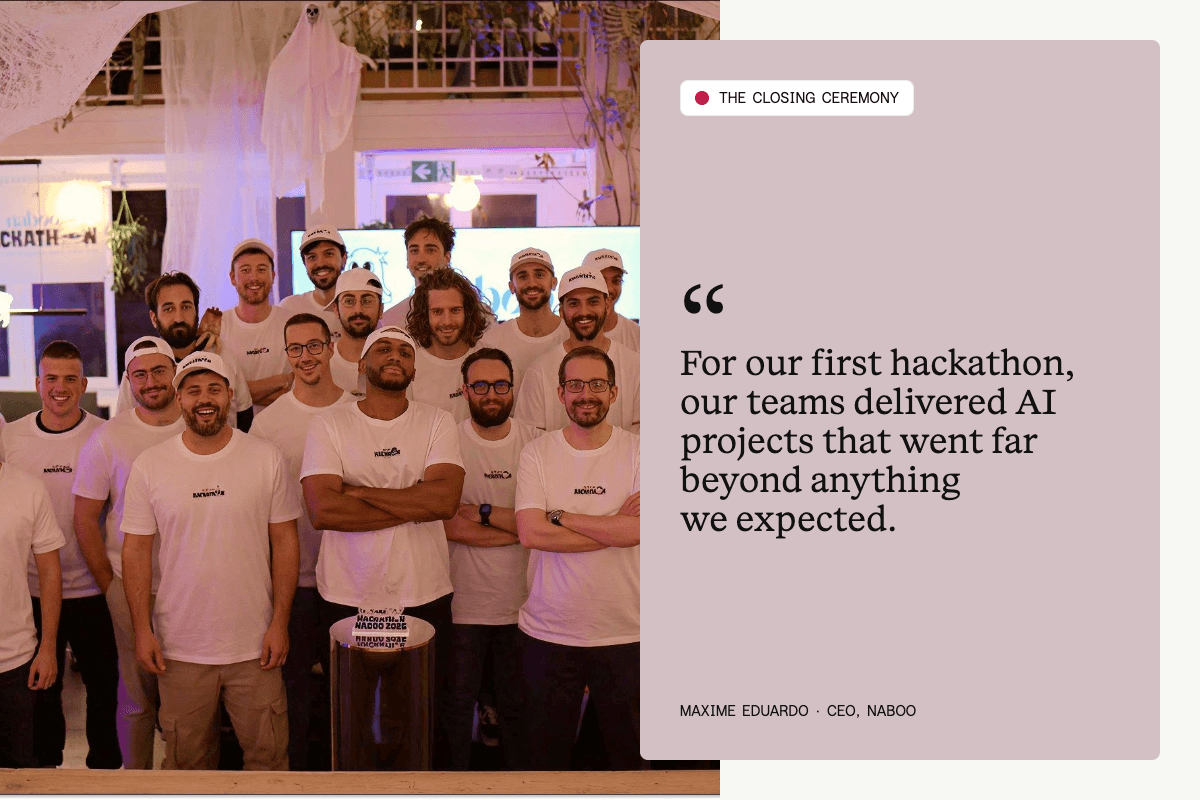
By the closing ceremony, several projects had already gone way beyond the small prototypes we expected at kickoff.
“For our first hackathon, our teams delivered AI projects that went far beyond anything we expected.”
Maxime Eduardo, CEO at Naboo
One team built a tool that automates entering event information into our internal back office. Another analyzed client briefs so the sales team could put proposals together faster. A third dug into financial data and came back with priority actions, including automating some payments.
Other ideas born during those three days fed the next steps of our AI work, especially in Sales, Marketing, and the friction points between Finance and event planners.
Not everything was meant to become a product. And that’s perfectly fine.
A hackathon is also about accepting that you’ll build things that fail.
But instead of spending four weeks in meetings to find out an idea is weak, you can find out in three days, with something real in front of you.
What if the best AI product is the one you stop noticing?
Looking back, this is the lesson that stuck with me most.
We wanted to speed up the use of AI across the entire company. So you’d expect the strongest projects to be the ones where AI was the most visible.
Working on the teams’ real problems showed us something else.
Being AI-native doesn’t mean slapping an “AI” button on everything.
Often, the best way to use AI is to make it disappear.
When a tool takes away a thankless task, turns five back-and-forths into one, or wipes out twenty minutes of manual data entry, users don’t need a behind-the-scenes tour. They just need to feel that their work got lighter and faster.
That idea has become central to how we think about Naboo.
Maxime said it plainly at the end of the hackathon:
“AI changes everything, so now we want to change the way people here think about AI and the way they use it, as an answer to every problem they might have.”
Maxime Eduardo, CEO at Naboo
In the end, we came back to the monster under the bed from the beginning.
Making AI less intimidating didn’t take a three-hour explainer.
It took dragging it out into the daylight, handing it a real problem, and showing what it could take off the painful side of a workday.
Alice said it best:
“It’s really satisfying to see that our work is so useful.”
Alice, Developer at Naboo
And the ROI didn’t stop at the products
There was one more outcome we were hoping for, without knowing how big it would get: the hackathon sparked interest well beyond the people taking part.
Candidates started looking at Naboo after seeing the teams in action. Investors and people from our network stopped by to see what was going on. For a few days, our internal culture, usually invisible from the outside, became something you could watch live.
That’s where the ROI of this kind of event gets easier to measure. The same budget speeds up tech adoption, brings together teams that don’t work together enough, tests products, strengthens the employer brand, generates content and makes company culture tangible.
Not many internal events hit that many goals at once.
Why I think more companies should run a hackathon
Not every company needs to copy what we did at Naboo. You don’t need three full days, seven teams, a custom set design or an office full of neon lights for the idea to work.
The principle of a hackathon is simpler than people make it sound.
Get together people who don’t work together enough. Give them a real problem, enough room to break out of their usual routine, and a deadline short enough that the work can’t get lost in meetings.
Then let them build.
In a few days, the business teams have to explain their problems clearly. Tech has to understand before it builds. Ideas run into reality fast. And people get to see, often for the first time, what their colleagues twenty feet away actually do.
That’s why, despite the set design, the swag, the games, the nights and the prizes, the most important part of our hackathon was also the simplest: for three days, people used to working next to each other started working with each other.
Everything else was there to make them want to give it everything they had.
Want to build your own?
If you’d like to run something like this with your team, from the space and the art direction to the food, the merch and the closing show, Naboo Agency designs and produces internal events like this one end to end. And if you just need the right place to bring everyone together, our turnkey events team can handle the venue, the catering and the logistics while your people focus on building.