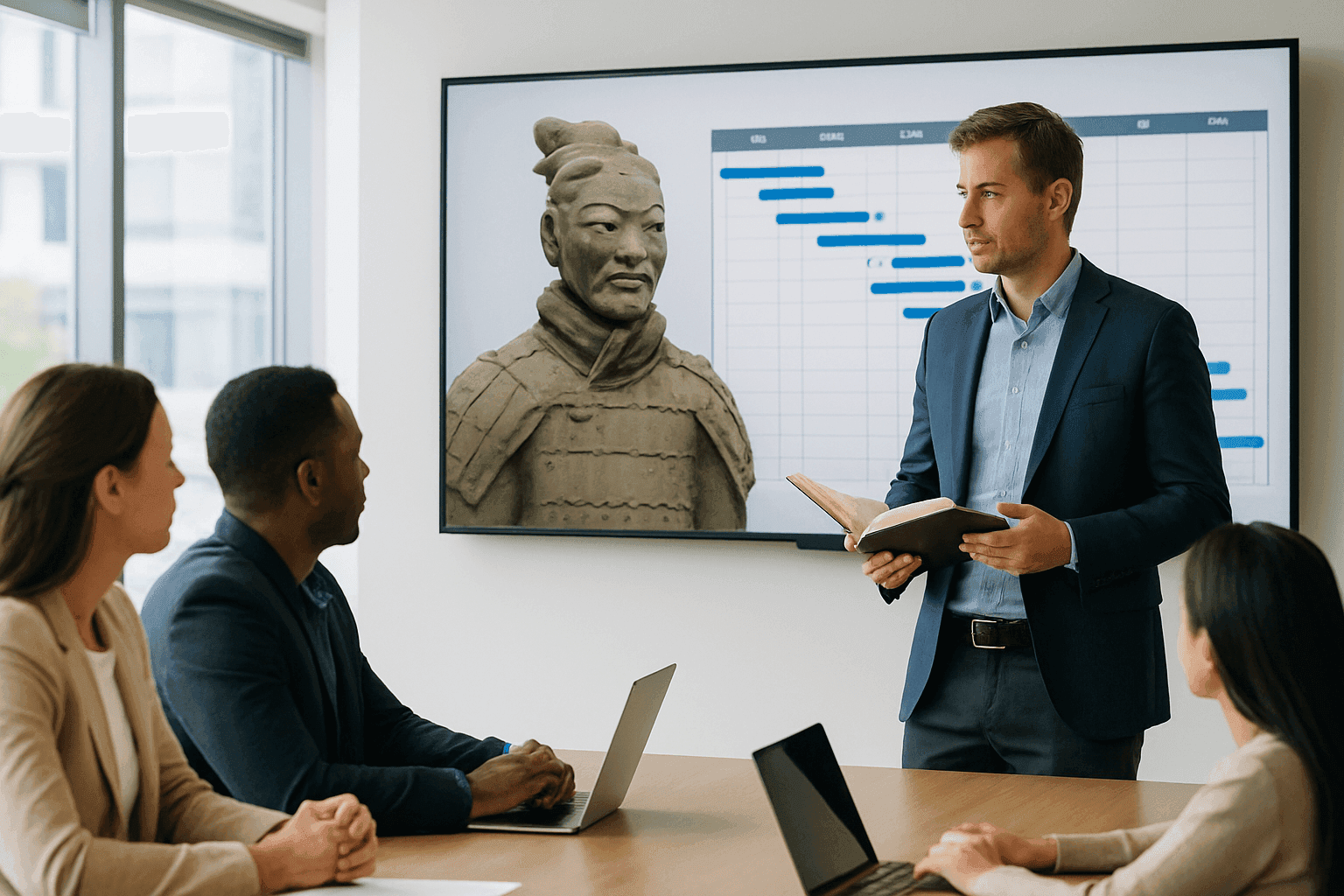
For more than two thousand years leaders have looked to Sun Tzu to deal with conflict and uncertainty. Though written for commanders, The Art of War offers practical ideas for people running projects today. UK project managers in 2026 face familiar problems: tight deadlines, small budgets, juggling stakeholders in London, Manchester, Birmingham and Leeds, and teams spread from the Scottish Highlands to Cardiff. Framing project work with clear strategy helps teams plan, act and deliver with less drama.
Strategic planning: win before you start
Sun Tzu said battles are won before the first sword is drawn. The same applies to projects. Too often teams rush in and confuse activity with progress. Strategic planning means defining what success looks like before spending time or money.
Start by being clear: what outcome do stakeholders want, and why does it matter? Who needs to sign off and who’s affected day to day? Spend sensible time up front — typically 15–20 percent of the overall timeline — so the rest of the project doesn’t become firefighting. For practical tips and case studies you can read more articles on the Naboo blog.
Leadership that gets people moving together
Project managers act as generals: setting direction, making calls under pressure and keeping the team pulling in the same direction. Good leaders combine confidence with a readiness to listen. They define roles clearly so everyone knows how their work links to others, and they make decision routes visible so people aren’t blocked waiting for approvals.
Know the landscape: your local battlefield
Sun Tzu’s advice to know yourself and your opponent translates to projects as understanding the forces that will slow you down: organisational politics, technical limits, suppliers and market changes. In the UK that might mean anticipating local supplier holidays, regulatory updates from Westminster or a sudden shift in customer demand in a region such as Greater Manchester.
Map your stakeholders beyond job titles. What keeps them up at night? Where will they resist? Treat stakeholder management like intelligence gathering: regular check‑ins, short interviews and updated assumptions reduce surprises later.
Flexible execution: adapt like water
Rigid plans break when reality changes. The Art of War recommends adaptability, and modern agile approaches put that into practice: short iterations, regular feedback and course corrections. Make sure your team understands that adapting isn’t failure — it’s how you avoid wasted effort and build what people actually need.
Tempo: move with purpose
Speed is an advantage, but sustainable speed. Set realistic schedules with contingency, spot and remove bottlenecks, and decide when you have enough information to act. In 2026 many UK teams rely on quicker, smaller deliveries to keep stakeholders in the loop and reduce risk.
The RAPID project command framework
The following five-part approach borrows Sun Tzu’s thinking and puts it into everyday project terms.
- Reconnaissance — gather facts on stakeholders, risks and resources; document assumptions and test them early.
- Alignment — make sure everyone shares the same objectives and measures of success; use visuals and short workshops to surface conflicts.
- Positioning — focus resources on the few things that matter most; plan fallbacks for the riskiest areas.
- Initiative — keep up momentum with quick decisions and frequent deliveries; act rather than only react.
- Discipline — resist scope creep, keep quality steady and hold regular reviews so the team learns and improves.
Example: rolling out a CRM across a UK sales team
A project lead starts with Reconnaissance by meeting sales leads in London and regional managers in Leeds to understand workflows and real concerns. During Alignment she runs short workshops to agree on measures such as adoption and data accuracy. For Positioning she assigns the best technical resource to data migration and schedules training for quieter weeks. Initiative looks like releasing working features often and fixing real user problems quickly; Discipline means refusing low‑value custom requests that would derail the core goals.
Common misconceptions
- Strategic thinking isn’t over‑planning. It’s having a clear intent so you can make good tactical calls as things change.
- Adaptability isn’t an excuse for chaos. You still need rules and clear objectives.
- Other teams aren’t enemies. Treat problems — not people — as the opponent to solve together.
- Speed isn’t recklessness. Fast work comes from removing waste and choosing where to concentrate effort.
Measuring success: what counts
Track both delivery metrics (schedule, budget, scope) and outcome metrics (customer satisfaction, cost savings, revenue impact). Use leading indicators such as velocity trends, defect rates and stakeholder engagement to spot trouble early. Capture lessons so future projects start stronger and quicker.
Risk and opportunity
Treat risk as continuous. Run short, regular risk checks rather than a single workshop. Look for opportunities too: if a supplier stalls, can you accelerate a different area? Teams in the UK that balance mitigation with opportunistic moves often gain the most.
Team unity: the real multiplier
Cohesive teams outperform better‑resourced but divided ones. Invest in straightforward relationship building — regular face‑to‑face time where possible, or well‑run virtual check‑ins for distributed teams from Bristol to Edinburgh. Create psychological safety so people report problems early and suggest fixes.
If you need ideas to bring teams together, especially across regional offices, consider simple, practical activities and workshops; the inspiring event ideas page has useful suggestions for planners.
Resolving conflict quickly
Address small disagreements early. Find the interests behind positions and reframe disputes around shared outcomes. That keeps energy focused on delivering value rather than on internal battles.
Sustainable victory
Sun Tzu favoured winning without costly fights. In projects this means reducing resistance through good stakeholder work, delivering a few standout things well, and making sure knowledge is handed on. Documentation, training and short handovers turn one‑off wins into lasting improvement across teams in Manchester, Glasgow or anywhere else in the UK.
FAQs
How does this differ from traditional project management?
Traditional approaches often focus on process and sticking to plan. A Sun Tzu approach puts more weight on strategy, ongoing assessment and adapting tactics to reach the desired outcome.
Do these ideas work for small projects?
Yes. The same principles scale down: clear objectives, a short risk check, and quick alignment make even a week‑long piece of work run more smoothly.
How do you balance flexibility with stakeholder commitments?
Agree outcomes rather than detailed methods. Keep stakeholders informed about changes and why they help meet the agreed goals.
What skills should project managers develop?
Systems thinking, good judgement under uncertainty, clear communication and the ability to read people’s concerns are all helpful and can be learned with practice.
How do organisations know this approach is working?
Look at outcomes as well as outputs: did the project deliver the intended business changes? Monitor portfolio metrics and team engagement to see if projects are creating long‑term value.