
For corporate procurement leaders, the primary mandate has always been clear: secure strategic supplier agreements, maximize volume discounts, and lock down major multi-year contracts. This laser-focused approach handles your direct spend beautifully. Yet, right next door, a massive, fragmented beast continues to roam wild in the corporate backyard: unmanaged tail spend.
According to Deloitte, tail spend is traditionally considered the weak link of spend management. This is mainly because purchases in the tail account for only one-fifth (around 20%) of total corporate spend, but constitute the vast majority—up to 80%—of its transactional volume and active supplier bases.
For procurement managers and finance executives under pressure to prove ROI, managing tail spend effectively is not optional. If you want to
1. Why Tail Spend is Procurement’s Greatest Efficiency Drain
A common corporate misconception is that because tail spend only makes up a minor portion of the budget, it doesn’t warrant significant procurement effort. However, while the individual dollar value per transaction is low, the compounding volume creates severe operational bottlenecks and millions in hidden corporate process costs.
In many organizations, tail spend is a breeding ground for maverick spend—uncontrolled, off-contract purchases made by employees outside approved procurement channels. This fragmented approach creates an environment where procurement loses visibility, supplier bases bloat, and legal, compliance, and quality risks thrive unchecked.
Table 1: The Classic Procurement Tail Spend Breakdown
Category | Typical Purchase Examples | Procurement Reality | Key Operational Risk |
|---|---|---|---|
Indirect Tail Spend | Office supplies, basic facilities maintenance, IT peripherals, local marketing agencies. | Low financial value per order, but generates thousands of individual, disparate invoices. | Administrative overload, duplicate supplier profiles. |
Direct Tail Spend | Low-value manufacturing components, emergency spot buys, urgent raw materials. | Production continuity takes precedence over sourcing discipline. | Premium spot-market pricing, unvetted terms & conditions (T&Cs). |
Meetings & Events (M&E) | Ad-hoc team offsites, localized trainings, regional dinners, customer entertainment. | Classic tail-spend category. ~78% of requests are $\le \$20\text{k}$ but represent only ~26% of GMV. | Bloated vendor master list, manual deposit tracking, missed VAT reclaims. |
2. The Structural Root of Maverick Spend
Maverick spend appears when the internal cost or delay of using the formal procurement process becomes higher than the cost of bypassing it. At that point, the problem is no longer a behavioral or employee discipline issue; it is a structural proof that the standard
When a business team requires an emergency spare part or an immediate venue for a regional training session, they do not bypass procurement out of spite—they are trying to execute. Onboarding a brand-new supplier into an ERP system entails a real cost in time, legal coordination, and administrative workload. When processing a simple $5,000 purchase triggers the exact same heavy compliance verification steps as a million-dollar strategic contract, a bureaucratic bottleneck occurs.
The Bureaucratic Doom Loop
Faced with long turnaround times, business teams multiply "urgent" requests or develop alternative peer-to-peer purchasing routes to secure their needs. In response, procurement typically reinforces rigid controls to reduce these deviations.
However, these manual controls increase friction, lengthen delays, and make the official processes even less adapted to real needs. A self-reinforcing loop sets in: the more rigid the framework becomes, the more exceptions develop; the more exceptions develop, the less visible and governable the tail spend becomes.
3. Designing a Procurement Framework for Tail Spend
To optimize tail spend management without slowing down business execution, procurement must move away from manual, uniform controls and instead segment expenditures by risk and financial value.
Tail spend analysis starts with consolidating all historical spend data across disparate ERP, P2P, and corporate purchasing card (PCard) systems into a single, normalized view. Once the data is cleansed, procurement teams can deploy a strategic risk-value matrix to allocate resources effectively.
Table 2: The Procurement Spend Risk-Value Matrix
Value / Risk Tier | Quadrant Description | Procurement Action Strategy |
|---|---|---|
High-Value, High-Risk | Critical procurement categories, direct production materials, or major strategic partnerships. | Deep In-House Sourcing: Requires close manual negotiation, custom legal reviews, and long-term management. |
High-Value, Low-Risk | Essential recurring services or enterprise assets that carry large budgets. | Strategic Sourcing: IT software contracts or global logistics agreements optimized via volume consolidation. |
Low-Value, High-Risk | Specialized niche services or regulated vendors with low financial outlay. | Targeted Compliance: Strict qualification protocols paired with specialized framework agreements. |
Low-Value, Low-Risk (The Tail) | Office supplies, local M&E venues, basic facilities maintenance, and ad-hoc corporate services. | Digital Automation: Move away from 3-way manual matching to 2-way matching, automated buying catalogs, or outsourcing. |
4. In-House Automation vs. Tail Spend Outsourcing
Deciding whether to manage the long tail internally or outsource it to a specialized provider is a pivotal choice that depends entirely on a procurement team's digital maturity.
The In-House Automation Strategy
Procurement teams with strong, unified digital foundations—such as integrated Source-to-Pay (S2P) suites—can manage the tail internally. They achieve this by deploying guided buying channels, enforcing preferred-vendor panels, and utilizing automated catalog buying. This maintains direct process control and guarantees tight alignment with corporate policy.
The Outsourcing / Vendor of Record Model
Conversely, outsourcing to a specialized tail spend management company or tech-driven consolidator is highly effective when data is deeply fragmented across global business units. Rather than flooding internal legal and finance teams with thousands of low-value supplier agreements and Know Your Business (KYB) checks, the company partners with an intermediary platform.
The outsourcing partner acts as the Single Vendor of Record, managing the contracting, multi-stage vendor deposits, and compliance checks on the back-end while presenting a clean, unified invoicing channel to the enterprise.
Table 3: In-House vs. Outsourced Tail Spend Control
Approach | Pros | Cons | Ideal For |
|---|---|---|---|
In-House Management | * Direct control over process & data
* Seamless alignment with internal policies
* Closer ties to long-term category strategies | * Demands highly mature internal tools
* Consumes vast administrative capacity
* Slower to scale across highly fragmented spend | Organizations with advanced P2P platforms, highly standardized buying habits, and centralized procurement structures. |
Tail Spend Outsourcing | * Near-instant operational scale
* Immediate supplier aggregation models
* Drastically reduces internal administrative burden | * Less direct relationship with micro-vendors
* Requires robust third-party governance
* Initial data integration efforts | Organizations with highly decentralized, geographically fragmented tail spend, or constrained internal procurement teams. |
5. Case Study: Procurement Taming the M&E Long Tail
To see how modern procurement principles transform a classic tail spend category, let’s look at Meetings & Events (M&E). Long considered a sub-category of travel, M&E has historically operated in corporate silos, leading to low visibility, leakage, and high process costs per event.
As Marie Suiveng, Category Manager at Siemens, points out:
"The main pitfall in this category is focusing solely on source-to-contract, as that's typically the only component offered by venue finders. However, most of the value actually lies in the P2P integration and tax reclaim processes."
Naboo’s Source-to-Reclaim (S2R) operating model changes this pattern by introducing a single, end-to-end operating system that unifies every stage of the lifecycle, from demand to tax reclaim.
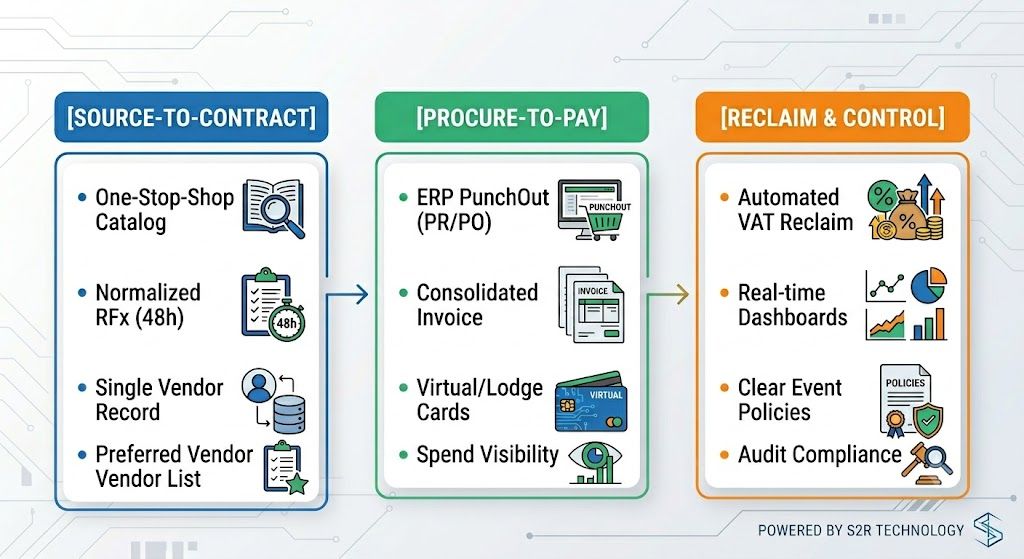
Pillar 1: Source-to-Contract (S2C)
Instead of scattered venue searches and one-off suppliers, S2R establishes a unified sourcing layer. Using a specialized Venue Finder prevents the need to onboard a new supplier for every event. Acting as a transparent intermediary, it lets you operate with a single vendor of record while sourcing thousands of venues. The platform manages contracting, KYB, purchasing T&Cs, and critical GDPR/anti-bribery controls. When looking at how automation reduces this upfront logistics friction,
Pillar 2: Procure-to-Pay (P2P)
S2R automates the operational flow by embedding a PunchOut integration directly into your main ERP/P2P solutions (such as SAP, Oracle, Coupa, or Basware) in a typical 4–6 week deployment. The PunchOut catalog auto-creates PRs based on live quotes, saving requesters hours of data entry. To manage complex multi-stage vendor deposits efficiently, the system handles transactions via virtual cards for smaller ad-hoc spend (under $2,000) and structured lodge cards or wire transfers for larger milestones, reconciling all payments against the initial Purchase Order.
Pillar 3: Reclaim
The final stage of S2R unlocks value that most companies leave on the table. Taxes and VAT typically represent 5% to 10% of total category spend. Because invoicing in this space is traditionally highly fragmented, these funds are chronically under-realized. By embedding tax-compliance validation and line-item mapping from the outset, the platform integrates with specialized VAT recovery services, turning a manual, low-yield task into a predictable, recurring cash return.
6. Embracing AI, Automation, and Modern Tools
Utilizing a modern procurement or spend management solution to effectively manage tail spend delivers massive structural benefits:
Elimination of Manual POs & Invoices: Automating PO creation when inventory thresholds are met or quotes are approved removes administrative burdens, speeds up cycle times, and slashes invoice processing errors.
Electronic Invoice Management (EIM): Centralizing documentation onto a single digital platform eliminates paper tracking, provides complete audit visibility, and cuts invoice approval times by up to 50%.
Strategic Spot Buying: Rather than purchasing ad-hoc services at unpredictable market rates, digital procurement platforms allow teams to run fast, automated bidding rounds, capturing instant cost reductions.
The "Amazon-Like" Guided Experience: A catalog-based buying experience streamlines procurement by allowing users to easily browse, select, and purchase from pre-approved catalogs within an eProcurement platform, promoting efficiency and cost control. To discover how digital sourcing environments transform mid-tier transactions, you can explore more resources in
Naboo's procurement blog hub
The Role of Artificial Intelligence
AI is completely rewriting the rules of long tail spend management. Modern AI engines can review lengthy vendor contracts and terms and conditions in seconds, highlighting hidden liabilities, suggesting optimal redlines, and allowing like-for-like comparison of vendor terms.
Furthermore, AI copilots can interpret detailed, context-rich briefs from team bookers to instantly match them with highly tailored, ESG-vetted venue recommendations. Category managers can use these AI copilots to generate bespoke supply and demand analytics reports on demand, uncovering hidden savings opportunities and forecasting spend patterns without relying on lengthy manual analysis.
"Over the past few months, AI has changed sourcing dramatically: highly tailored solutions now come together in a fraction of the time. Event organizers are impressed by the speed and how bespoke it feels." — Maxime Eduardo, Cofounder and CEO at Naboo
7. The 12-Month Procurement Horizon: Realizing Value
Implementing a disciplined, data-driven tail spend framework delivers rapid, highly material bottom-line value. Within 8 to 12 months of rollout, companies under mature governance can target a 15% to 25% overall category budget improvement.
Table 4: Expected Value Realization (8–12 Month Horizon)
Performance Indicator | Target Benchmark | Direct Business Value Realized |
|---|---|---|
Process Cost Reduction | Up to -90% | Moves the cycle from brief to booking down from days to minutes. Eliminates manual PR/PO chasing. |
Hard Budget Savings | 10% - 15% | Realized via dynamic competitive sourcing, RFx automation, and pre-negotiated corporate rates. |
Policy Compliance Rate | > 90% | Automated controls enforce budget ceilings, sustainability standards, and preferred suppliers. |
Spend Under Governance | 85% - 90% | Eradicates rogue spending and unvetted expenses across distributed business units. |
Tax & VAT Reclaimed | 5% - 10% of spend | Recovers eligible category spend via automated, cross-border compliant document workflows. |
Booker Satisfaction (NPS) | > 80 points | Radically improves employee experience through speed and transactional simplicity (Industry average: 30-40). |
As Sandra Bellin, Executive Assistant to the CEO at Siemens DIS, points out:
"Since Siemens has chosen Naboo, I book venues in minutes, not days. I no longer have to create Purchase Requests, everything follows policy automatically, and Finance never has to chase me anymore. It's just so simple now."
8. Ready to Take Control of Your Tail Spend?
The convergence of high procurement maturity in travel and a surge in post-COVID corporate gatherings means that procurement teams are more prepared than ever to elevate this category, unlocking higher savings and enforcing full compliance. Overcoming these localized challenges requires shifting from ad-hoc reaction to strategic execution. Establishing a strict financial blueprint and a 10% contingency buffer is non-negotiable for low-value purchases that frequently scale up. For a step-by-step breakdown on handling unvetted vendor proposals, check out our guide on
Whether you choose to optimize internally via advanced eProcurement catalogs or partner with a specialized vendor-of-record platform, the goal remains the same: eliminate structural friction, secure full visibility, and empower your teams to execute with speed.
Naboo is offering a free 360° M&E Maturity Diagnosis, followed by a personalized roadmap to help your business eliminate tail-spend fragmentation.