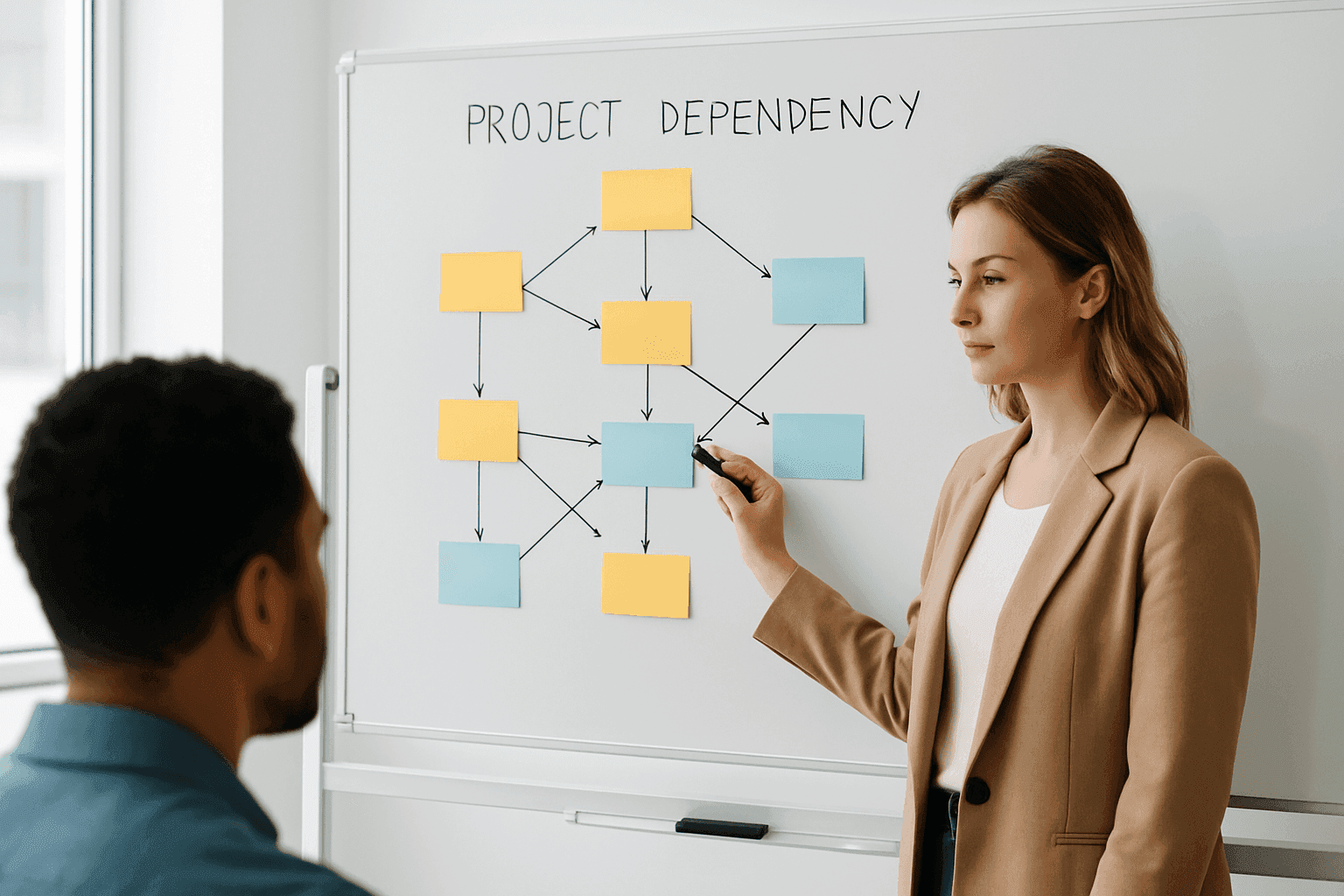
Complex projects in US organizations fail when teams work in silos. From New York to Miami, success requires coordinating work so one team's output becomes another team's starting point. A project dependency map visualizes these links, helping leaders spot delays, allocate resources effectively, and keep delivery on track across programs and portfolios.
why dependency mapping matters for workplace leaders
A project dependency map shows how tasks, deliverables, systems, and people connect inside a project or program. Instead of a long list of activities, it makes visible which work must finish before other work can start, where parallel streams meet, and which relationships are the biggest risks.
Simple arrows on a Gantt are fine for small jobs, but when initiatives scale across multiple teams, external vendors, or cloud integrations, timeline-based schedules get noisy. A focused dependency map removes timeline clutter and highlights relationships, which is easier for program leads in Seattle, Washington DC, or Austin to explain to stakeholders.
common dependency types you will see
- finish to start one task must finish before another starts, like provisioning a database before deploying an app
- start to start tasks begin together but stay coordinated, such as docs work that runs alongside feature builds
- finish to finish activities must complete together, common in coordinated product launches
- resource multiple teams need the same specialist, budget, or test environment
Beyond these scheduling links, expect organizational dependencies for approvals and external dependencies for vendor deliverables or regulatory reviews. A good map captures all of them so program teams from San Francisco to the Rocky Mountains can see the full picture.
where teams commonly go wrong
Teams often make mapping mistakes that turn a useful tool into a paperwork exercise. The biggest errors are mapping alone, confusing preferences with real constraints, letting maps go stale, and over-detailing trivial links.
When one project manager builds the map without input from delivering teams, hidden dependencies pop up as blockers during execution. When teams label preferences as musts, they artificially extend timelines. Maps that are not updated become inaccurate within weeks. And maps that try to capture every tiny interaction become unreadable and lose value.
dependency classification framework
Use two simple dimensions to prioritize dependencies in planning workshops and monthly reviews. First, rate impact: critical, significant, or minor. Second, rate control: internal, collaborative, or external.
Critical internal dependencies need the most attention because your organization controls them and failure would halt work. Critical external dependencies are the riskiest because they combine high impact with little control; build contingencies early. Significant collaborative dependencies benefit from regular syncs and shared dashboards. Minor dependencies should be noted but not crowd leadership time.
building your first project dependency map
Start with the right people: bring technical leads, product owners, operations, security, and anyone who owns major deliverables. Use sticky notes in an office in Chicago or a digital whiteboard if teams work remote. List outcomes not activities. For example, write user requirements validated rather than conduct user research.
Then draw arrows from prerequisites to dependents. Look for high-connectivity nodes that either require many inputs or enable lots of downstream work; those are potential bottlenecks. Label connections to show whether they are technical constraints, information flows, approval gates, or shared resources, and assign owners for both sides of each link.
For teams planning team-building or knowledge transfer sessions, consider pairing your mapping workshop with ideas for planning meaningful events so cross-functional groups leave the session aligned and energized.
example: digital transformation at a regional bank
Picture a regional bank launching a customer portal that ties into legacy systems, needs new authentication, and must meet compliance checks. The program includes developers, infrastructure, security architects, compliance officers, and an external identity vendor based in Atlanta or Las Vegas.
In an early mapping workshop the team finds portal development depends on finalized API specs, which in turn depend on an infrastructure capacity assessment. Authentication needs security architecture sign-off that hinges on a threat model built after functional requirements are set. Mapping surfaces a critical internal dependency where the security architecture team is a bottleneck. The program assigns extra architects and weekly checkpoints to keep that stream on schedule.
The team also finds a critical external dependency on the identity vendor delivering an SDK. They add contractual delivery dates and build mock interfaces so portal work can continue if the vendor is late. A collaborative dependency between development and compliance is handled by moving compliance reviews into sprint cycles so reviews run in parallel with development rather than after it.
measuring the value of dependency mapping
- track dependency related delay frequency and aim to reduce surprises over multiple projects
- monitor critical path stability; frequent shifts suggest missed dependencies in planning
- survey cross functional leads about coordination and timely updates
- count resource contention incidents to spot shared capacity issues
- measure stakeholder confidence in delivery timelines with short pulse surveys
integrating maps into governance
Make the map a living tool. In weekly syncs, leads should check the map when reporting progress so everyone knows which downstream teams can move. Monthly steering meetings should include a dependency status review and mitigation plans for anything that turns yellow or red.
Change control must evaluate how scope or schedule shifts affect existing dependencies. Risk reviews should focus mitigation on dependencies that are high impact with limited control. For teams wanting repeatable practices and guidance, read more articles on the Naboo blog to build a consistent approach across projects.
scaling maps across programs and portfolios
Link maps at the portfolio level to reveal cross project dependencies. Focus on major milestones so leaders can see when multiple projects rely on the same shared platform, vendor, or approval process. Standardize language and classifications so roll ups are meaningful, and use portfolio tools to flag cross project conflicts as complexity grows.
applying mapping in agile and hybrid teams
Dependencies do not disappear in agile; they only need lighter weight maps and faster updates. Agile teams map dependencies between teams, platforms, and major features and update them during program increment planning or sprint planning. Hybrid environments that mix sprints and waterfall phases need clear maps to prevent misalignment between different ways of working.
Project Dependency Mapping Methods Comparison
| Mapping Method | Implementation Cost | Setup Duration | Difficulty Level | Best Team Size | Best For |
|---|---|---|---|---|---|
| Manual Spreadsheet Mapping | Low ($0-500) | 1-2 weeks | Easy | 2-5 people | Small projects, initial discovery |
| Gantt Chart Dependencies | Medium ($500-2,000) | 2-4 weeks | Moderate | 3-8 people | Sequential projects, timeline-focused work |
| Network Diagram (PERT/CPM) | Medium ($1,000-3,000) | 3-6 weeks | Moderate | 4-10 people | Complex dependencies, critical path analysis |
| Dedicated Mapping Software | High ($3,000-10,000) | 4-8 weeks | Difficult | 5-15 people | Enterprise governance, ongoing management |
| Visual Board System (Kanban) | Low-Medium ($500-1,500) | 1-3 weeks | Easy | 3-12 people | Agile teams, continuous workflow |
| Integrated Portfolio Tool | Very High ($10,000+) | 8-12 weeks | Very Difficult | 8-20+ people | Multi-team programs, digital transformation |
what the future holds
Teams are adding predictive analytics from past projects to forecast dependency risks, using automated tooling to detect technical links in code and architecture, and enabling continuous monitoring that alerts teams when upstream work falls behind. Leading organizations are building centers of excellence that keep mapping standards, teach techniques, and maintain libraries of common dependency patterns.
frequently asked questions
what is the difference between a dependency and a constraint in project management?
A dependency is a relationship where one task relies on another. A constraint is a limit the project must work within, like a budget, headcount, or regulation. Dependencies focus on sequencing; constraints set boundaries.
how often should teams update dependency maps?
Update cadence depends on complexity. Large enterprise programs should review monthly and update immediately when scope or timelines change. Agile teams may review every two to three weeks during sprint planning. Pick a cadence that catches changes before they cause surprises.
who should maintain the map?
The project manager usually owns the artifact, but maintenance is collaborative. Team leads must report changes. In big programs a PMO can coordinate updates. Make sure both sides of each dependency have clear owners.
can small projects use dependency mapping?
Yes. Use a lightweight map focused on critical links. A short one hour session with a simple sketch can prevent the biggest surprises without heavy process.
how do you handle dependencies with external parties?
Make expectations explicit in contracts, add schedule buffers, build mock interfaces or alternatives, and keep regular communication. Escalate through executive channels when critical external dependencies are at risk.