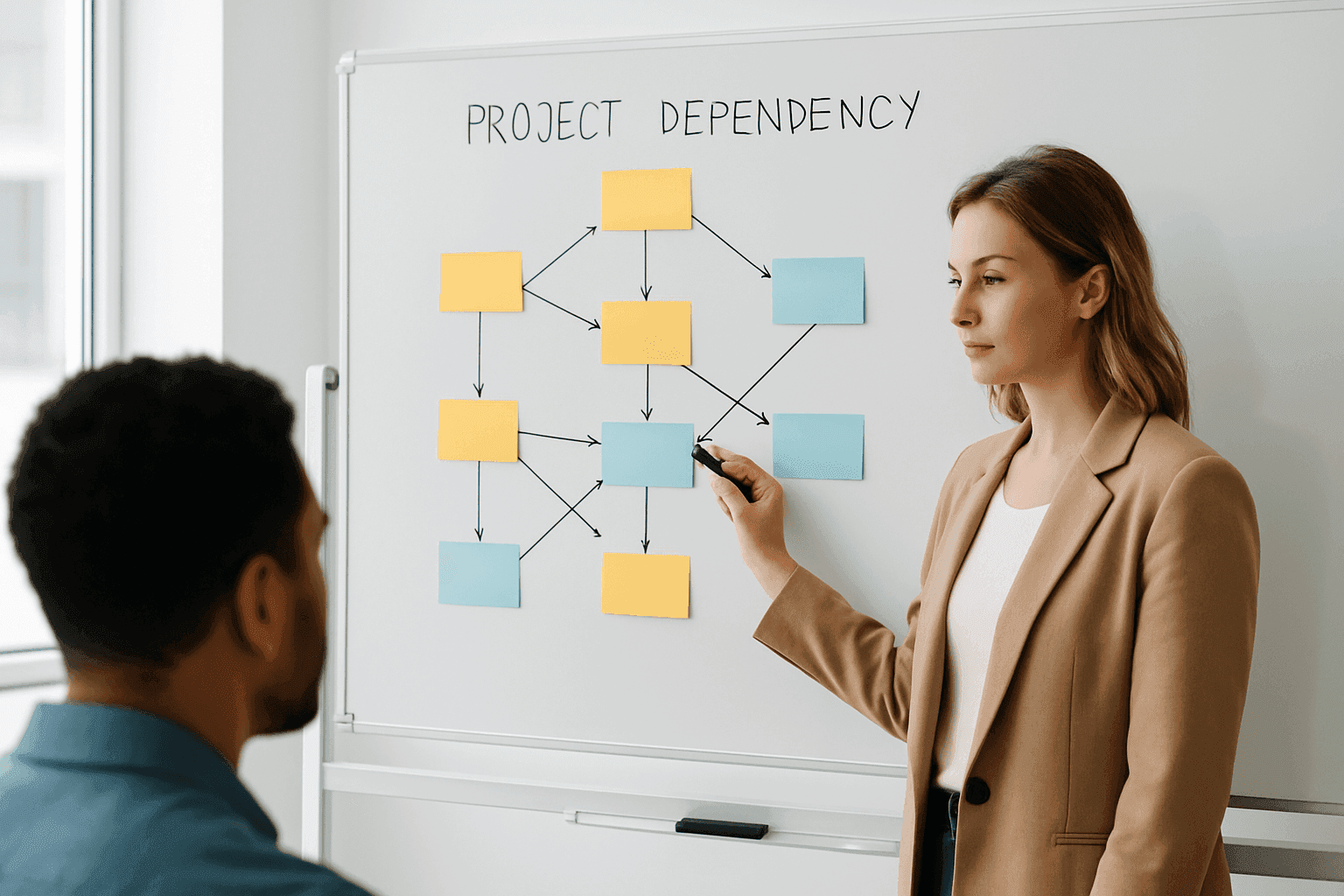
Complex projects in the UK rarely succeed when tasks happen in isolation. Whether you're rolling out a new service in Manchester, upgrading systems in Edinburgh, or launching a portal for clients in Birmingham, work needs careful coordination. A project dependency map clarifies connections so teams can spot delays, allocate resources sensibly, and stay on schedule.
Why dependency mapping matters for UK workplace leaders
A project dependency map shows how tasks, deliverables, systems and people connect across a project or programme. Instead of listing activities one after another, the map makes clear which work must finish before another starts, where parallel streams meet, and which links carry the biggest risk.
For simple tasks a Gantt chart with arrows might be enough, but when projects scale across multiple teams in London, Leeds and the Scottish Highlands, or involve external suppliers, those charts get hard to read. A dependency map focuses only on relationships so everyone from technical leads to business stakeholders can see the picture.
Common mistakes to avoid
Organisations often trip up not because mapping is hard but because they treat it as a paperwork exercise. One common error is creating maps in isolation. If a single project manager in Bristol documents dependencies without input from the teams doing the work, important links stay hidden.
Another mistake is treating preferences as dependencies. Teams might say one task "should" come first when, with a bit of co-ordination, work could run in parallel. Mapping should separate genuine technical or regulatory constraints from negotiable preferences.
Many maps go out of date. Projects change and a static map made in planning can be obsolete within weeks unless updated regularly. Equally damaging is creating a map with every tiny link. Keep the map focused on relationships that really affect delivery or resources; minor co-ordination can stay in team-level communication.
The dependency classification framework
Use a simple two‑axis framework: impact and control. Impact can be critical (stops many workstreams), significant (delays delivery but has workarounds) or minor (inconvenient but non‑critical). Control can be internal, collaborative or external.
Critical internal dependencies need immediate attention and risk plans because you can control them. Critical external dependencies are high risk and harder to manage, for example when a key vendor in the supply chain delays an integration. Significant collaborative dependencies benefit from regular syncs and shared dashboards to keep everyone aligned.
How to build your first dependency map
Start by bringing together representatives from each workstream: technical leads, business owners and anyone responsible for key deliverables. In-person sessions work well if teams are based nearby, say across Greater Manchester, while a digital whiteboard helps teams spread between Cardiff and Glasgow.
List major outcomes, not tasks. Use nodes such as "payment API signed off" or "user requirements validated" rather than activity names. Draw arrows from prerequisites to dependents and note whether a link is a technical constraint, a resource share, an information flow or an approval gate.
As patterns appear, you’ll spot nodes with many incoming arrows (coordination risks) and many outgoing arrows (bottlenecks). Label owners for each side of a dependency so someone is accountable for delivering prerequisites and someone else for consuming them. For practical examples and tools, you can discover more content on the Naboo blog to help structure workshops and templates.
Example: a digital transformation in a UK bank
Imagine a regional bank launching a new customer portal that must integrate with legacy systems, add modern authentication and meet UK regulations. Development teams, infrastructure, security and compliance officers plus an external identity vendor all need to work together.
Mapping quickly shows that API specs depend on an infrastructure capacity assessment, while authentication design depends on security sign‑off. If security is a bottleneck, assign extra architects or carve out focused sprints. If the identity vendor is late, build mock interfaces so development can continue. Regularly update the map during steering meetings so leadership in London or regional offices can see which downstream tasks are affected.
Measuring the benefit
Track a few simple indicators: how often delays are caused by missed dependencies, how stable the critical path is, how well teams coordinate across functions, and how often resource clashes happen. Also measure stakeholders' confidence in delivery dates with short surveys — rising scores suggest mapping is working.
Embedding maps into governance
Make the dependency map a living document. Use it during weekly team standups so people know when their upstream work is ready. At monthly steering meetings highlight any dependencies that have moved from green to amber or red and explain the impact. When approving scope changes, check the map first to see the ripple effects.
For creative team building or cross‑team planning days, consider inspiring event ideas that help improve communication and surface hidden dependencies early.
Scaling across programmes and portfolios
Connect maps across related projects so you can see where initiatives compete for the same platform or vendor. At portfolio level, focus on major milestones rather than every task. Standardise language and severity levels across projects so leadership can spot systemic risks like several projects depending on the same data platform being built by another programme.
Agile and hybrid teams
Dependencies exist in agile setups too. Agile teams should keep lightweight maps that show team, system or feature dependencies and update them during programme increment planning or sprint planning. Hybrid environments where some teams use sprints and others use phases benefit most from a clear map that bridges those differences.
20 Ways to Map Project Dependencies: Quick Comparison Guide
| Mapping Method | Cost (Low/Medium/High) | Setup Time | Difficulty Level | Team Size | Best For |
|---|---|---|---|---|---|
| Manual Spreadsheet | Low | 2–4 hours | Easy | 1–3 people | Small projects, quick audits |
| Gantt Chart Software | Medium | 1–2 days | Moderate | 3–8 people | Timeline-focused delivery |
| Network Diagram (PERT/CPM) | Medium | 2–3 days | Moderate | 2–5 people | Complex task sequences, critical path analysis |
| Dependency Matrix | Low | 1–2 days | Easy | 2–4 people | Cross-team visibility, governance reporting |
| Enterprise Portfolio Tool | High | 2–4 weeks | Hard | 5–15 people | Multi-programme scaling, compliance tracking |
| Visual Flow Diagram | Medium | 1–2 days | Moderate | 3–6 people | Stakeholder communication, digital transformation |
| Risk-Based Dependency Map | Medium | 3–5 days | Moderate–Hard | 4–8 people | High-risk programmes, financial services |
Looking ahead
Organisations are starting to use predictive analytics on past dependency data to spot which links usually cause delays, and automated tools that scan code or architecture to surface hidden technical dependencies. Continuous monitoring can alert teams in real time when upstream work slips, letting them respond faster.
As dependency mapping matures, some organisations set up a centre of excellence to keep standards, train staff and collect common dependency patterns that help projects across the UK run more smoothly.
Frequently asked questions
What’s the difference between a dependency and a constraint?
A dependency is a link between tasks where one piece of work relies on another. A constraint is a limit on how work can be done, such as budget, people or regulation. Dependencies are about sequencing; constraints are about boundaries.
How often should teams update their dependency maps?
For most enterprise programmes review monthly in governance meetings, and update immediately when significant scope or timeline changes happen. Agile teams should check them every sprint or during programme planning every two to three weeks.
Who owns the map?
The project manager usually owns the artefact but maintaining it is a shared job. Each team lead should flag changes. In larger programmes a programme office can co‑ordinate tracking. Make sure each dependency has owners on both sides.
Can small teams use dependency maps?
Yes. Keep it light: focus on critical links only. A one‑hour session to draw a simple sketch can prevent problems later with little effort and no heavy tools.
How do you handle external parties you can’t control?
Make expectations clear in contracts, build buffers into schedules, create mock interfaces or alternate suppliers and keep regular contact. Escalate through senior contacts if critical external dependencies start to slip.
- Keep maps simple and focused on what could actually delay delivery.
- Review them regularly and after any major change.
- Assign clear owners for both sides of every dependency.
Good dependency maps save time, reduce firefighting and make delivery dates more reliable across teams from London to Leeds and beyond.